
Operating
Adjusting Operator Seat
Move From Transport to Operating Position
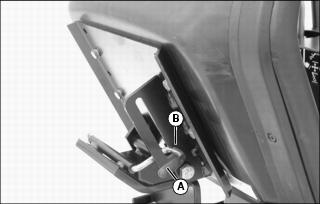
1. Tilt seat forward so handle (A) clears cutout area (B).
2. Tilt handle toward tractor and slide handle along groove as you tilt the seat back and down.
Front-to-Back Adjustment
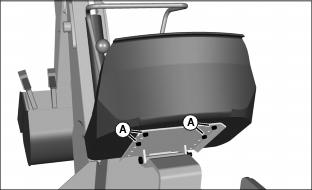
1. Remove four cap screws (A) and lockwashers holding seat to plate.
2. Install seat in one of four positions. Be sure operator can reach controls.
3. Install lockwashers and cap screws.
Height Adjustment
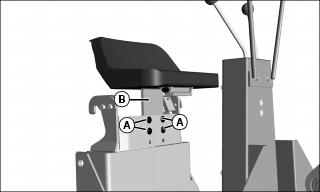
2. Raise or lower seat bracket (B).
3. Install bolts, lockwashers and nuts.
Using Controls
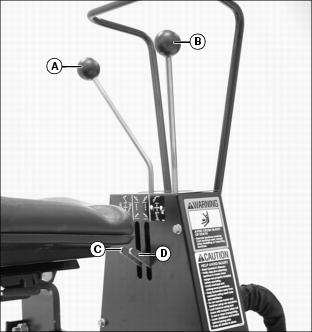
Boom And Swing Control Lever (A):
• To raise boom: pull lever to rear.
• To lower boom: push lever forward.
• To swing boom to left: push lever to left.
• To swing boom to right: push lever to right.
Dipperstick And Bucket Control Lever (B):
• To retract dipperstick: pull control lever to rear.
• To extend dipperstick: push control lever forward.
• To curl bucket in: push lever to left.
• To roll bucket out: push lever to right.
Stabilizers Control Levers; Left (C), and Right (D):
• To raise stabilizer: pull control lever up.
• To lower stabilizer: push control lever down.
Digging Safely
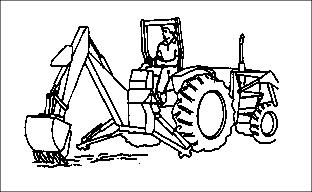
 c CAUTION: Avoid injury! To dig safely:
|
Operating Tractor
Operate tractor engine at the proper speed to reduce hydraulic system heat buildup in hot conditions.
• Operate engine at the following maximum speeds when using backhoe in hot conditions:
Gear Drive Tractor...........................................2400 rpm
Hydrostatic Drive Tractor.................................2700 rpm
Faster engine speeds result in faster backhoe movement. When operating where precise movements of the backhoe are required, slow the engine to slow backhoe movement.
Digging forces and breakout forces are functions of hydraulic pressure only, and are the same at any digging rpm.
Removing Boom And Swing Lock Pins
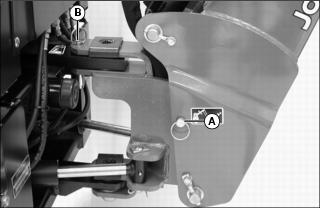
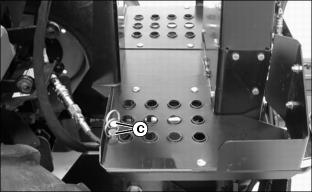
3. Store pins in storage holes (C) on floor of operator’s station while operating backhoe.
Digging Position
|
c CAUTION: Avoid injury! Avoid serious injury or death: Check for buried electric cables or gas pipes before you dig.
|
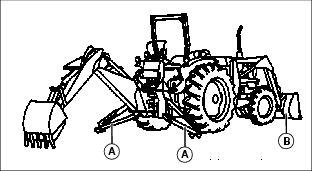
1. Lower backhoe stabilizers (A), and loader bucket (B) to ground.
2. Set throttle to 1400–2400 rpm on gear tractor, 1400-2700 rpm hydrostatic tractor.
Digging Angle
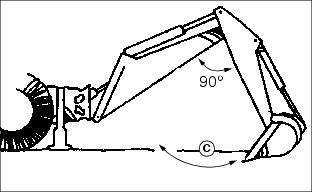
1. Put dipperstick at correct angle to boom for digging, approximately 90 degrees.
2. Put bucket teeth in-line with crowd angle (C).
Bucket Digging
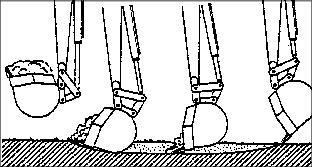
2. Retract dipperstick and curl bucket until full.
3. Raise bucket, swing, and dump onto spoil pile.
Dipperstick Digging
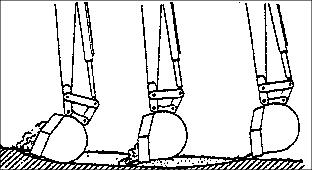
1. Lower bucket until teeth lie flat on ground.
2. Retract dipperstick until bucket is half full.
3. Retract dipperstick as you roll bucket back.
4. When bucket is full, raise, swing, and dump onto spoil pile.
Spoil Pile Location
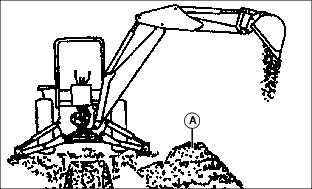
Put spoil pile (A) where minimum effort is needed to back fill.
Spoil pile should be a minimum of 0,6m (2 ft) from hole.
Lifting With Backhoe
IMPORTANT: Avoid damage! Do not use backhoe as towing vehicle. Damage to backhoe and tractor could occur. |
|
c CAUTION: Avoid injury! Improper lifting may cause crushing, injury or death. To lift safely:
• Fasten chains to object and backhoe. |
1. Extend boom and dipperstick until you can fasten chain to object.
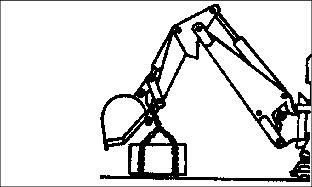
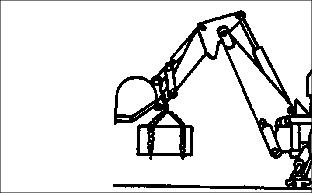
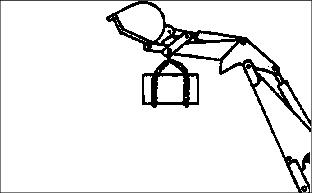
2. Fasten chain to dipperstick approximately 50 mm (2 in.) above bucket pin.
4. Raise boom to full height. Extend dipperstick cylinder if needed.
5. Retract dipperstick cylinder to lift load.
Transporting Backhoe
|
c CAUTION: Avoid injury! To help prevent injury while transporting backhoe:
• Look for people or obstacles BEFORE you change directions. • LOCK backhoe in TRANSPORT position. See steps below. |
1. Fully raise and center the boom.
2. Fully retract the dipperstick.
3. Curl the bucket back into dipperstick.
4. Fully raise the left stabilizer leg.
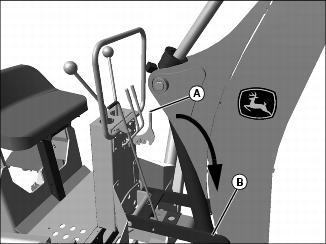
6. Set boom and swing locking device:
a. Pull latch handle (A) towards the operator to release the locking device.
b. Be sure the pin is fully inserted on swing frame (B) and the locking arms are resting on the spools located on both sides of the boom.
|
c CAUTION: Avoid injury! Stay clear of path when raising or lowering stabilizer leg.
|
8. Stand in area between right stabilizer leg and boom, facing the tractor.
9. Push right stabilizer control lever back to fully raise right stabilizer leg.
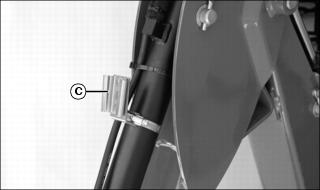
10. Install Slow Moving Vehicle (SMV) sign in bracket (C) on bucket cylinder.
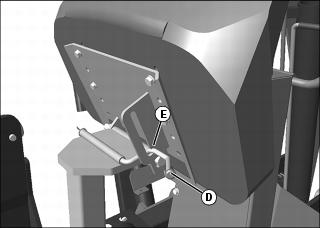
11. Pivot seat forward until handle (D) locks into cutout area (E).
Transporting Tractor With Backhoe
|
c CAUTION: Avoid injury! Do not chain backhoe down in order to secure tractor to trailer.
|
NOTE: Backhoe bucket should be lowered to trailer bed if possible.
1. Put wheel chocks against tractor wheels. Chain tractor securely to trailer bed.
2. Do not attach hold-down chains to any part of the backhoe assembly. Lower the backhoe bucket to the trailer bed, if possible.