
Service Engine - Model GX335
Engine Warranty Maintenance Statement
Maintenance, repair, or replacement of the emission control devices and systems on this engine, which are being done at the customers expense, may be performed by any non-road engine repair establishment or individual. Warranty repairs must be performed by an authorized John Deere dealer.
Avoid Fumes
Engine Oil
Use oil viscosity based on the expected air temperature range during the period between oil changes.
The following John Deere oils are preferred:
Other oils may be used if above John Deere oils are not available, provided they meet the following specification:
· API Service Classification SG or higher
Checking Engine Oil Level
NOTE: Check oil twice a day if you run engine over 4 hours in a day.
Make sure engine is cold when checking engine oil level.
1. Park machine safely. (See Parking Safely in the SAFETY section.)
3. Clean area around dipstick to prevent debris from falling into crankcase.
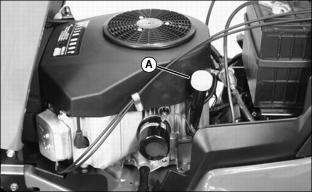
4. Remove dipstick (A). Wipe with clean cloth.
5. Install dipstick into tube, but do not tighten it. Let dipstick threads rest on top of tube.
7. Check oil level on dipstick. Oil must be between ADD and FULL marks.
8. If oil level is low, add oil to bring oil level no higher than FULL mark on dipstick.
9. Install and tighten dipstick. Lower hood.
Changing Engine Oil and Filter
2. Park machine safely on level surface. (See Parking Safely in the SAFETY section.)
4. Put drain pan under drain valve. If available, install drain hose.
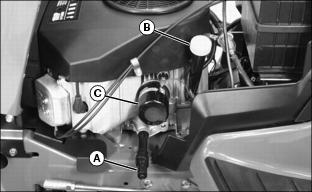
5. Open drain valve (A) and drain oil into oil drain pan. Allow oil to drain completely.
NOTE: Change oil filter at recommended service interval.
a. Wipe dirt from around oil filter (C).
b. Place a drain pan or funnel under filter tray.
c. Remove old filter and wipe off filter tray.
d. Apply a light coat of fresh oil to filter seal.
e. Install replacement oil filter by turning oil filter to the right (clockwise) until rubber seal contacts filter base. Tighten filter an additional one-half turn.
· With oil filter change: 1.7 L (1.8 qt)
· Without oil filter change: 1.6 L (1.7 qt)
10. Install and tighten dipstick.
11. Start and run engine at idle to check for leaks. Stop engine. Fix any leaks before operating.
12. Check oil level, add oil if necessary.
Cleaning Air Intake Screen and Engine Fins
 c CAUTION: Avoid injury! Compressed air can cause debris to fly a long distance.
· Clear work area of bystanders. · Wear eye protection when using compressed air for cleaning purposes. |
1. Park machine safely. (See Parking Safely in the SAFETY section.)
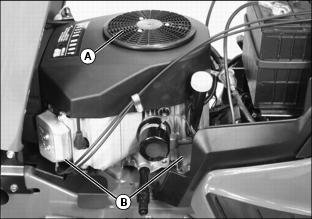
2. Clean air intake screen (A), cooling fins, and external surfaces (B), with rag, brush, vacuum or compressed air.
Servicing Air Cleaner Elements
1. Park machine safely. (See Parking Safely in the SAFETY section.)
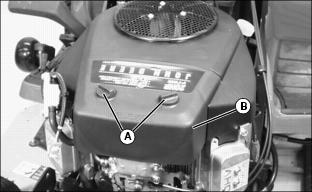
4. Remove plastic retainers (A) and air cleaner cover (B).
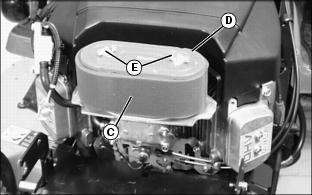
· If precleaner (C) is dirty, remove it from paper element (D). If paper element is very dirty or damaged, remove wing nuts (E) and element (D). Replace with new element.
6. If precleaner is damaged, replace it. If precleaner is dirty, clean it as follows:
a. Wash it in a solution of warm water and liquid detergent. Do not wash paper element.
c. Squeeze excess water from precleaner.
d. Allow precleaner to air dry.
7. Install precleaner on paper element.
8. Install air cleaner cover and secure with original hardware.
Checking Spark Plugs
1. Park machine safely. (See Parking Safely in the SAFETY section.)
4. Disconnect spark plug wire on each side of engine.
6. Clean each spark plug carefully with a wire brush.
· Pitted or damaged electrodes.
NOTE: In Canada, replace spark plug with resistor plug only.
8. Replace spark plugs as necessary.
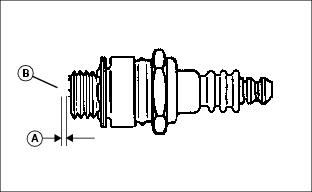
9. Check plug gap (A) with a wire feeler gauge. To change gap, bend outer electrode (B).
· Gap must be 0.75 mm (0.030 in.).
10. Install and tighten spark plug. Tighten spark plug to 15 N·m (11 lb-ft).
Adjusting Carburetor
NOTE: Carburetor is calibrated by the engine manufacturer and is not adjustable.
If engine is operated at altitudes above 1829 m (6,000 ft), some carburetors may require a special high altitude main jet. See your authorized dealer.
If engine is hard to start or runs rough, check the TROUBLESHOOTING section of this manual.
Possible engine surging will occur at high throttle with transmission in "N" neutral and mower engagement lever disengaged. This is a normal condition due to the emission control system.
After performing the checks in the troubleshooting section and your engine is still not performing correctly, contact your authorized dealer.
Replacing Fuel Filter
NOTE: Change filter when fuel is low to prevent excessive fuel spillage.
1. Park machine safely. (See Parking Safely in the SAFETY section.)
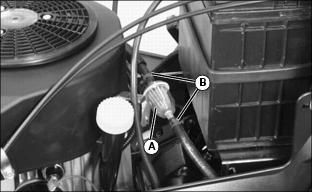
4. Place a drain pan under fuel filter (A).
5. Note direction of arrow on fuel filter so new filter can be installed in the same direction.
6. Use a pliers to slide hose clamps (B) away from fuel filter.
7. Disconnect hoses from filter.
IMPORTANT: Avoid damage! Incorrect installation of fuel filter may cause engine damage. Install the filter with the arrow pointing in the direction of fuel flow for proper operation. |
8. Make sure arrow on new filter is pointing in the direction of fuel flow. Connect hoses to filter.