
Service Miscellaneous
Filling Fuel Tank
Use regular grade 87 octane unleaded fuel. (For gasoline engines only.)
Add John Deere fuel stabilizer to fuel before using it in your machine to prevent engine damage due to stale fuel. Follow directions on stabilizer container.

NOTE: Capacity of fuel tank is 29.5 L (7.8 gal).
1. Stop engine, let it cool several minutes before adding fuel.
2. Remove any grass or debris from top of fuel tank.
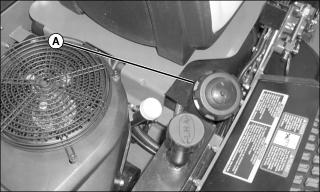
4. Fill tank with fuel only to 25 mm (1 in.) below bottom of filler neck.
Tightening Drive Wheel Hardware
1. Tighten rear wheel nuts to 100 N·m (75 lb-ft).
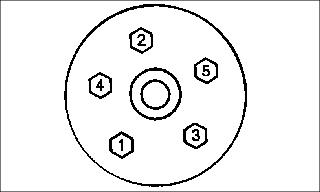
2. Tighten wheel nuts in numbered sequence shown. Tighten alternately until recommended torque value is reached.
Checking Tire Pressure
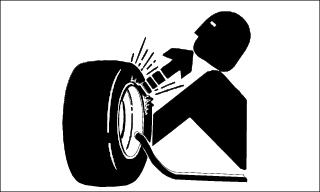
2. Check tire pressure with an accurate gauge.
Servicing Caster Pivot Bearings
1. Park machine safely. (See Parking Safely in the Safety section.)
2. Raise and securely support the front of the mower deck.
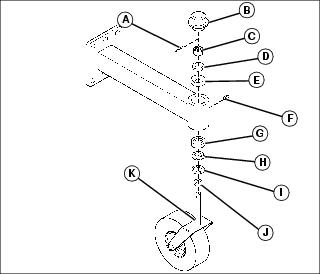
3. Remove cap (B), cotter pin (A), castle nut (C), caster yoke and wheel assembly (K) and caster bushing (J).
NOTE: It is not necessary to remove the bearing races (E) and (G), unless the bearings need to be replaced.
4. Remove seal (I) and lower bearing (H).
6. Clean and inspect bearings (D) and (H); pack with clean grease. Replace bearings if needed.
NOTE: Install seal with lip to the outside.
7. Install lower bearing (H) and a new seal (I).
NOTE: Do not overtighten castle nut (C). Tighten castle nut only enough to install the cotter pin (A). The caster wheel yoke assembly must be free to rotate.
9. Install caster bushing (J) on yoke shaft, and install caster yoke and wheel assembly (K), castle nut (C), cotter pin (A) and cap (B).
10. Apply grease to lubrication fitting (F).
Cleaning and Repairing Plastic Surfaces
Your John Deere dealer has the professional materials needed to properly remove surface scratches from any plastic surfaces, do not attempt to paint over marks or scratches in plastic parts.
1. Wash surface with clean water and a mild liquid automotive washing soap.
2. Dry thoroughly to avoid water spots.
Cleaning and Repairing Metal Surfaces
Cleaning:
Follow automotive practices to care for your vehicle painted metal surfaces. Use a high-quality automotive wax regularly to maintain the factory look of your vehicle's painted surfaces.
Repairing Minor Scratches (surface scratch):
1. Clean area to be repaired thoroughly.
2. Use automotive polishing compound to remove surface scratches.
3. Apply wax to entire surface.
Repairing Deep Scratches (bare metal or primer showing):
1. Clean area to be repaired with rubbing alcohol or mineral spirits.
2. Use paint stick with factory-matched colors available from your John Deere dealer to fill scratches. Follow directions included on paint stick for use and for drying.
3. Smooth out surface using an automotive polishing compound. Do not use power buffer.