
Service Engine
Engine Warranty Maintenance Statement
Maintenance, repair, or replacement of the emission control devices and systems on this engine, which are being done at the customer’s expense, may be performed by any non-road engine repair establishment or individual. Warranty repairs must be performed by an authorized John Deere dealer.
Avoid Fumes
Engine Oil - Diesel
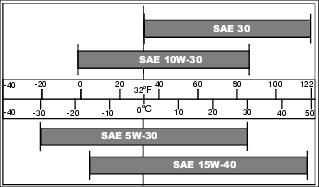
Use oil viscosity based on the expected air temperature range during the period between oil changes.
The following John Deere oils are preferred:
Other oils may be used if above John Deere oils are not available, provided they meet the following specification:
• API Service Classification CH or higher
• ACEA Specification E3 or higher
Checking Engine Oil Level
NOTE: Check oil twice a day if you run engine over 4 hours in a day.
Make sure engine is cold when checking engine oil level.
1. Park machine safely. (See Parking Safely in the SAFETY Section).
4. Clean area around dipstick prior to removing it.
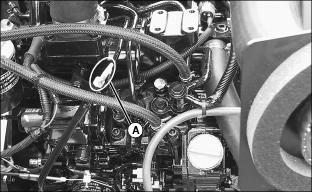
5. Remove dipstick (A). Wipe it clean.
7. Remove dipstick and check oil level. Oil level should be between low and high marks on dipstick.
• If oil is low, add oil to bring oil level no higher than the “H” high mark on dipstick.
• If oil level is above the “H” high mark, drain to proper level.
IMPORTANT: Avoid damage! To prevent extensive engine wear or damage, always maintain the proper engine oil level. Never operate the engine with the oil level below the add mark or over the full mark. |
Changing Engine Oil and Filter
IMPORTANT: Avoid damage! Change the oil more often if the vehicle is used in extreme conditions: |
2. Park machine safely. (See Parking Safely in the Safety section).
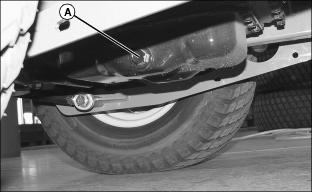
3. Put container under drain bolt (A).
5. Allow oil to drain into a container with at least 3.6 L (3.8 qt) capacity.
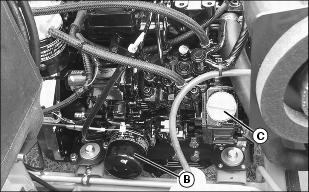
8. Remove oil filter (B). Turn filter counter-clockwise to remove.
9. Apply a film of clean engine oil on gasket of new filter.
10. Install filter. Turn filter clockwise until gasket makes contact with mounting surface. Tighten 1/2 to 3/4 turn after gasket contact.
11. Clean area around the oil fill cap (C) and oil dipstick.
12. Unscrew and remove the oil fill cap.
13. Add approximately 3.6L (3.8 qt) of oil.
15. Install and tighten oil fill cap.
16. Start engine and run at slow throttle for approximately two minutes. Check for leaks around filter and drain plug.
Cleaning Pump Drive Blower Fan
 c CAUTION: Avoid injury! Compressed air can cause debris to fly a long distance.
• Clear work area of bystanders. • Wear eye protection when using compressed air for cleaning purposes. |
1. Park machine safely. (See Parking Safely in the Safety section.)
2. Lift and secure operator seat in the raised position.
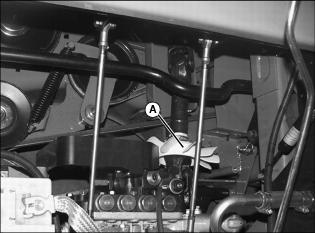
3. Clean fan (A) with a rag, brush or compressed air.
Cleaning Engine Cooling Fins
|
c CAUTION: Avoid injury! Compressed air can cause debris to fly a long distance.
• Wear eye protection when cleaning with compressed air. |
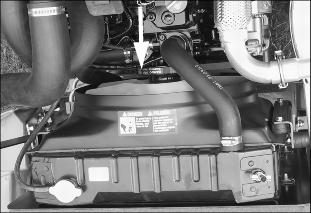
1. Park machine safely. (See Parking Safely in the Safety section.)
3. Blow compressed air to clean the radiator from the inside (See arrow).
4. Clean rear of radiator with brush.
5. Clean fins with a brush or compressed air.
6. Clean intake screens from inside and outside.
Servicing Air Cleaner Elements
Primary Air Cleaner Element
1. Park machine safely. (See Parking Safely in the Safety section.)
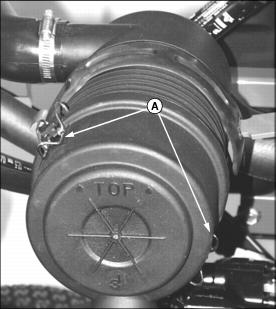
4. Release spring latches (A), and unhook latches from air cleaner housing.
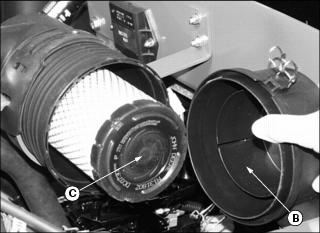
5. Remove air cleaner cover (B).
6. Remove and discard primary element (C).
7. Install new primary element.
8. Install air cleaner cover, making sure the word “TOP” is facing upwards.
9. Reset air restriction indicator.
10. Start engine and run at high idle for one minute.
11. Stop engine. Check air restriction indicator:
• If indicator window remains yellow, air cleaner is ready for operation.
• If indicator window has turned red, change secondary air filter element.
Secondary Air Filter Element
2. Remove primary air cleaner element.
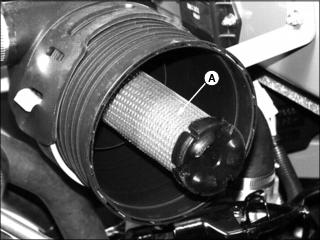
3. Remove and discard secondary element (A).
4. Install a new secondary element.
5. Install air cleaner cover, making sure the word “TOP” is facing upwards.
Cleaning Dust Unloading Valve
IMPORTANT: Avoid damage! Do not operate engine without air cleaner element and rubber dust unloading valve installed. |
1. Park the vehicle safely. (See Parking Safely in the SAFETY section.)
3. Access the engine compartment.
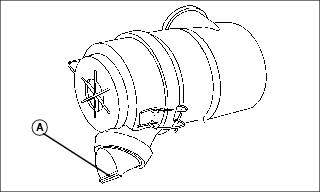
4. Squeeze dust unloading valve (A) to clean. Remove and replace if damaged.
Checking Air Filter Restriction Indicator
1. Park machine safely. (See Parking Safely in the Safety section.)
NOTE: Indicator will not function correctly if plastic indicator housing is damaged.
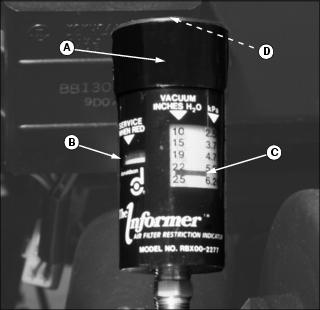
3. Check air restriction indicator (A).
• When the indicator window (B) is yellow, no air cleaner service is required.
• When the indicator window is red, air cleaner element needs replacement.
• Vacuum scale (C) on indicator shows how restricted the air cleaner elements are becoming.
4. Depress the rubber button (D) on top of the housing to reset indicator.
Service Cooling System Safely
Recommended Engine Coolant
The engine cooling system is filled to provide year-round protection against corrosion and cylinder liner pitting, and winter freeze protection to -37 degrees C (-34 degrees F). If protection at lower temperatures is required, consult your John Deere dealer for recommendations.
The following coolants are preferred:
• John Deere COOL-GARD™ II Premix
• John Deere COOL-GARD™ Premix
• John Deere COOL-GARD™ PG Premix
John Deere COOL-GARD™ II Premix and John Deere COOL-GARD™ Premix are available in a concentration of 50% propylene glycol.
John Deere COOL-GARD™ PG Premix is available in a concentration of 55% propylene glycol.
Additional recommended coolants:
• John Deere COOL-GARD™ II Concentrate in a 40% to 60% mixture of concentrate with water.
• John Deere COOL-GARD™ Concentrate in a 40% to 60% mixture of concentrate with water.
If the recommended coolants are unavailable, use an ethylene glycol or propylene glycol base coolant that meets the following specification:
• ASTM D3306 prediluted (50%) coolant.
• ASTM D3306 coolant concentrate in a 40% to 60% mixture of concentrate with water.
Check container label before using to be sure it has the appropriate specifications for your machine. Use coolant with conditioner or add conditioner to coolant before using.
Water Quality
• Water quality is important to the performance of the cooling system. Distilled, deionized, or demineralized water is recommended with ethylene glycol base engine coolant concentrate.
Checking Coolant Level
|
• Do not operate engine without coolant. • Do not pour coolant into the radiator when the engine is hot. |
1. Park machine safely. (See Parking Safely in the Safety section.)
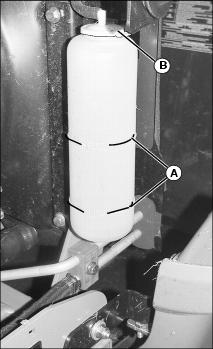
• If engine is cold, coolant should be between minimum and maximum level (A).
4. If coolant is low remove cap (B) and add coolant.
6. Clean debris from air intake screen and radiator.
7. Check condition of hoses. Check for leaks or loose connections.
Draining Cooling System
1. Stop engine and lock parking brake.
2. Open hood. Let engine cool.
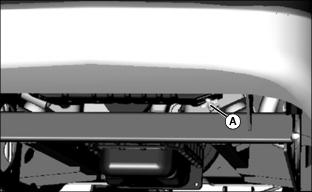
4. Place a drain pan with at least 7.1 L (7.5 qt.) capacity under the radiator drain plug (A).
6. Close drain plug after all coolant is drained.
7. Remove cap from expansion tank.
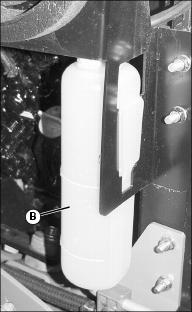
8. Move expansion tank (B) upward. Remove expansion tank and empty.
9. Install coolant tank and fill cooling system.
Flushing Cooling System
|
• Do not operate engine without coolant. • Do not pour coolant into the radiator when the engine is hot. |
1. Drain cooling system completely.
2. Fill cooling system with clean water and cooling system cleaner. Follow directions on can.
3. Fill coolant tank 1/3 full.
4. Install and tighten radiator cap and coolant tank cap.
5. Start and run engine until operating temperature is reached.
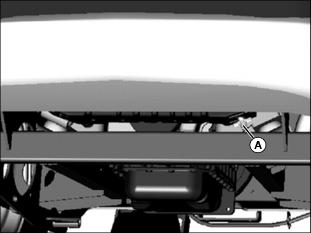
6. Open radiator drain cock (A). Drain the cooling system immediately before rust and dirt settles.
Filling Cooling System
1. Fill cooling system. For cold weather, use a solution of only ethylene glycol antifreeze (without a stop-leak additive) and clean, deionized or distilled water.
3. Run engine until operating temperature is reached.
4. Stop engine. After engine cools, check coolant level in coolant tank. Add if necessary.
5. Check condition of coolant system hoses. Install new hoses periodically. Tighten hose clamps regularly.
Bleeding Cooling System
No bleeding required. Cap releases redundant air.
Servicing Belt
Checking Belt
|
c CAUTION: Avoid injury! Rotating parts can catch fingers, loose clothing, or long hair. Wait for engine and all moving parts to stop before leaving operator’s station to adjust or service machine.
|
IMPORTANT: Avoid damage! DO NOT allow oil to come in contact with belt. Belt will slip if contaminated with oil. If a squealing sound is heard, the tension of the belt is not correct. |
1. Park machine safely. (See Parking Safely in the Safety section).
• Inspect belt for excessive wear, damage or stretching while mounted on engine.
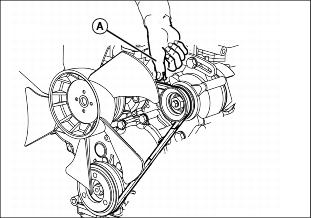
• Check belt deflection using thumb (A). Compare to specification.
• If deflection is not within specification, perform Adjustment Procedure.
Specifications:
Alternator Drive Belt Deflection 10-15 mm (0.40-0.60 in.)
Adjusting Belt
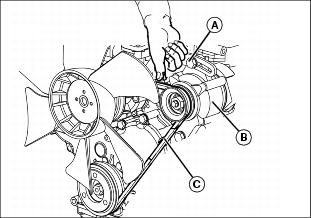
3. Apply force to the alternator housing (B) until tension is correct.
Replacing Belt
3. Adjust alternator (B) until belt tension is correct.
Replacing Fuel Filter
IMPORTANT: Avoid damage! When installing a new fuel filter, the filter arrow must be pointed in the direction of the fuel flow. |
NOTE: Change filter when fuel is low.
1. Park machine safely. (See Parking Safely in the Safety section).
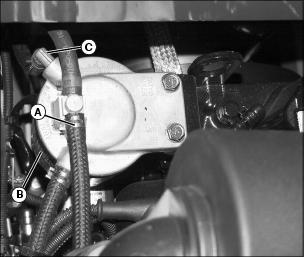
3. Slide hose clamps (A) away from fuel filter (B).
4. Place a drain pan under hose (C) to catch any fuel that may be left in the hoses.
5. Disconnect hoses from fuel filter.
• Make sure fuel filter is installed with arrow pointing in direction of fuel flow.
7. Connect hoses to new fuel filter.
Checking Water Separator Bowl
1. Park machine safely. (See Parking Safely in the Safety section.)
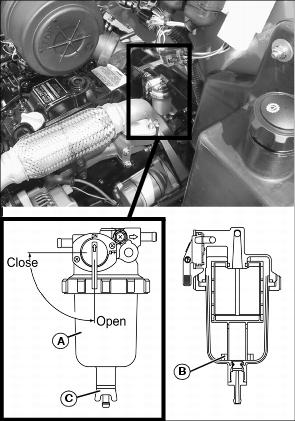
4. Check for water in water separator bowl (A).
• Red ring (B) will float on water.
5. If necessary, drain water with cock (C) or clean bowl and replace filter.
NOTE: Tighten water separator bowl collar to 15-20 N•m (11-15 lb-ft).