Prime and Start the Pump
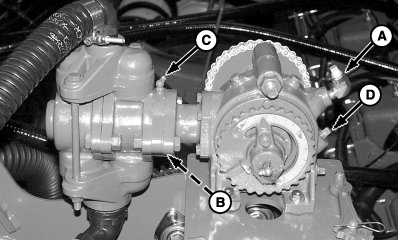
IMPORTANT: Avoid pump damage. Install a vent plug (A) in the pump crankcase. If the pump has been removed from the planter, remove the solid plug from the pump crankcase and replace with a vent plug.
A60524-UN-27JUL07
A - Vent Plug
B - Weep Hole
C - Lubrication Fitting
D - Oil Check and Fill Plug
It is normal for a small amount of oil to leak from the weep hole (B). The weep hole must remain open. Perform an inspection at the beginning of each season. Too much grease at the lubrication fitting (C) increases the chance of plugging the weep hole or leaking grease.Before priming, inspect fertilizer distribution system. Verify that filter screen is clean and that there are no leaks in the pump suction line. Verify that there are no pinched, kinked, or otherwise restricted hoses. Verify that there are no extreme high or low variations in the path of the hose. Inspect all orifices for debris and blockages. Verify that all 14 kPa (0.1 bar) (2 psi) check valves are free of debris and blockage.
-
Open the shutoff valve at the tank and the strainer.
-
Fill the tank with a minimum of 75 L (20 gal) and check the system for leaks.
-
IMPORTANT: Avoid excessive system pressure. Do not exceed the maximum recommended rate for the orifice or the nozzle size.
Refer to the rate chart and set the pump to the maximum rate for the in-line orifice or nozzle that is installed.
-
Lower the planter to the planting position and drive 90 m (100 yd) at the planting speed 9.7 km/h (6 mph).
-
Raise the planter and turn the drive wheel on the fertilizer pump by hand.
-
Check all the rows for liquid exiting the opener tubes in a steady stream. Repeat steps 2—5 until a steady flow of liquid is apparent at all the openers and all the air is flushed from the distribution hoses.
-
Select a target fertilizer rate from the rate chart. Set the pump range and install the in-line orifices or nozzles for the selected fertilizer rate.
-
NOTE: As the travel speed increases, the fertilizer system pressure also increases.
Verify that the system pressure is within 103—621 kPa (1.0—6.2 bar) (15—90 psi) when traveling at the desired planting speed.
-
If the planter is stationary for a long period, air bubbles can develop and become trapped in the distribution hoses. Prime the system as necessary.
|
WP29706,0000AF0-19-20161116 |