Calculate Maximum Commodity Weight for Road Transport—1910
A88013-UN-09OCT15
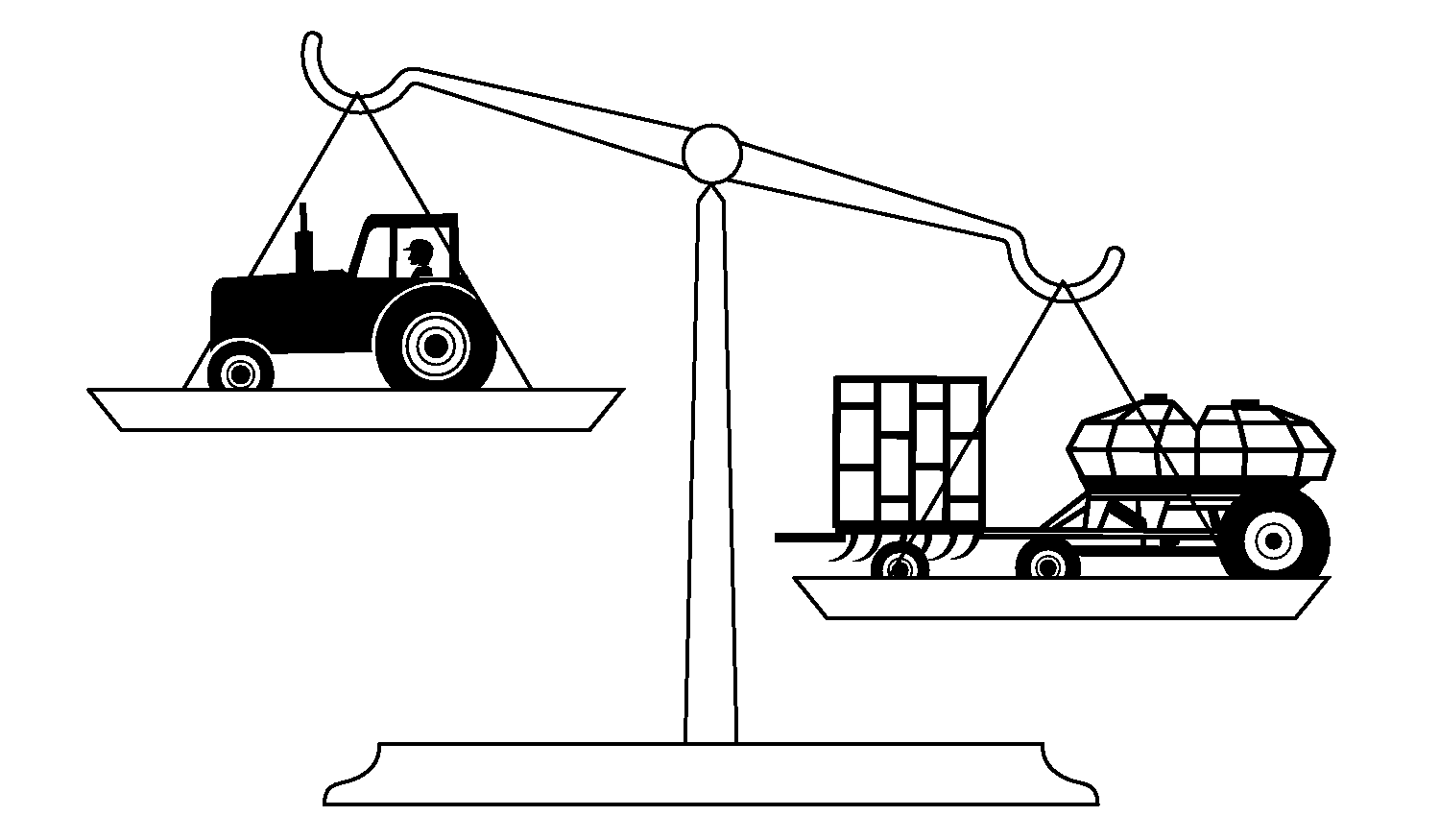
 Towing with an underweight tractor can result in loss
of control during transport or braking, resulting in serious injury
or death.
Towing with an underweight tractor can result in loss
of control during transport or braking, resulting in serious injury
or death.
Transporting at speeds greater than 32 km/h (20 mph) can result in loss of control and serious injury or death.
If an implement is attached to the rear of a tow-behind cart or seeding tool, add the implement weight to the total weight of the cart and seeding tool.
To determine the tractor weight, refer to the tractor Operator's Manual.
Use the following calculations to determine maximum cart fill for safe roadway transport.
|
Road Transport at 32 km/h (20 mph) |
||||
|---|---|---|---|---|
|
Formula |
Calculation |
Result |
Example kg |
Example (lb) |
|
A |
Tractor Weight1 |
22 680 |
50 000 |
|
|
B |
Formula A times 1.5 |
22 680 x 1.5 = 34 020 |
50 000 x 1.5 = 75 000 |
|
|
C |
Braking Capacity of Cart2 |
0 |
0 |
|
|
D |
Formula B plus Formula C |
Maximum Tractor Towing Capacity |
34 020 + 0 = 34 020 |
75 000 + 0 = 75 000 |
|
E |
Weight of the Seeding Tool3 |
14 069 |
31 017 |
|
|
F |
Weight of the Empty Cart2 |
7031 |
15 500 |
|
|
G |
Weight of the Rear Implement (if any)4 |
3629 |
8000 |
|
|
Formula G must not exceed the 9979 kg (22 000 lb) rated capacity of the cart rear hitch. |
||||
|
H |
Formula E plus Formula F plus Formula G |
Total Empty Weight Behind the Tractor |
14 069 + 7031 + 3629 = 24 729 |
31 017 + 15 500 + 8000 = 54 517 |
|
I |
Formula D minus Formula H |
Potential Fill Capacity of the Cart |
34 020 - 24 729 = 9291 |
75 000 - 54 517 = 20 483 |
|
J |
Tire Weight Limit (Transport)2 |
8119 |
17 900 |
|
|
K |
Smaller value of Formula I and J |
Maximum Commodity Fill (Transport) |
8119 |
17 900 |
Use the following table to determine your specific commodity weight restriction. Multiply tractor weight by local road transport regulations not exceeding 1.5.
|
Commodity Weight Calculation |
|||
|---|---|---|---|
|
Formula |
Calculation |
Result |
Example |
|
A |
Tractor Weight |
||
|
B |
Formula A times 1.5 |
||
|
C |
Braking Capacity of Cart |
||
|
D |
Formula B plus Formula C |
Maximum Tractor Towing Capacity |
|
|
E |
Weight of the Seeding Tool |
||
|
F |
Weight of the Empty Cart |
||
|
G |
Weight of the Rear Implement (if any) |
||
|
H |
Formula E plus Formula F plus Formula G |
Total Empty Weight Behind the Tractor |
|
|
I |
Formula D minus Formula H |
Potential Fill Capacity of the Cart |
|
|
J |
Tire Weight Limit (Transport) |
||
|
K |
Smaller value of Formula I and J |
Maximum Commodity Fill (Transport) |
5 |
Use the Maximum Commodity Fill (Transport), tanks size information, and product density in the Implement and Commodity Weight Charts to determine maximum bushels of each commodity for transport.
|
Example Calculation2 |
|||||||||
|---|---|---|---|---|---|---|---|---|---|
|
kg |
(lb) |
Calculations |
|||||||
|
Tank |
Size (bushels) |
Fill (bushels) |
Product |
Weight per Bushel6 |
Weight per Tank |
Weight per Bushel6 |
Weight per Tank |
Weight per Bushel6 |
Weight per Tank |
|
Front |
200 |
0 |
0 |
0 |
|||||
|
Middle |
150 |
150 |
Barley |
21 |
3150 |
48 |
7200 |
||
|
Rear |
200 |
200 |
Urea |
24 |
4800 |
54 |
10 800 |
||
|
Total |
7950 |
18 000 |
|||||||
In this example, the total weight in the tanks is more than the calculated Maximum Commodity Fill (Transport) and is not acceptable for road transport. If the rear tank were 75% full (150 bushels) of urea, the total weight would be slightly less than the Maximum Commodity Fill (Transport).
|
1 Refer
to the tractor Operator’s Manual.
|
BB83525,0000478-19-20170502 |