QUIK-FILL™ Liquid Fertilizer Attachment
|
|
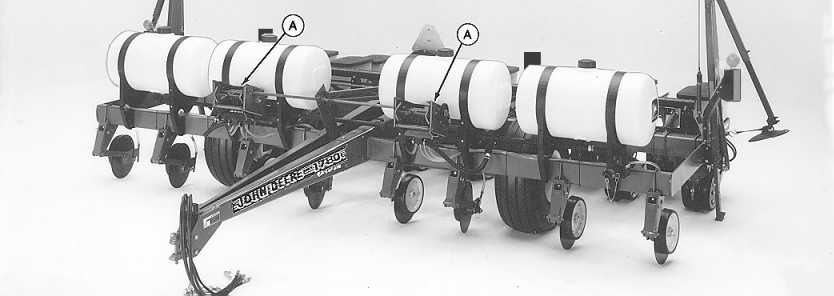
Excessive pressure can cause tank rupture. Monitor tank fill and shut off nurse tank pump when attachment tanks are full. The QUIK-FILL ™ Liquid Fertilizer Attachment allows one-point filling instead of filling individual tanks. The fertilizer tanks each hold approximately 264L (70 U.S. gal) per tank. Fertilizer is distributed to fertilizer openers by metering (squeeze) pump (A) or piston pump. IMPORTANT: It is not recommended that a 75 mm (3 in.) or larger centrifugal nurse |
tank pump be used. These larger pumps will not fill any faster and may exceed the liquid fertilizer attachment pressure limit of 103 kPa (1.0 bar) (15 psi), resulting in damage to the tanks. Excessive pressure will cause leakage through the seals of the tank caps and bottom fittings. Excessive pressure may also cause swelling of tanks, which could result in possible cracking or bursting of tanks. The QUIK-FILL ™ Liquid Fertilizer System will fill at the rate of 227L to 264L (60 gal to 70 gal) per minute. The fill rate can be achieved with a 40 mm (1.5 in.) centrifugal pump and a 2.2 kW to 3.7 kW (3 hp to 5 hp) gasoline engine on the nurse tank. If a 50 mm (2 in.) centrifugal pump is used with a 3.7 kW to 5.5 kW (5 hp to 7.5 hp) gasoline engine, it is recommended that the engine be run at half throttle. To fill the liquid fertilizer tanks, proceed as follows: |
 CAUTION:
Agricultural chemicals can be dangerous. Improper selection or use can injure persons, animals, plants, soil or other property. TO AVOID INJURY, select the right chemical for the job. Handle and apply it with care. Follow instructions of the chemical manufacturer. Check all valves, fittings, hose clamps, plugs, and caps for tightness before admitting liquid fertilizer to the system. Check again at regular intervals and replace hoses when worn, cracked, or leaking.
CAUTION:
Agricultural chemicals can be dangerous. Improper selection or use can injure persons, animals, plants, soil or other property. TO AVOID INJURY, select the right chemical for the job. Handle and apply it with care. Follow instructions of the chemical manufacturer. Check all valves, fittings, hose clamps, plugs, and caps for tightness before admitting liquid fertilizer to the system. Check again at regular intervals and replace hoses when worn, cracked, or leaking.
|
QUIK-FILL is a trademark of Deere & Company | AG,OUO6074,1326 -19-04AUG00-1/6 |
|
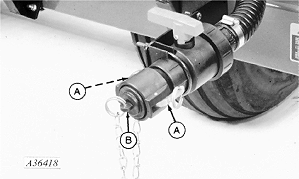
1. Release latch handles (A) on quick-attaching coupler and remove dust cover (B).
|
|
AG,OUO6074,1326 -19-04AUG00-2/6 |
|
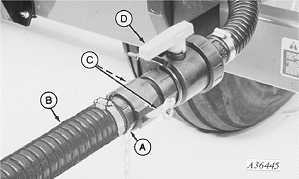
2. Connect nurse tank hose (B) with adapter (A) to quick-attaching coupler and lock in position with latch handles (C). 3. Open shut-off valve (D) before filling tanks.
|
|
AG,OUO6074,1326 -19-04AUG00-3/6 |
|
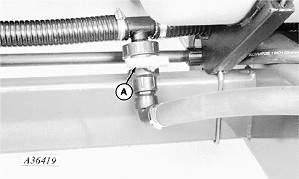
4. Close shut-off valve (A) to fertilizer pump(s). 5. Open valve on nurse tank, start pump and fill tanks. 6. Shut off nurse tank pump.
|
|
AG,OUO6074,1326 -19-04AUG00-4/6 |
|
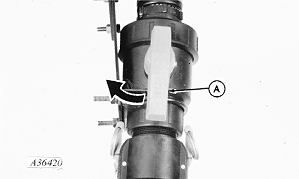
7. Close shut-off valve (A) at fill point. 8. Close valve on nurse tank. 9. Remove nurse tank hose from machine.
|
|
AG,OUO6074,1326 -19-04AUG00-5/6 |
|
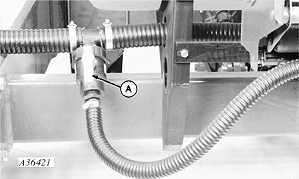
10. Open shut-off valve (A) to fertilizer pump(s).
|
|
AG,OUO6074,1326 -19-04AUG00-6/6 |