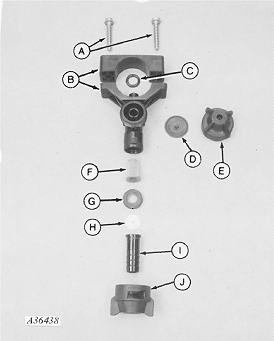
System OperationIMPORTANT: John Deere recommends that all liquid fertilizer systems should be equipped with a gauge to monitor system pressure. IMPORTANT: Remove drive chain from piston pump when fertilizer is not used while planting. This will prevent damage to pump The liquid fertilizer pump is a single piston, variable stroke pump. This pump is a ground driven, positive displacement metering device. Select the high or low rate range and set the stroke of the pump to adjust the output rate. The gallons per acre application will be accurate regardless of varying speeds of the drive mechanism. NOTE: Orifice is not used with unit mounted single-disk openers. The unit-mounted single disk opener is equipped with nozzles which function similar to orifices. For all opener types except unit mounted single-disk opener, the special fittings for delivery to the openers have removable orifices that restrict the flow of the pump to each row in order to maintain a specific pressure range in the manifold. The unit mounted single-disk opener's have a nozzle at the opener delivery tube. The lower end of the range, 138 kPa (1.4 bar) (20 psi), must be maintained to ensure even fertilizer distribution from row to row. The upper end of the range, 483 kPa (5.0 bar) (70 psi), should NOT be exceeded to prevent damage to the system. Maintaining pressure is the ONLY function of the orifices. They have no effect on the application rate.
|
|
AG,OUO6074,1328 -19-04AUG00-1/3 |
|
The special fitting has a diaphragm that acts as a check valve. A pressure of 69 kPa (0.7 bar) (10 psi) minimum must be in the fertilizer manifold before fertilizer is delivered to the opener. |
AG,OUO6074,1328 -19-04AUG00-2/3 |
|
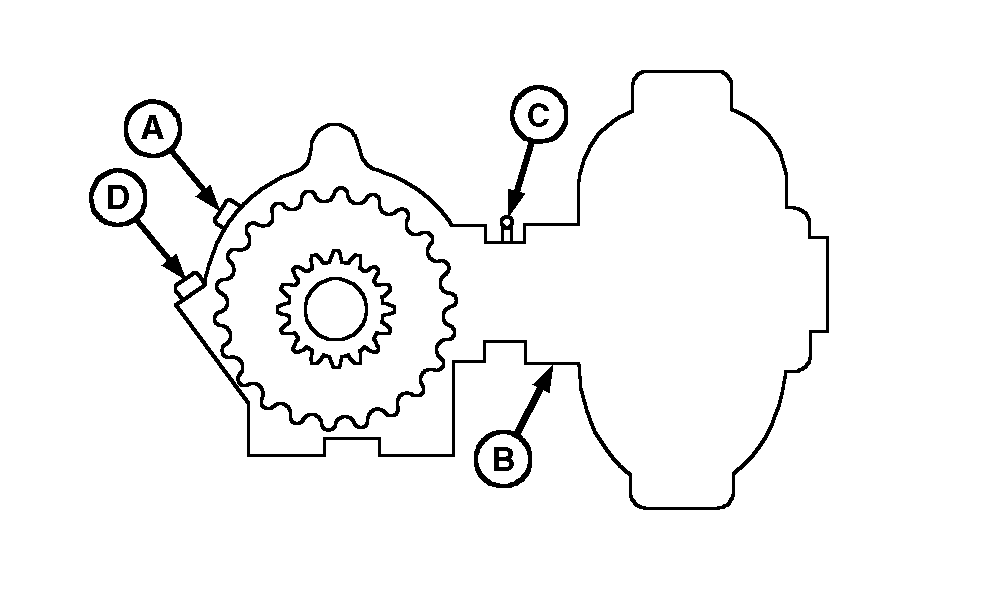
IMPORTANT: Pump crankcase should be equipped with a vent plug (A). If pump is removed from machine, remove vent plug in pump crankcase and replace with solid plug to prevent oil from leaking out. It is normal for a SMALL amount of oil to leak from weep hole (B). The weep hole must remain open. Inspect at the beginning of each season. Over greasing of lubrication fitting (C) can cause plugging of weep hole and/or grease to leak from weep hole. |
|
AG,OUO6074,1328 -19-04AUG00-3/3 |