SELECTING THE CORRECT FIELD CORN SEED DISK FOR OPTIMUM PERFORMANCE
| Corn Seed Disk Selection Guide | |||||
|---|---|---|---|---|---|
| Seed Shape | Seed/kg (Seed/lb) |
Disk Name | Part Number | Number of Cells (Hole Diameter (mm)) |
If population is hard to control |
| Non-Uniform (mixed shapes) | Mixed Sizes (Mixed Sizes) |
Large Sweet Corn With Double Eliminator | A52391 | 40 (4.5) |
If over or under populating with starting disk, adjust double eliminator |
| Uniform Flat | Less than 3308 (1500) |
Large Sweet Corn With Double Eliminator | A52391 | 40 (4.5) |
If over or under populating with starting disk, adjust double eliminator |
| Uniform Flat | 3308-6175 (1500-2800) |
Small Corn Disk | A43215 | 30 (3.6) |
Adjust vacuum first, if unsuccessful, switch to overlapping disk shown in vacuum level charta |
| Uniform Flat | Greater than 6175 (2800) |
Sunflower/ Popcorn |
H136478 | 30 (2.6) |
Adjust vacuum first, if unsuccessful, switch to Small Corn Disk (A43215) |
| Uniform Round | Less than 3308 (1500) |
Standard Corn Disk | A52391 | 30 (3.6) |
Adjust vacuum |
| Uniform Round | 3308-6175 (1500-2800) |
Small Corn Disk | A43215 | 30 (3.6) |
Adjust vacuum first. if unsuccessful, switch to Standard Corn Disk (A50617) |
| Uniform Round | Greater than 6175 (2800) |
Sunflower/ Popcorn |
H136478 | 30 (2.6) |
Adjust vacuum first, if unsuccessful, switch to Small Corn Disk (A43215) |
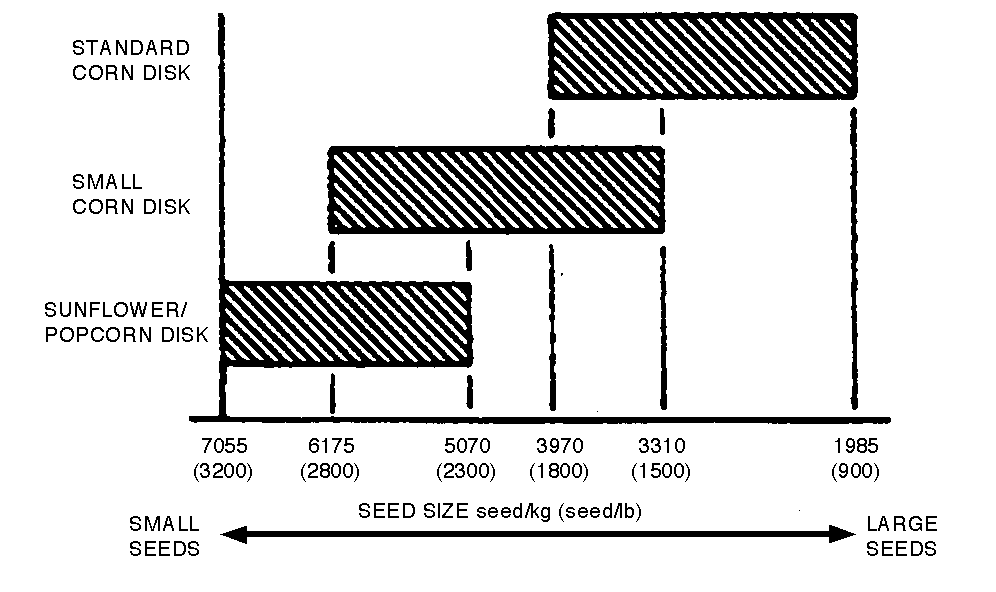
| aFor larger seed sizes that are less than 3970 seeds/kg (1800 seeds/lb), switch to Standard Corn Disk (A50617). If population control problems persists, switch to Large Sweet Corn Disk (A52391) with double eliminator. For smaller seed sizes that are greater than 5072 seeds/kg (2300 seeds/lb), switch to Sunflower/Popcorn Disk (H136478). If population control problem persists, switch to Large Sweet Corn Disk (A52391) with double eliminator. | |||||
|
Use the above Corn Seed Disk Selection Guide to determine the recommended seed disk first, and then refer to vacuum level chart for initial vacuum setting. Most corn seed can be planted near 100 percent of desired population when using small corn or standard corn seed disks (WHICH HAVE SEED CELLS) and properly adjusted vacuum level. Using cell-type disks (Small and Standard Corn Seed Disks) requires careful selection for proper performance. |
Metering performance is directly dependent on the consistency of seed sizing. Seeds that are mixed in shape and size will not perform optimally with cell-type disks. The Large Sweet Corn Disk (A52391) with double eliminator will be required for optimum seed singulation and seed release for seed sizing that is variable. |
OUO6074,0000ECE -19-22JUN06-1/3 |
|
For seed sizes that overlap the Small Corn Disk (A43215) and the Standard Corn Disk (A50617), choose the Small Corn Disk for initial setting. If population is difficult to control, switch to Standard Corn Disk. DIFFICULT TO PLANT SEEDS
PLANTING CORN IN HILLSIDE CONDITIONS In hillside conditions, changing direction of planting can affect performance. Planting with the left side of the machine on the downhill can result in skips due to the seeds being pulled away from the seed disk and a smaller seed puddle next to the seed disk. With the right side of the machine downhill, overpopulation can result due to the seed being pushed against the seed disk and a larger seed puddle next to the seed disk. To maximize vacuum meter performance on hillsides, follow these steps:
|
|
OUO6074,0000ECE -19-22JUN06-2/3 |
|
|
OUO6074,0000ECE -19-22JUN06-3/3 |