Stationary Method for Meter VerificationIMPORTANT: Avoid errors. Configure all cart, tool, and tractor configurations first for accurate results. All tank meters and the speed sensor on cart tire must be calibrated. (Refer to Performance Monitor and Monitor Setup sections to complete all these requirements first.) 1. Select a target application rate.2. Properly configure meter segments. 3. Verify that proper sprockets are installed. 4. Fill tank with enough product to collect a sample and maintain coverage over meter inlets. Do not pile product on one side of tank. 5. Place half-width disconnect handles fully down. 6. (Stationary Double-Shoot System Only) Move slide to bottom shoot position. 7. Set transmission to the value determined during meter calibration (value shown on bottom of meter setup screen). Manually set fixed rate transmission or seed a short distance to allow variable rate transmission to adjust. 8. Start fan and seed a short distance to fill meter with product. 9. Shut off hydraulics and place tractor transmission in park. |
OUO6074,0001085 -19-15MAR08-1/8 |
|
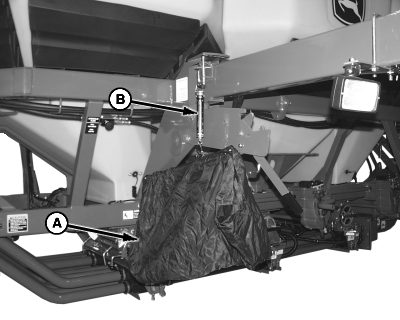
NOTE: To verify more than one meter at a time accurately, a separate scale must be used for each meter. Collection bags weigh different amounts and have a different zero reference on scale. 10. Hang empty collection bag (A) from scale (B). Turn knob on top of scale until gauge indicates zero. If more than one bag and scale are used, label bags and scales as matched sets.
|
|
OUO6074,0001085 -19-15MAR08-2/8 |
|
11.
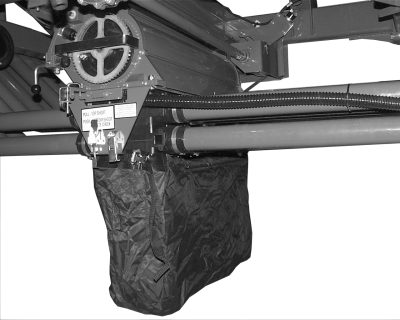
Remove cover plate from bottom of manifold.
IMPORTANT: Do not operate fan with collection bags installed. 12. Install collection bag. |
|
OUO6074,0001085 -19-15MAR08-3/8 |
|
13.
Select primary
Menu
button >>
Air Cart
button >>
Main
softkey.
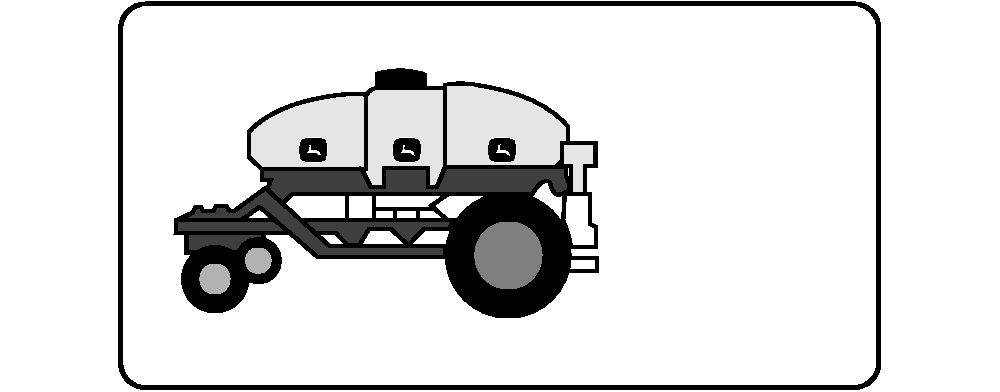
14. Turn on individual clutches for meters with collection bags installed. 15. Turn off individual clutches for meters without collection bags. 16. Turn on main clutch. |
|





OUO6074,0001085 -19-15MAR08-4/8 |
|
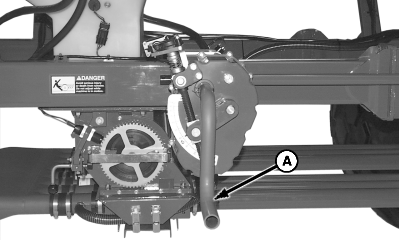
IMPORTANT: Avoid damage. Slide must be in bottom-shoot position on machines with stationary double-shoot manifolds. NOTE: Avoid inaccurate rate verification. Do not turn handle clockwise. NOTE: Avoid handle contact with frame or other components. Do not move crank handle from the transmission it was attached to at the factory. 17. Note position of crank handle (A). NOTE: All transmissions and driveshafts turn when crank handle is turned. 18. Turn handle counterclockwise and count each 360 degree rotation. NOTE: Check product level occasionally. Do not overfill collection bag. 19. One hundred crank rotations normally produce an adequate sample. For low displacement products or when yellow meter segments are used, turn crank more than 100 rotations for an adequate sample. |
|
OUO6074,0001085 -19-15MAR08-5/8 |
|
20.
Remove the collection bag (A), hang it from scale (B), and record weight.
21. Select a K-factor based on cart tire size and units set on monitor.
22. Calculate the weight factor as follows and record the result. IMPORTANT: Enter 19 cm (7.5 in.) into the formula for machines with 38 cm (15 in.) or 76 cm (30 in.) row spacing. IMPORTANT: Row spacing must be entered as cm or inch. Collected Sample Weight kg (lb.) x K-Factor x Row Spacing cm (in.) = Weight Factor EXAMPLE ONE: Cart with 18.4-26 (R3) tires and tool with 30.5 cm (12 in.) row spacing. Metric EXAMPLE ONE: 5.74 kg x 358.6 x 30.5 cm = 62 780.1 Imperial (U.S.) EXAMPLE ONE: 12.65 lb. x 1519 x 12 in. = 230 584.2 EXAMPLE TWO: Cart with 18.4-26 (R3) tires and tool with 38 cm (15 in.) row spacing. |
|
OUO6074,0001085 -19-15MAR08-6/8 |
|
Metric EXAMPLE TWO: 5.74 kg x 358.6 x 19 cm = 39 108.9 Imperial (U.S.) EXAMPLE TWO: 12.65 lb. x 1519 x 7. 5 in. = 144115.1 23. Calculate area factor as follows and record the result. Tool Width m (ft.) x Crank Rotations = Area Factor Metric EXAMPLE: 12.5 m tool width x 80 turns = 1000 Imperial (U.S.) EXAMPLE: 41 ft. tool width x 80 turns = 3280 24. Calculate application rate as follows: Weight Factor ÷ Area Factor = Application Rate kg/ha (lb./acre) Metric EXAMPLE: 62 780.1 ÷ 1000 = 62.8 kg/ha Imperial (U.S.) EXAMPLE: 23 0584.2 ÷ 3280 = 70.3 (lb./acre) 25. If actual rate equals target rate, return half-width disconnect handles and double shoot slide to original positions. If actual rate does not equal target application rate, perform the following: NOTE: See your John Deere dealer for assistance, if needed.
|
|
OUO6074,0001085 -19-15MAR08-7/8 |
|
|
OUO6074,0001085 -19-15MAR08-8/8 |