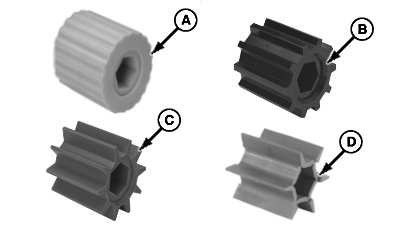
How To Change Meter RollersIMPORTANT: Avoid meter binding. When black meter rollers and small seed wear plates are used and small seed sizes approach 6 mm (0.25 in.), switch to standard wear plates or green meter rollers. NOTE: Field peas and chick peas sometimes wedge between the meter housing and the fine tuning rings. When product wedges in the meter, the meter is very hard to turn. Remove the fine tuning rings and recalibrate. When fine tuning rings are removed, the rate charts and the standard calibration values no longer apply. NOTE: The Very High Rate Meter is able to deliver enough product to overload the product tubes. Use the monitor calculation function to ensure that the application rate does not exceed 13.6 kg/min (30 lb./min). NOTE: When high rates of product are metered to a seeding tool with three or four secondary manifolds, either install additional secondary manifolds or reduce ground speed. Four types of fluted meter rollers accommodate a variety of different products, product delivery needs, and application rates. The rollers are color-coded for easy identification. · Yellow (A) - Low Rates and granular products: Use with low rate products such as flax, canola, and alfalfa. NOTE: Reduce application rate by approximately 30% when the black meter roller and small seed wear plate is used. Use standard wear plates or a green fluted meter roller as necessary. · Black (B) - Regular Rates: Use with seeds up to 6 mm (0.25 in.) diameter. This roller is most commonly used with wheat, barley, and small soybeans. · Green (C) - High Volume Rates: Use with seeds (soybeans) larger than 6 mm (0.25 in.) diameter and with high rates of fertilizer. |
|
OUO6076,0000203 -19-30APR09-1/6 |
|
· Blue (D) - Very High Rates: Use with very large seeds and with high rates of fertilizer up to 290 kg/ha (260 lb./acre). To change rollers and application rate, perform the following. |
OUO6076,0000203 -19-30APR09-2/6 |
|
|

|
1.
Remove meter cartridge assembly from housing.
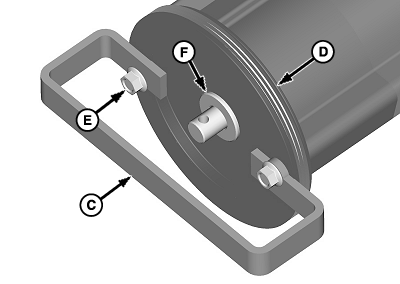
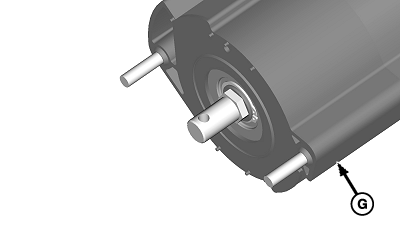
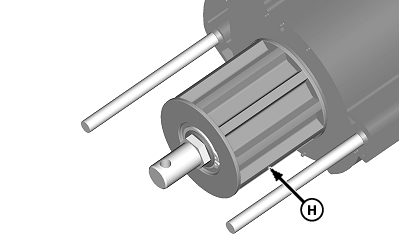
2. Remove cap screw (A), lock nut, spacer, sensor ring (B), and washers. NOTE: Handle (C) must be installed in original position during reassembly. 3. Mark handle (C) position on end cap (D). Mark end cap orientation on cartridge assembly. 4. Remove flange nuts (E) and handle. 5. Remove end cap and seal (F). NOTE: Each meter segment consists of an enclosure, meter roller assembly, wear plate, and brush. Do not mix segment components. 6. Number every enclosure (G) and divider in order. Components must be returned to original locations when procedure is complete. 7. Remove enclosure (G). NOTE: If tuning rings or meter rollers are reinstalled in a different order, product distribution is affected. 8. Note number of tuning rings on meter roller (H) before removing roller. Keep roller components and corresponding enclosure together. Do not mix segment components. |
|
OUO6076,0000203 -19-30APR09-3/6 |
|
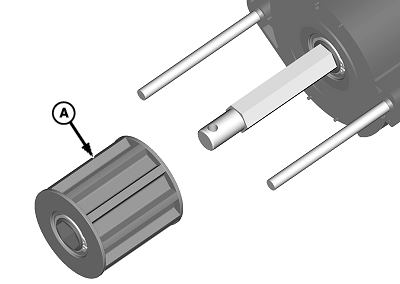
9.
Remove meter roller (A) assembly from shaft.
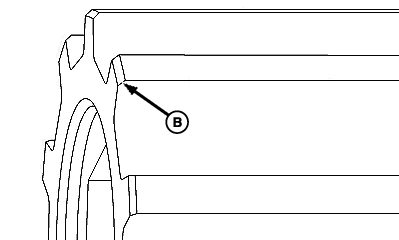
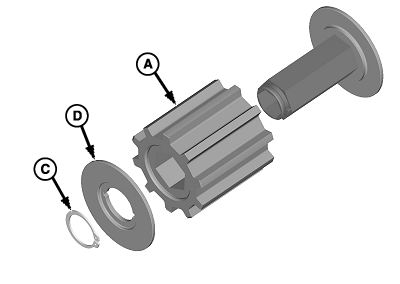
10. Locate beveled edge (B) on roller. 11. Remove snap ring (C) and bearing plate (D) from same side as beveled edge. 12. Remove meter roller. Note number of tuning rings. Install same number of tuning rings on replacement meter roller (See TUNE METER SEGMENT OUTPUT TO TOWER SIZE in this section). Assemble replacement meter roller, bearing plate, and snap ring.
|
|
OUO6076,0000203 -19-30APR09-4/6 |
|
|

|
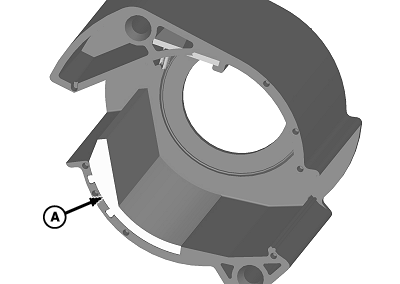
NOTE: Reduce application rate by approximately 30% when the black meter roller and small seed wear plate is used. Use standard wear plates or a green fluted meter roller as necessary. 13. Install proper wear plate.
|
14. Keep enclosure and meter roller together. Remove next enclosure and repeat procedure. Continue until all meter rollers are replaced. Do not install meter rollers or wear strips of different colors in meter cartridge. NOTE: Use alignment pegs and holes to aid enclosure installation onto meter cartridge. 15. Install meter rollers and corresponding enclosures onto meter cartridge in the order noted earlier. |
OUO6076,0000203 -19-30APR09-5/6 |
|
|
|
|
|
|
|
16.
Install previously removed end cap (D) and seal (F) in original position as previously marked.
17. Install previously removed meter handle (C) in original position as previously marked. IMPORTANT: Do not over tighten flange nuts (E). An overtightened nut distorts plastic enclosures and restricts meter rotation. An overtightened nut also increases wear on meter components and causes rod to interfere with sensor ring. |
18. Tighten flange nuts (E) until one or two threads are visible past top of flange nut. NOTE: Fully assembled meter cartridge rotates easily by hand. 19. Install previously removed washers and sensor ring (B). 20. Install previously removed cap screw (A), spacer and lock nut. 21. Install meter cartridge in cart. |
OUO6076,0000203 -19-30APR09-6/6 |