Seed Spacing Coefficient of Variation

A59325-UN-19FEB07
Menu
A59551-UN-08MAR07
Planter Button
A67122-UN-12MAY10
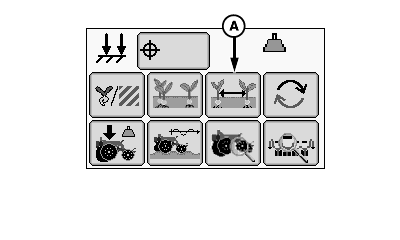
Seed Spacing Coefficient of Variation Button
A - Seed Spacing Coefficient of Variation Button
Select Menu >> Planter button.
When seed spacing coefficient of variation button (A) is selected the seed spacing coefficient of variation at a glance screen is displayed.
The Seed Spacing Coefficient of Variation (CV) run screen provides information about overall planter in-row seed spacing performance.
The Planter Main 1 (PM1) controller measures the consistency of the timing of the seed counts from the seed sensors to determine seed spacing performance for the planter. These spacing measurements are used to calculate the seed spacing coefficient of variation (CV) on a whole planter average and individual row basis.
NOTE: Coefficient of Variation (CV) measurements are only available for target seed rates below 40 seeds per second at 12.9 kph (8 mph). For example, CV information will only be displayed for target seed rates less than 148,250 seeds/hectare on 76 cm rows (60,000 seeds/acre on 30 inch rows). For target seed rates above 40 seeds per second at 12.9 kph (8 mph), dashes (- -) are displayed in place of CV values.
Seed spacing coefficient of variation (CV) is defined as seed spacing standard deviation divided by the average spacing. Coefficient of Variation allows the operator to evaluate planter performance over a wide range of crops and target populations. Coefficient of variation is expressed as a decimal, with lower numbers indicating better in-row seed spacing.
Coefficient of Variation at a glance bars increase in height as seed spacing consistency gets worse. Maximum bar height indicates a Coefficient of Variation (CV) of 0.50. In typical planting conditions, operators can expect coefficient of variation measurements to range from 0.10 to 0.30. CV values will vary with different crops, seed disks, planting conditions, and ground speeds. Planter seed spacing performance should always be verified with in-ground population and spacing checks.
To improve overall planter seed spacing performance, ensure meter drives are operating properly, check meter settings, adjust row unit down force, and reduce ground speed.
NOTE: Since CV measurements are taken at the seed sensor, the appearance of the emerged crop may not be the same as the information displayed on the monitor. For example, seed roll and bounce in the furrow due to excessive ground speed can make emerged seed spacing appear worse than what the monitor indicated.
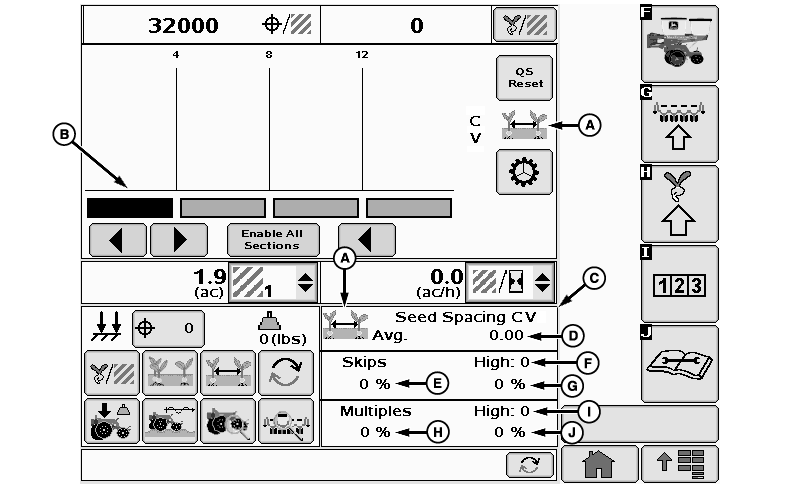
A67889-UN-28JUN10
A - Seed Spacing Coefficient of Variation Icon
B - Coefficient of Variation Bar Graph
C - Seed Spacing Coefficient of Variation Details Screen
D - Planter Average Coefficient of Variation (CV)
E - Planter Average Percent Skips
F - Row With Highest Skips
G - High Row Skip Percentage
H - Planter Average Percent Multiples
I - Row With Highest Multiples
J - High Row Multiple Percentage
Seed Spacing Coefficient of Variation at a Glance Screen
(A) Coefficient of Variation icon
(B) Coefficient of variation bar graph
(C) Seed spacing coefficient of variation details screen contains the information of the current bar graph.
(D) Good spacing.
(E) Planter average percent skips
(F) Row with highest skips.
(G) High row skip percentage
(H) Planter average percent multiples.
(I) Row with highest multiples.
(J) High row multiple percentage
Screen Area Information
QS Reset - QS Reset
Enable All Sections - Enable All Sections
Avg. - Average
|
OUO6064,0000198-19-20100721 |