Variable-Rate Drive (VRD) Overview
A Variable-Rate Drive (VRD) system uses one or more hydraulic motors to turn the seed meters. Various sensors along with data entered into the monitor by the operator determines meter speed required to achieve a chosen population.
VRD features provide additional performance over mechanical drives.
- Manually change seed rates from the cab without stopping.
- Manually change seed rates when crossing different soil types.
- Manually change seed rates when crossing transitions between irrigated and non-irrigated ground.
- Program up to five different seed rates to choose from while planting.
- Use multiple VRD motors to seed different rates with each hydraulic drive motor or select the same rate for all motors.
- Compatibility with APEX software and Map Based Planter Field Doc™ to design a prescription plan that automatically adjusts seed rates in the field.
System Components
- Hydraulic Motor - Motor turns planter drive shafts and meters.
- Valve and Solenoid - Varies oil flow to motor.
- Motor Sensor - Monitors motor speed.
- Height Sensor or Switch - Monitors frame height.
- Motion Sensor - Monitors planter wheel rotation.
- Tractor Radar or GPS Receiver - Indicates ground speed.
- System Controller - Processes all signals and data input.
- Monitor Display - Presents data and accepts operator input.
Hydraulic Requirements
Tractor must have either a load sensing hydraulic system or a closed center hydraulic system with flow control. These types of hydraulic systems usually have large oil reservoirs and increased oil cooling capacity. They only deliver the oil flow needed for the VRD motors to maintain a constant speed.
Each VRD motor requires a nominal hydraulic oil flow of 3.79 to 30.28 L/min. (1.0 to 8.0 gpm) at 3447 to 10 342 kPa (500 to 1500 psi).
NOTE: Tractors with open center hydraulic systems are not recommended for the following reasons:
- No control of oil flow volume.
- Excessive oil temperature.
- Decreased oil flow to motor during operation of other tractor control valves.
System Functionality
- SeedStar™ 2 Controller (PM1): A controller mounted on the planter frame receives power from the tractor and signals from all the system components. The controller processes all the information, controls the hydraulic motor valve, and provides information to the monitor display. The controller communicates over a CAN (Controller Area Network) system. SeedStar™2 is compatible with John Deere GreenStar™ 2 1800 and 2600 displays and ISO 11783 compliant competitive displays only.
- Monitor Display: A monitor accepts operator inputs and sends data to the controller. The monitor also displays data received from the controller.
- Height Sensor: Most drawn planters use an adjustable wheel frame height sensor to start and stop seeding at chosen points as the planter is lowered and raised. The start and stop points are input and adjusted by the operator on the GreenStar™2 display.
- Height Switch: Most integral planters use one or more push button switches mounted on a row unit parallel arm. The switch compresses when the planter is raised and release when lowered. Two Switch System: One switch is installed on the far left side of the machine, and one switch on the first row unit to the right of center. If only one switch is compressed, the drives continue to turn. Uneven ground can cause one switch to compress while one switch remains in the released position. Drives only stop when BOTH switches are compressed as planter is raised.
- A tractor mounted radar or GPS receiver determines ground speed.
- A wheel motion sensor mounted on a planter wheel detects motion and indicates the planter is moving. This is a safety feature validating the ground speed signal from the radar or GPS receiver.
- Power to the variable-rate drive motors is supplied by continuous hydraulic flow from the tractor. The controller signals a solenoid operating a hydraulic valve on the motor to control motor speed.
- A speed sensor mounted on the motor shaft detects motor speed for feedback to the SeedStar™ controller.
-
NOTE: Population readings detected by seed sensors do NOT control
motor speed.
The operator enters data into the monitor for seed rates, seed disks, seed meters, row spacing, motor sprockets, and frame position. The controller uses other operator entered data to adjust motor speed and therefore meter speed.
The following components must be active for system operation:
- Monitor operation—Monitor and controller must have electrical power.
- Seed Rates—One or more must be entered and turned ON from the Planter - Rates screen.
- Continuous hydraulic oil flow—Oil must be flowing to motors.
- Ground Speed from the tractor—Controller must detect ground speeds greater than 1.6 km/h (1 mph).
- Wheel motion sensor—Controller must detect planter wheel motion.
- Height Sensor or Switch—Must be calibrated and controller must detect that planter is lowered.
To view current status of VRD inputs, Select Planter >> Diagnostics softkey >> Readings tab >> VRD Data from drop down menu.
In order for variable-rate drive to work, seed rates must be entered and turned ON from the Planter - Rates screen.
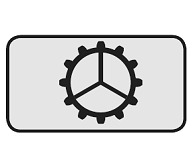
A62923-UN-23JUL08
No Activity
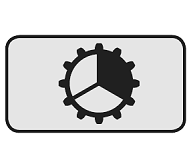
A62924-UN-23JUL08
Wheel Motion Active
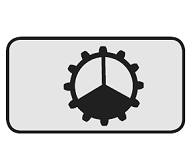
A62925-UN-23JUL08
Planter Lowered
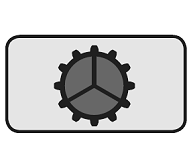
A62926-UN-23JUL08
Drives Engaged
During normal operation, a visual indicator appears on the RUN screen when motors are operational. The gear indicator sections fill in, one at a time based on system activity, then turn solid green to indicate at least one motor is operational.System Performance
Low speeds affect performance. Motor performance becomes marginal at speeds less than 3.2 km/h (2 mph) and stops at speeds below 1.6 km/h (1 mph). NO monitor warnings are given at speeds below 3.2 km/h (2 mph).
Extreme and sudden changes in speed cause a decrease in population and spacing accuracy. To start from a stopped position, use high idle and a low gear. Gradually upshift and increase speed from 3.2 km/h (2 mph) to target speed to allow the VRD system time to adjust. Use Quick Start feature to improve initial motor activation. Downshift instead of idling down to turn on ends of field. Attain 3.2 km/h (2 mph) before lowering the planter and gradually upshift to target speed.
|
Field Doc is a trademark of Deere & Company |
OUO6064,00001F1-19-20100630 |