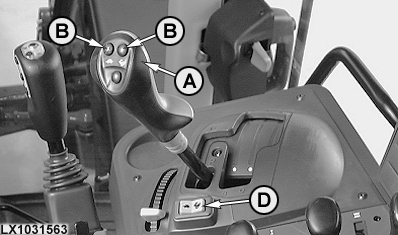
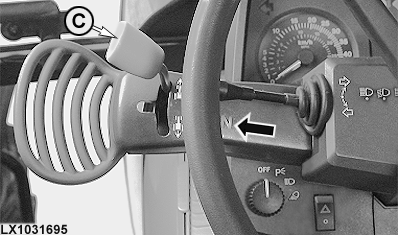
Shifting the PowrQuad Plus TransmissionGears are shifted by means of range shift lever (A), gear shift keys (B) - or by gear shift switch (D) - and reverse drive lever (C). Before starting the engine, move reverse drive lever (C) to its neutral position. To drive away, first move range shift lever (A) to the desired range and then move the reverse drive lever to the desired direction of travel.
The clutch pedal must be depressed to change the ranges. There is no need to depress the clutch pedal to shift gear or to change the direction of travel. When changing ranges from approx. 7 km/h (4.4 mph), an automatic function ensures that the gear selected matches the travel speed. This automatic function can be suppressed by holding down one of the gear-shift keys. To park the tractor, move reverse drive lever (C) to its neutral position, then engage park lock at the range shift lever (A). IMPORTANT: Engage park lock only when the tractor is stationary.
|
|
 CAUTION:
If the reverse drive lever is actuated when the engine is running and a range is selected, the tractor will start to move.
CAUTION:
If the reverse drive lever is actuated when the engine is running and a range is selected, the tractor will start to move.
OU12401,0000EE6 -19-08OCT03-1/3 |
|
NOTE: If shift lever (A) is moved to its park position when reverse drive lever (C) is not in neutral, an acoustic signal is triggered and the letter "N" starts to flash. When the engine shuts off, the reverse drive lever remains in its selected position but the transmission shifts into neutral. If the reverse drive lever is not in neutral when the engine is started, an acoustic signal is triggered and the letter "N" starts to flash to alert the operator to this situation. If the reverse drive lever is moved out of neutral while park lock is engaged, an acoustic signal is triggered. To make the tractor move, first put the reverse drive lever in neutral and then move it to the desired position. Engine-speed matching when shifting gearsFor a smoother shift, engine speed is temporarily matched by the electronic system. See "Customization" in the "Diagnostic Trouble Codes" section. Optimum gear-shifting for driving under load (transport):1.
Select a range suitable for driving away under load.
If the oil is cold (0°C, 32°F), it may affect how the reverse drive lever operates. At temperatures below -10° C (14° F), it may take longer to change the direction of travel. Automatic engine-speed matching is de-activated at temperatures below +5°C (41°F). In certain circumstances, the reverse drive lever may have to be actuated several times before the tractor starts to move. When the oil has had time to warm up, operation becomes normal again. "Come-home" modeUnder certain circumstances, the tractor can still be driven even if there is an electrical fault in the transmission. |
OU12401,0000EE6 -19-08OCT03-2/3 |
|
To do this, stop the engine, remove plug K10/4 (relay box K10) and re-install it at a position 90° from its original position. The wording "Come Home" must be uppermost. NOTE: In the come-home mode, engine speed is limited to 1500 rpm and only the first gear in each range is available. |
OU12401,0000EE6 -19-08OCT03-3/3 |