AutoPowr™/IVT™ — Settings
Set travel speed
LX1057255-UN-23SEP13
LX1057256-UN-22JAN14
Transmission Button
LX1057257-UN-24SEP13
LX1057183-UN-28AUG13
Max Speed Forward
LX1057184-UN-28AUG13
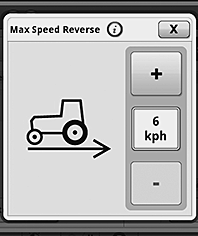
Max Speed Reverse
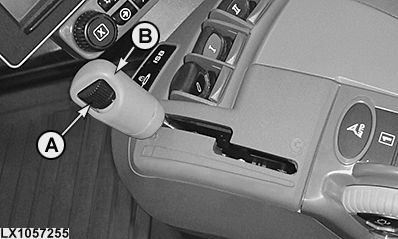
A - Speed Wheel
B - Speed Control Lever
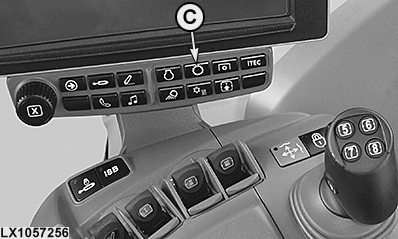
C - Transmission Button
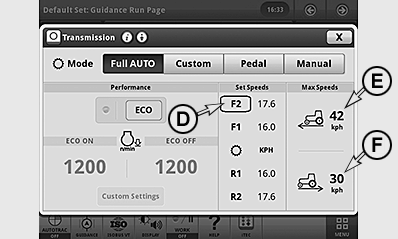
D - Speed Range Marker
E - Maximum Forward Speed
F - Maximum Reverse Speed
The maximum speed in a speed band is adjusted using speed wheel (A) and speed control lever (B).
NOTE: The maximum speed setting is shown on the instrument panel by means of the LEDs on the circumference of the speed display.
On the transmission page, a frame appears round the speed band (D) that is currently activated, and the set maximum speed is displayed.
To set a forward speed band only, switch on the ignition and move the reverse drive lever to forward. Use speed control lever (B) to select the desired band and set the desired travel speed with wheel (A).
To set a reverse speed band only, switch on the ignition and move the reverse drive lever to reverse. Use speed control lever (B) to select the desired band and set the desired travel speed with wheel (A).
To set a forward and a reverse speed band, turn on the ignition and shift the reverse drive lever to neutral. Band mark (D) alternates every 2 seconds between the forward and reverse speed bands. Use speed control lever (B) to select the desired band and set the desired travel speed with wheel (A).
Limit maximum speed for forward and reverse travel
Maximum speed for forward and reverse can always be limited on the transmission page. These set maximum travel speeds cannot be changed using speed wheel (A) or overridden using the accelerator pedal or hand throttle.
Increasing speed does not change dynamic behavior of tractor.
To adjust, press transmission button (C) and access the transmission page.
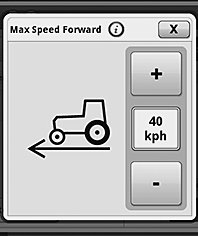
The maximum speeds for forward and reverse are displayed in boxes (E) and (F). To change maximum speed for forward and reverse, actuate display box (E) or (F). In the context menu, enter the desired settings by means of the +/— buttons and close the menu. Increasing the speeds does not change the dynamic behavior of the tractor. The maximum speed set in boxes (E) and (F) always takes utmost priority, even if a higher speed has been selected in another setting.
FieldCruise™, Using Cruise Control
LX1057180-UN-22JAN14
LX1057090-UN-22JUL13
LX1057091-UN-22JUL13
LX1057129-UN-01AUG13
LX1057092-UN-14OCT13
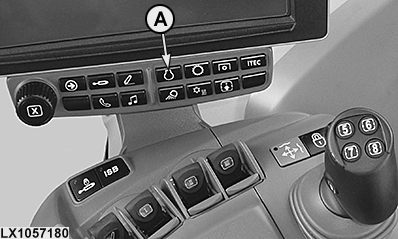
A - Engine Button
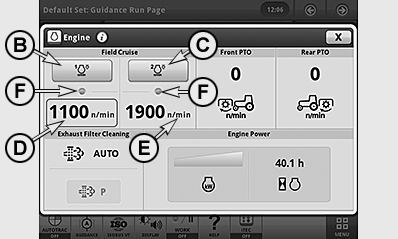
B - Button, FieldCruise™ 1 On/Off
C - Button, FieldCruise™ 2 On/Off
D - FieldCruise™ Speed 1 (Status, Activated)
E - FieldCruise™ Speed 2
F - FieldCruise™ Indicator Light, Speed Switched On
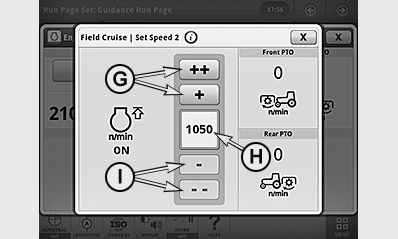
G - Button, Increase Speed
H - Speed Setting
I - Button, Reduce Speed
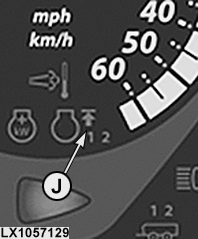
J - FieldCruise™ Indicator Light, 1 or 2
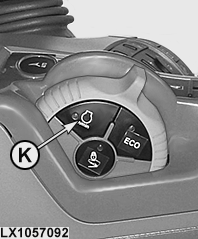
K - Button, FieldCruise™ ON/OFF
By means of the FieldCruise™ function, the engine speed can be limited to a range from 1050 to 2100 rpm.
Using cruise control in light load situations may reduce fuel consumption.
FieldCruise™ may be used in some applications such as operating the rear PTO while baling.
Two different FieldCruise™ speeds can be set, enabling the operator to toggle quickly from the one to the other.
• Set a FieldCruise™ speed
-
Press engine button (A).
-
Press button (D) or (E) and set the desired speed using button (G) or (I).
IMPORTANT: FieldCruise™ is not available in pedal mode. If the button (K) or (B) or otherwise (C) is pressed, the set speed is approached promptly regardless of the hand throttle position.
• Switch FieldCruise™ on or off
-
Press engine button (A).
-
Press button (B) or (C) to switch FieldCruise™ 1 or FieldCruise™ 2 on or off.
NOTE: If FieldCruise™ has been activated, FieldCruise™ remains active when the engine is restarted.
When FieldCruise™ is switched on, indicator lights (F) and (J) light up together with the figures “1” or “2”. On the CommandARM™, the indicator light in button (K) also lights up.
Button (K) allows FieldCruise™ to be switched on and off directly. When FieldCruise™ is switched off, the previously used speed is highlighted and automatically reselected whenever FieldCruise™ is switched on at button (K) on the CommandARM™.
Set operating modes
LX1057315-UN-22JAN14
Transmission Button
LX1057258-UN-24SEP13
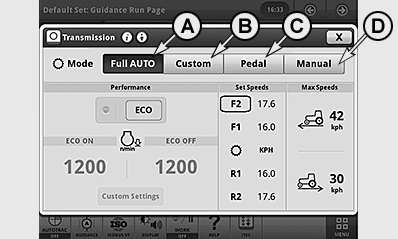
A - Auto
B - Custom Settings
C - Accelerator Pedal Mode
D - Manual
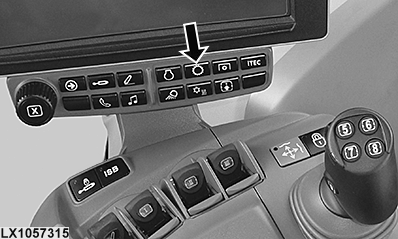
The AutoPowr™/IVT™ transmission offers four operating modes to get the most fuel efficiency and load control from your tractor. Pressing the transmission button allows the desired operating modes to be selected on the page shown.
A — Full Auto
The minimum
engine speed for best fuel economy when operating the tractor under
light load is automatically set.
The engine speed droop of
the auto shift is automatically set for use of full power when the
tractor is operated under full load.
B — Custom
Operator
can choose the Fuel Economy Minimum Engine Speed, Auto Shift Engine
Speed Droop, and Load Anticipation reaction.
C — Accelerator Pedal Mode
Operator can control wheel speed independently of engine speed by
using the accelerator pedal. At the same time, the operator uses the
hand throttle to keep the engine at a constant speed. This is important
for certain types of work where the engine speed must be kept constant
independent from wheel speed (mowing for example).
D — Manual
Tractor
performs as though equipped with a normal transmission and reacts
to controls. No Fuel Economy or Load Control functions are active
in this mode.
|
A — Full Auto |
B — Custom |
|---|---|
|
|
|
C — Accelerator Pedal Mode |
D— Manual |
|---|---|
|
|
Custom settings
NOTE: All settings pertaining to this page are only applicable when AutoPowr™/IVT™ transmission is in custom mode.
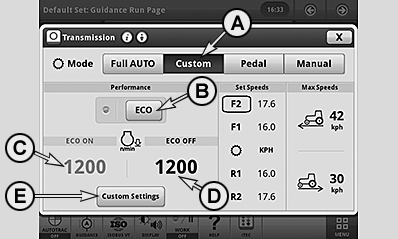
LX1057259-UN-24SEP13
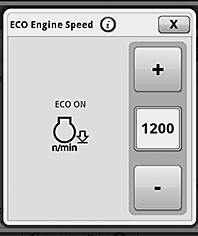
LX1057185-UN-28AUG13
Minimum Engine Speed with ECO Mode ON
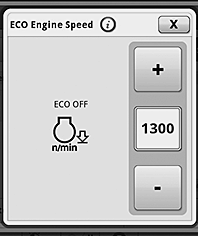
LX1057186-UN-28AUG13
Minimum Engine Speed with ECO Mode OFF
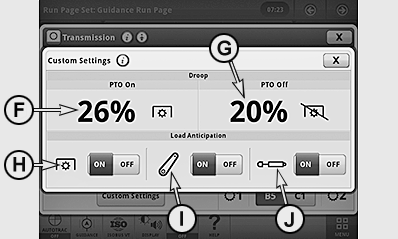
LX1057199-UN-30AUG13
LX1057200-UN-30AUG13
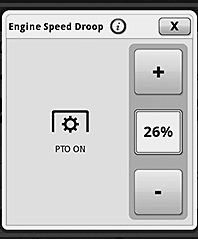
Engine Speed Droop with PTO ON
LX1057201-UN-30AUG13
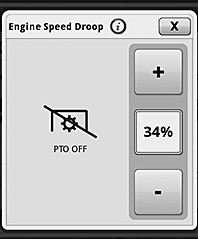
Engine Speed Droop with PTO OFF
A - Custom Settings
B - ECO Mode ON/OFF
C - Minimum Engine Speed with ECO Mode ON
D - Minimum Engine Speed with ECO Mode OFF
E - Custom Settings
F - Engine Speed Droop with Front and Rear PTO ON
G - Engine Speed Droop with Front and Rear PTO OFF
H - Load Anticipation (Front and Rear PTOs)
I - Load Anticipation (Front and Rear Hitches)
J - Load Anticipation (SCV)
Reduction of engine speed:
This function allows fuel economy to be improved. If the speed commanded by the accelerator pedal or hand throttle has been reached, the engine speed that is required to maintain travel speed will be reduced automatically. Input boxes (C) and (D) allow a minimum engine speed to be selected which will not be reduced any further by the engine speed reduction function. Selecting ECO (B) allows the operator to toggle between the minimum engine speeds in boxes (C) and (D).
NOTE: The value can be incrementally configured from 1200 rpm to 2100 rpm.
NOTE: Due to the more fuel-efficient engine and transmission control, driving characteristics are more sluggish in ECO Mode.
To adjust minimum engine speed, actuate transmission button and button (A) to activate Custom Settings. Use the following procedure to change the speeds.
• Change minimum engine speed with ECO Mode ON:
-
Switch on ECO Mode by pressing button (B).
-
Actuate input box (C) and access the context menu.
-
Use the +/— buttons to set the desired speed.
-
To save, close page.
• Change minimum engine speed with ECO Mode OFF:
-
Use button (B) to switch off ECO Mode off.
-
Actuate input box (D) and call up the context menu.
-
Use the +/— buttons to set the desired speed.
-
To save, close page.
Engine Speed Droop:
If engine
speed is reduced under load, an adjustable automatic control ensures
that e.g. a lower gear is selected to keep engine speed at a constant
level when operating a rear PTO. Engine Speed Droop intensity depends
on the setting which corresponds to a percentage of the current speed.
Example: In the case of a preselected engine speed of about 1930 rpm, setting the engine speed droop to 10 % means that the transmission is regulated down in the event of a speed decrease to about 1740 rpm. This would correspond to a drop in PTO speed from 540 to about 490 rpm accordingly.
Engine Speed Droop also influences the shifting behavior when upshifting in Auto mode. The higher the value set for engine speed droop is, the sooner the tractor will shift up.
NOTE: Engine speed droop percentage with rear PTO on can be set from 6 % to 30 %.
To adjust Engine Speed Droop, actuate button (E) and access the Custom Settings context menu. Use input boxes (F) or (G) to access the Engine Speed Droop settings for PTO ON and PTO OFF, and use the +/— buttons to set the desired values. To save, close page.
Adjust Engine Speed Droop for additional anticipated extra load:
This setting is used to select an additional anticipated load created by the use of PTO (H), hitch (I) or SCV (J). If the PTO is actuated while the ECO mode is enabled, the engine speed will be increased permanently. When the hitch or the selective control valves is activated, the speed is increased briefly.
To activate or disable the relevant function, press the ON or OFF button. To save, close page.
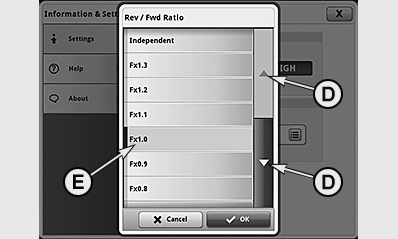
Set the reverse/forward speed ratio
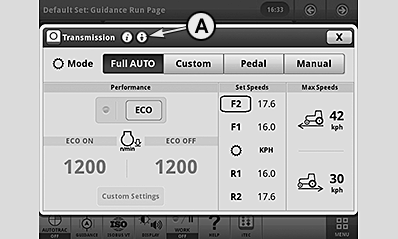
LX1057305-UN-24SEP13
Transmission Button → Transmission Page
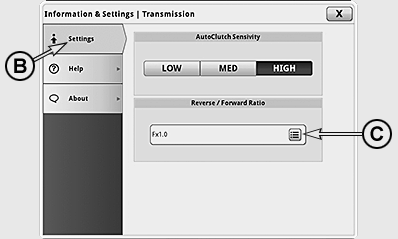
LX1057306-UN-24SEP13
LX1057307-UN-24SEP13
A - Advanced Settings Icon
B - Settings Tab
C - Input Box
D - Arrow Buttons
E - Reverse/Forward Speed Ratio
This function allows a different travel speed to be selected automatically when direction of travel is changed.
Maximum reverse speed is 30 km/h (18 mph) regardless of ratio.
To change, press the transmission button and actuate icon (A; advanced settings) in the first line of the transmission page.
Select tab (B) and select input box (C) for forward/reverse speed. Use arrow keys (D) to set the desired ratio. To save, press the OK button.
-
In speed band 1, reverse speeds can be set to a maximum of 30%
higher (selection 1,3) and 70% lower (selection ,3) than forward speeds.
A setting such as this only takes effect if the maximum speed in a
speed band is adjusted using the speed wheel.
In speed range 2, the forward/reverse speed ratio is 1:1 up to 22 km/h (14 mph). Above that speed, it changes automatically to 40:30 or 50:30.
- If independent is selected, any speed can be set in speed band 1 and 2 for each direction of travel. This does not apply to creeper mode.
AutoClutch Sensitivity
LX1057305-UN-24SEP13
Transmission Button → Transmission Page
LX203981-UN-14MAR14
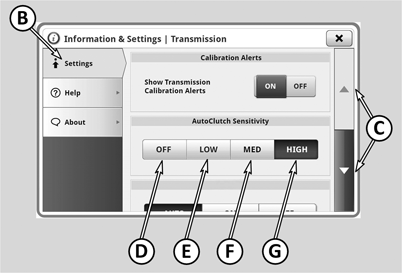
A - Advanced Settings
B - Settings Tab
C - Arrow Buttons
D - Select/Deselect AutoClutch2
E - Low Sensitivity
F - Medium Sensitivity
G - High Sensitivity
AutoClutch is an automatic clutch function. When AutoClutch is switched on, the clutch pedal does not need to be pressed to stop the tractor.
If both brake pedals are depressed when driving the tractor, the speed will be reduced or the tractor stops. When the brakes are released again, the tractor automatically accelerates up to the speed currently commanded by the hand throttle or accelerator pedal.
 CAUTION: When AutoClutch is switched off2, the
clutch pedal needs to be pressed to stop the tractor.
CAUTION: When AutoClutch is switched off2, the
clutch pedal needs to be pressed to stop the tractor.
IMPORTANT: The AutoClutch function operates only when the brake pedals are coupled together. Actuating a pedal individually (e.g. to steer) does NOT actuate the automatic clutch function.
NOTE: For driving maneuvers using the turn brake (only one brake pedal is actuated), the engine speed should not drop below 900 rpm, because otherwise the AutoClutch function becomes active again.
Switch AutoClutch on and set sensitivity:
- Press the transmission button and actuate icon (A) for advanced settings in the first line of the transmission page.
- Select tab (B) and use arrow keys (C) to select the AutoClutch input box.
- Various possible selections (D) to (G) are displayed.
- Make the desired selection by pressing the button.
- To save, close page.
IMPORTANT: AutoClutch remains switched on after start-up. If AutoClutch is switched off by the operator, it switches on again automatically the next time the tractor is started.
NOTE: If desired, the sensitivity setting can be displayed directly on the CommandCenter™ status monitor.
|
Meaning of buttons (D) to (G) |
|
|
(D) |
Switch off the auto coupling function by pressing the OFF button2. When "OFF" is marked (dark background) then AutoClutch is switched off. It can be switched off only if the brake pedals are NOT pressed. |
|
(E) |
Low: is recommended for driving downhill with a trailer, particularly if ground conditions are difficult. |
|
(F) |
Medium: is primarily for driving with a trailer in moderately hilly terrain. |
|
(G) |
High: is primarily for driving without a trailer or with a trailer on level ground. |
NOTE: When Medium and Low settings are selected, more force is required to press the brake pedal.
|
1 (See AutoPowr™/IVT™ — Operation
on Hillsides in Slippery Conditions in this section.)
|
OULXA64,0003115-19-20160226 |