AutoPowr™/IVT™ — Operating on Hillsides in Slippery Conditions
-
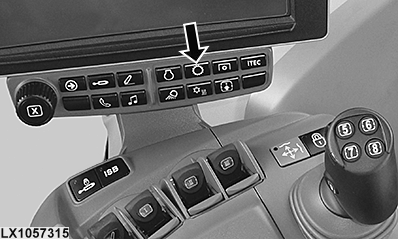
LX1057315-UN-22JAN14Transmission Button
Press the transmission button to access the transmission page.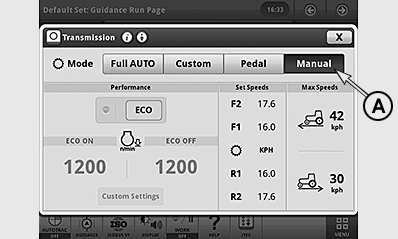
LX1057309-UN-24SEP13 -
Press button (A) to activate the Manual operating mode.
NOTE: AutoClutch sensitivity should be set to low.
The tractor performs as though equipped with a normal transmission and reacts to controls. No Fuel Economy or Load Control functions are active in this mode.
 CAUTION: Personal injury may result if control of the tractor
is lost while operating on hillsides. The tractor's wheels may lock
on slippery slopes, causing skidding. Observe the following precautions:
CAUTION: Personal injury may result if control of the tractor
is lost while operating on hillsides. The tractor's wheels may lock
on slippery slopes, causing skidding. Observe the following precautions:
- Select a travel speed that ensures safe operation on hillsides.
- Do not use the speed control lever to decelerate too quickly.
Braking of tractor and trailer (in particular when driving downhill)1:
IMPORTANT: It is essential to set AutoClutch sensitivity correctly; see "AutoPowr™/IVT™ — Settings" in this Section.
To brake a hitched-up unit (tractor plus trailer) under control, a stretching of the hitch-up is necessary for stable driving characteristics.
When there are speed reductions that are commanded by the driver, there may be strong braking characteristics by the tractor. These braking characteristics may be caused by the gear transmission and the engine and may be quite intensive at slow travel speeds.
To keep the hitched-up unit stretched in this situation, be sure to increase the engine speed to 1200 rpm at least and that the braking is primarily done by the tractor's service brake. As an alternative, the clutch pedal can be pressed at the same time as the service brake is pressed. In both cases, the trailer brake is actuated sufficiently to stretch the hitched unit. This provides the best possible driving stability during stopping or when slowing down for changing directions.
|
1 Valid
for tractors with AutoPowr™/IVT™ transmission and pneumatic
and hydraulic trailer brake system.
|
OULXA64,0003117-19-20130924 |