Connect Implements to Selective Control Valves (SCV)
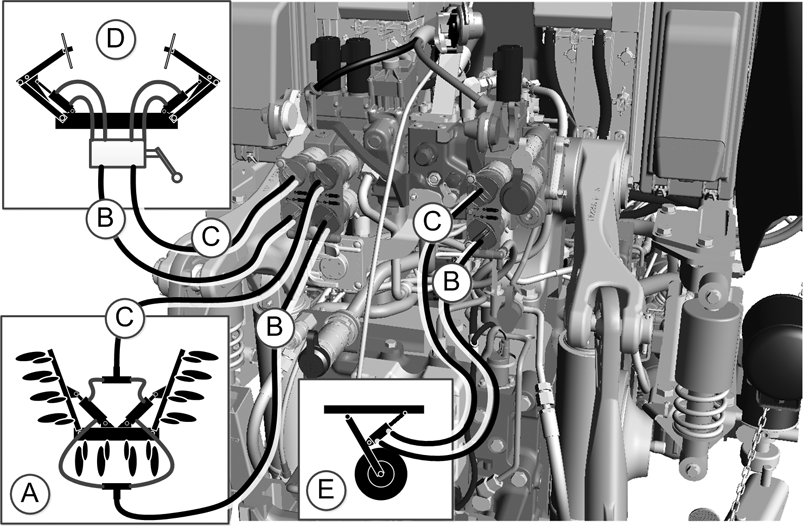
Sample illustration
LX228720-UN-27APR15
LX234695-UN-27APR15
A - Folding mechanism for example (double-acting cylinder connected in parallel).
B - SCV port for extend.
C - SCV port for retract.
D - With track markers for example. Two double-acting cylinders are actuated separately by means of a commutation valve.
E - Actuate depth gauge wheel via double-acting cylinder for example.
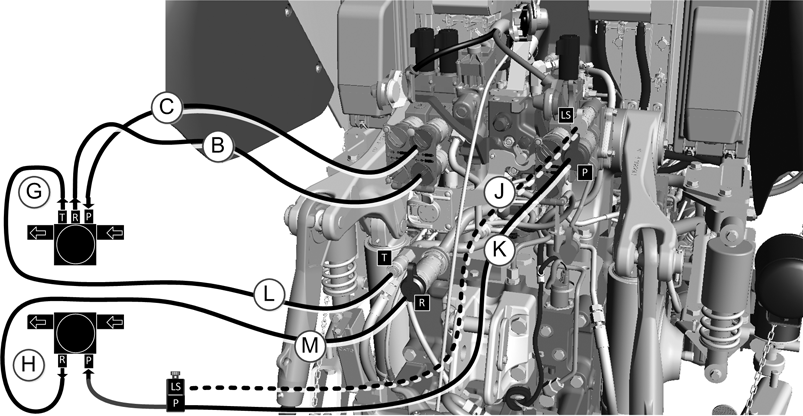
G Drain port of a hydraulic motor, in order to empty the motor case.
H - Hydraulic motor (e.g. for pump) without leak-off port.
J - Hose for LS pilot oil, connected to Power Beyond valve.
K - Hose for pressure oil, connected to Power Beyond valve.
L - Hose for draining the hydraulic motor case (leak-off oil returned, in order to empty the case of the hydraulic motor).
M - R port for large oil quantity.
The illustration shows typical applications and describes how implements have to be connected to the hydraulic system of the tractor. Also comply with the Operator's Manual of the implements.
Implements with folding mechanisms (A) are usually equipped with double-acting cylinders. These are connected to the SCV as for the functions "retract" (right SCV side) and “extend” (left SCV side). In the example shown, the two folding mechanisms are actuated simultaneously because the pressure lines of the cylinder and connected to each other by T-fittings.
It is possible to control two applications with just one SCV if a commutation valve is used, as shown in example (D). The commutation valve enables similar functions to be controlled successively, but independently of each other.
Connect applications with double-acting cylinders (e.g. on lowering gauge wheels (E)) to the SCV as for the functions “retract” (right SCV side) and “extend” (left SCV side).
If a hydraulic motor (G) has a drain port (F), it is very important to connect it to R port (L). This ensures that oil pressure does not build up inside the hydraulic motor case, which could cause damage. Example (G) shows a hydraulic motor connected through an SCV. Adjust SCV to continuous flow.
A hydraulic motor (H) on implements with independent hydraulic system must be connected as shown. The hydraulic motor return line and the connections of control valve (I) have to be connected to ports (J, K and M) of the Power Beyond valve.
IMPORTANT: If a hydraulic motor with pressure and return lines is connected to an SCV, an additional check valve has to be used at the return port. This prevents damage due to incorrect operation of the SCV. Always switch off the hydraulic motor with the SCV in its float position. This allows the hydraulic motor to coast down gradually. Switching off with the SCV in neutral position halts the rotational movement abruptly and may cause damage to the hydraulic motor or the implement.
|
OULXA64,0003703-19-20190221 |