Selective Control Valves, Mechanical - Control Levers

LX266771-UN-26JAN16
Control Levers for Selective Control Valves I to III
A - Extend
B - Neutral Position
C - Retract
D - Float Position
 CAUTION: To avoid personal injury, ensure that hoses are not
reversed. If hoses are reversed, cylinder extends when it should retract.
CAUTION: To avoid personal injury, ensure that hoses are not
reversed. If hoses are reversed, cylinder extends when it should retract.
IMPORTANT: Lock the selective control valves against unintended actuation when driving on roads and whenever the SCV control levers are in neutral because they are not needed. See also “Selective Control Valves, Mechanical - Transport Lock” on the following pages.
The following description refers to selective control valves with deactivated lock function:
The SCV control levers may be moved into 4 positions.
A — Extend (detent position)
If the lever is moved to the extend detent position and
released, the lever returns to neutral position only when the hydraulic
cylinder has been extended. The hydraulic cylinder is held in position.
A/B — Position between neutral and
extend detent position
If the lever is moved between
neutral and extend detent, the cylinder will be extended slowly. The
further the lever is moved to the detent position, the faster the
hydraulic cylinder is extended. If the lever is released, the lever
returns to neutral and the hydraulic cylinder is held in position.
B — Neutral position (between retract
and extend)
In neutral position, the hydraulic cylinder
is held in position.
B/C — Position between neutral and
retract detent position
If the lever is moved between
neutral and retract detent, the cylinder will be retracted slowly.
The further the lever is moved to the detent position, the faster
the hydraulic cylinder is retracted. If the lever is released, the
lever returns to neutral and the hydraulic cylinder is held in position.
C — Retract (detent position)
If the lever is moved to the retract detent position and
released, the lever returns to neutral position only when the hydraulic
cylinder has been retracted. The hydraulic cylinder is held in position.
D — Float position (detent position)
If the lever is moved beyond the retract detent position
and detented in the float position, the piston of the hydraulic cylinder
can move freely and the attached implement can follow the ground contour.
NOTE: If additional external valves are used, move the control lever to neutral when shutting off each hydraulic function.
NOTE: To release hydraulic pressure in the implement, move the lever to float position (D) while engine is running.
LX266747-UN-19JAN16
LX1057407-UN-07MAY14
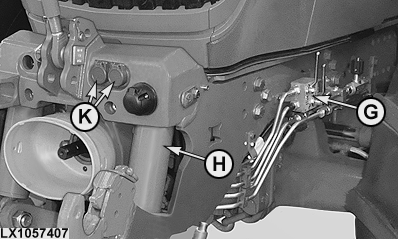
Front Hitch (Economy)
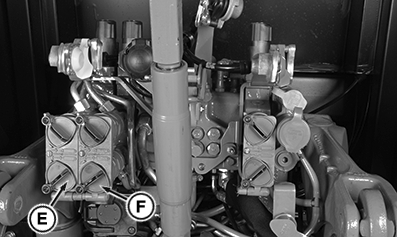
E - SCV I
F - SCV II
G - Shut-Off Valve
H - Front Hitch
K - Front Coupler, SCV II
CAUTION: Danger of accidents when an (Economy) front hitch and
front couplers are installed!
Make sure that selective control valves I and II cannot be used for two applications.
Use of selective control valve I:
- When using selective control valve I (E), make sure that shut-off valve (G) is closed.
- When using front hitch (H), make sure that the shut-off valve is open and no other implement is connected to selective control valve I.
Use of selective control valve II:
- When using selective control valve II (F), make sure that no other implement is connected to front couplers (K).
- When using front couplers (K), make sure that no other implement is connected to selective control valve II (F).
|
OULXA64,0003B5B-19-20160126 |