Draining, Flushing and Refilling Cooling SystemIMPORTANT: Thermostats should be replaced whenever system is flushed. Initial service is 3 years or 3000 hours. After initial service, drain interval would be every 5 years / 5000 hours if John Deere Cool-Gard is used and coolant is tested at recommended intervals. If other coolants are used, drain interval would be 2 years / 2000 hours. Follow recommendations in Fuel, Lubricants and Coolant section.
Shut off engine. Only remove cap when cool enough to touch with bare hands. Slowly loosen cap to first stop to relieve pressure before removing completely. IMPORTANT: Avoid cooling system damage. Test or replace thermostats and de-aeration tank cap whenever cooling system is flushed. See your John Deere dealer. Check de-aeration tank level. If tank is empty and recovery tank has been kept at least full cold, this indicates a leak that prevents system from recovering coolant from recovery tank. If recovery tank level does not change when engine is being warmed up, this is a sign of a leak or of a very low coolant level in the pressurized circuit. After flushing system, cooling system should be checked for leaks and de-aeration cap should be pressure checked. See your John Deere dealer for testing. |
|
|||||||||||||||||
 CAUTION:
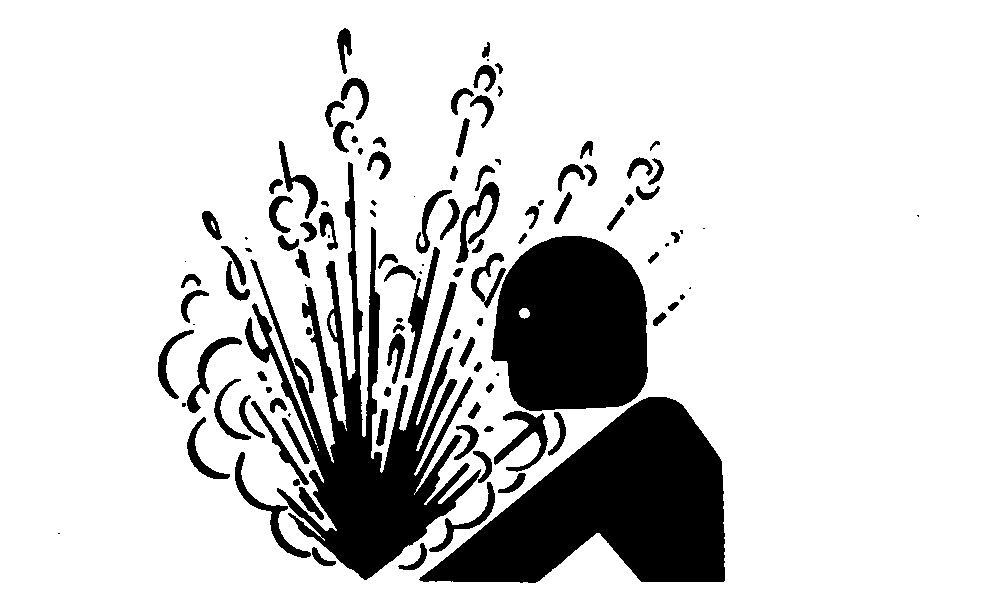
Explosive release of fluids from pressurized cooling system can cause serious burns.
CAUTION:
Explosive release of fluids from pressurized cooling system can cause serious burns.
OURX935,000052E -19-09MAY07-1/6 |
|
|
|
|
|
|
|
1.
Open hood.
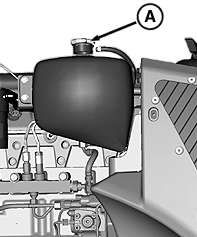
2. Remove de-aeration tank cap (A). NOTE: For tractors equipped with Automatic Temperature Control, temperature readout must say "HI" and key must be in RUN position. This prevents trapping old coolant in the heater. 3. For tractors equipped with Automatic Temperature Control (ATC), turn key to Run. Turn ATC controls to ON; ATC indicator must show "HI". |
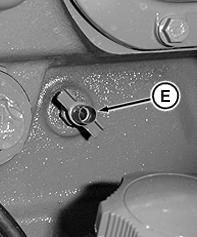
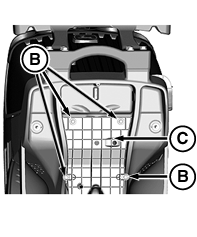
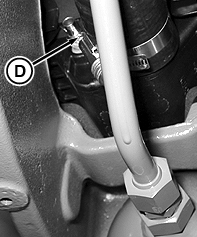
4. Remove side panel. 5. Remove four cap screws (B), then remove deflector (C) beneath radiator drain valve. 6. Open radiator drain valve (D) and drain coolant into catch pan. 7. Open engine drain valve (E) and drain coolant into catch pan. |
OURX935,000052E -19-09MAY07-2/6 |
|
|
|
|
|
|
|
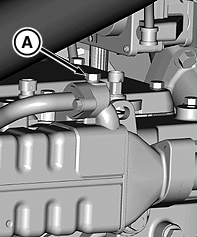
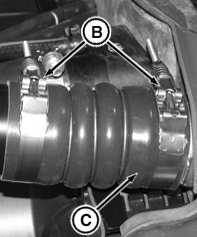
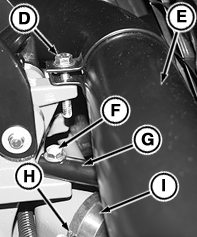
NOTE: Non emission certified (PowerTech) engines do not have EGR coolers. For those tractors, skip any step requiring EGR valve plug to be installed or removed though out this procedure. Tractors with non emission certified engines can easily be identified because those tractor's engine serial plate numbers have a "B" in the center of the engine serial number. An example of an engine serial number is RG6090 B XXXXXX. 8. Remove EGR cooler vent plug (A). 9. Remove charge air hose clamps (B) and slide charge air hose (C) toward tractor front and off of charge air tube. 10. Remove cap screw (D), then move charge air tube (E) out of the way. 11. Remove cap screw (F) and move radiator brace (G) out of the way. 12. Remove worm gear clamp (H) and upper radiator hose (I). NOTE: Early version tractors are equipped with thermostat bolts installed top to bottom. Later model tractors are equipped with thermostat bolts mounted bottom to top with individual thermostat gaskets for each thermostat. |
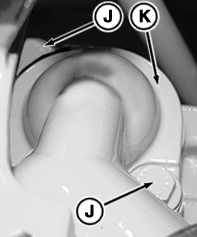
13. Remove three cap screws (J) and lift thermostat cover (K) out of the way. 14. Remove and discard old thermostats. 15. Install cover, O-ring and gasket without thermostats. Tighten cap screws to specifications. Specification
16. Replace previously removed radiator hoses and clamps, brace and tube. 17. Close engine drain valve, and radiator drain valve. NOTE: See your John Deere Dealer for recommendations on cleaning solutions. IMPORTANT: Never pour cold water or coolant into hot engine. 18. Begin filling system with cooling system cleaning solution. When air is purged and system cleaning solution appears at the EGR port, install EGR cooler vent plug and finish filling system. 19. Install de-aeration cap, side panel and close hood. |
OURX935,000052E -19-09MAY07-3/6 |
|
20. Start engine and run at a minimum of 1500 rpm for 15 minutes.
Shut off engine. Only remove cap when cool enough to touch with bare hands. Slowly loosen cap to first stop to relieve pressure before removing completely. 21. Shut off engine and allow to cool. 22. Open hood, remove de-aeration cap, put drain pans in place, then open radiator and engine drain valves. Remove EGR cooler vent plug. NOTE: For tractors equipped with Automatic Temperature Control, temperature readout must say "HI" and key must be in RUN position. This prevents trapping cleaning solution in the heater. 23. For tractors with ATC, start engine and turn ATC to High. When High is displayed on readout, turn off engine and finish draining system. 24. Install radiator and engine drain plugs. 25. Using clean water, begin filling coolant system. When air is purged and water appears at the EGR port, install EGR cooler vent plug and finish filling the system.
26. Close hood, start engine and run for a minimum of 1500 rpm for 15 minutes. |
Shut off engine. Only remove cap when cool enough to touch with bare hands. Slowly loosen cap to first stop to relieve pressure before removing completely. 27. Turn off engine, allow coolant to cool, then using previously listed steps, drain system. 28. Close engine drain valve and radiator drain valve. 29. Begin filling system with proper mix of coolant and distilled water or demineralized water. When air is purged and water is visible in the EGR valve port, close EGR cooler vent plug.
30. Start engine and run at 1500 rpm for a minimum of 15 minutes.
Shut off engine. Only remove cap when cool enough to touch with bare hands. Slowly loosen cap to first stop to relieve pressure before removing completely. 31. Turn off engine, allow coolant to cool, raise hood, remove side panel, then using previously listed steps, drain system. 32. Using previous steps, remove clamps, hoses, tube and braces. |
OURX935,000052E -19-09MAY07-4/6 |
|
Install New Thermostats
1. For early model tractors, remove thermostat cover and clean gasket sealing area. For late model tractors, remove thermostat cover and clean thermostat sealing rings. 2. For early model tractors only, apply RTV silicone sealant to new gasket. 3. Install new thermostats, new gasket (s) and cover. Tighten cap screws to specifications. Specification
4. Using previously listed sequence, install hoses, clamps, tube, cap screws and brace. 5. Install fan guard and side panel. 6. Close radiator and engine drain valves. Fill Cooling SystemIMPORTANT: Use coolant as specified in Fuel, Lubricants and Coolant section. 1. Fill high pressure coolant circuit at de-aeration tank. 2. Begin filling coolant recovery tank. When air is purged and coolant is visible, close EGR cooler vent plug. 3. Finish filling coolant recovery tank to Full Hot mark. NOTE: Coolant level in recovery tank will drop the first few cycles unless there is a leak. |
4. With de-aeration tank cap ON and hood closed, start engine and run at idle for 1 to 5 minutes. 5. Shut off engine, raise hood, remove de-aeration tank cap. Top off high pressure circuit at de-aeration tank and reinstall cap. 6. Close hood, start engine and warm up for 15 minutes. If the coolant recovery tank loses coolant to the ground, repeat previous step and top off until it does not. Loosing coolant to the ground indicates air in high pressure circuit is being discharged through coolant recovery bottle. 7. Shut off engine and allow to cool. Observe coolant level dropped below Full Hot in the recovery tank. NOTE: If coolant level did not drop below Full Hot , there is a leak in cooling system that could lead to engine damage. 8. Monitor coolant recovery tank level for the next two days of use. Refill coolant recovery tank as required. NOTE: It is normal for level to go down with the first few cycles and then range somewhere between Full Hot and Full Cold. NOTE: It is normal for de-aeration tank to be partially full of air when cap is removed and system completely de-aerated. When inspecting tank, if it is at least half full, do not add additional coolant. Topping off tank may cause coolant to be expelled onto the ground and/or cavitation of water pump. |
OURX935,000052E -19-09MAY07-5/6 |
|
|
|
Check Cooling System for Leaks
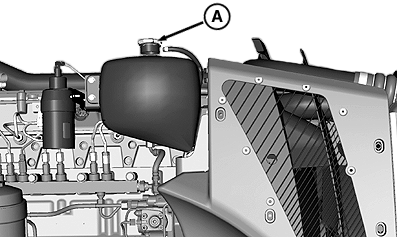
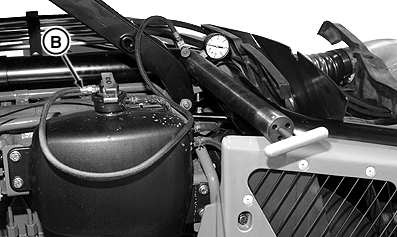
1. Raise hood. 2. Check radiator for leaks or damage. 3. Slowly turn de-aeration tank cap (A) to relieve pressure. Remove cap. 4. Attach radiator tester (B) to filler neck. 5. Pressurize system. Specification
6. If pressure drops immediately, or will not build pressure, have John Deere dealer check and repair system. 7. Test and/or replace de-aeration cap whenever cooling system is flushed. Use suitable equipment or see your John Deere dealer for testing equipment. |
NOTE: Cap gasket should be visually checked for sealing effectiveness. A good functioning gasket should have the imprint of the mating surface with no apparent scratches or leak paths. If gasket is damaged, replace cap and test new cap. NOTE: Cap should hold pressure within specifications. Relief occurs at top of range. NOTE: Replace cap if test result is out of specifications. 8. Pressurize cap. Specification
9. Remove tester and install radiator cap. 10. Close hood. |
OURX935,000052E -19-09MAY07-6/6 |