Service Safety
When a service person or mechanic is not familiar with all systems on this harvester, extra caution should be used when performing service work. A good working knowledge of the system and its components is important for removal or disassembly. The following is a list of basic precautions that should always be observed.
-
Make sure that you read and understand all warning plates and decals before lubricating or performing other maintenance.
-
Always wear protective glasses and footwear when working. In particular, wear safety glasses when pounding on any part of the machine or attachments with a hammer. Use protective clothing when welding. DO NOT wear any loosely fitting or torn clothing. Remove all rings from your fingers before working on the equipment.
-
Before starting work on the machine, disconnect the battery and hang this DO NOT START sign in the operator's station.
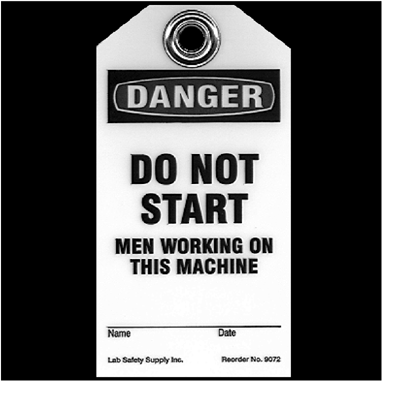
CM989999038-UN-07JAN00IMPORTANT: Before mounting machine, ensure that no one else is working under or on machine.
Ensure that all operators blow the horn several times before starting the machine.
Ensure that any persons near the machine know that when the horn blows, the machine is about to be started, and to move away as soon as possible.
Use the following procedure
-
Parking Procedure:
- Lower topper onto safety stop.
- Lower basecutter onto safety stops.
- Lower crop dividers.
- Lower elevator.
NOTE: In the event that topper and/or basecutter safety stops are not functioning properly, a 5 cm x 5 cm x 0.6 cm (2" x 2" x 1/4") angle bar may be used as a temporary safety stop.
-
Stop engine, remove ignition key, turn off electrical system master switch; remove negative battery cables from battery, install lock out device and tag. Also tag steering wheel or track control.
-
Before beginning any hydraulic repairs you must first relieve pressure from the hydraulic system.
NOTE: In the event repairs need to be made to the basecutter lift and/or topper lift, the hydraulic pressure should be relieved by lowering the basecutter and/or topper.
-
-
Whenever possible, make all repairs with the machine parked on level ground. Block the machine so it cannot move. DO NOT work on any machine that is supported only by lift jacks or a hoist.
-
Relieve all pressure in air, oil, or water systems before any lines, fittings, or related parts are disconnected or removed. Always make sure that all raised components and implements are correctly blocked. Be alert for possible pressure when disconnecting any device from a system that utilizes pressure.
 CAUTION: Liquid escaping from a very small hole can be almost
invisible. Use wood or cardboard, instead of your hand, when searching
for suspected leaks.
CAUTION: Liquid escaping from a very small hole can be almost
invisible. Use wood or cardboard, instead of your hand, when searching
for suspected leaks. -
Escaping fluid under pressure can have sufficient force to penetrate the skin. Therefore, before disconnecting any lines, be sure all pressure in the system is relieved. Before applying pressure, make sure all lines, fittings, and connections are tight and undamaged.
-
If you are injured by escaping fluid under pressure, see a doctor at once. A serious infection or reaction may result if proper medical attention is not received immediately.
NOTE: Any fluid injected into the skin must be surgically removed within a few hours or gangrene may result. Further information is available from Deere & Company Medical Department in Moline, Illinois. 1-800-822-8262
-
Lower all implements to the ground prior to working on the machine. If this cannot be done, make sure the implement is properly blocked to prevent it from dropping unexpectedly.
-
To avoid back injuries, use a hoist when lifting components that weigh over 23 kg (50 lb). When using a hoist, make sure all hooks are correctly positioned.
-
To avoid burns, be alert for hot parts located on the machine after it has stopped. Be particularly careful of hot fluids in lines, tubes, and components.
-
Be careful when removing cover plates. Gradually loosen the last two bolts or nuts located at the opposite ends of the cover or device. Carefully pry the cover loose to relieve any spring or other tension before removing it completely.
-
Be careful when removing filler caps, breathers, or plugs on the machine. Hold a rag over the cap or plug to prevent being sprayed or splashed by pressurized fluids.
-
Always use tools that are in good condition. Before performing any service, make sure you know how to use the proper tools.
-
Replace all fasteners with the same SAE or metric grade. Never substitute a softer part where a hardened part is used, and never substitute a harder part where a softer part is used.
Ensure that all protective devices and guards are properly installed and are functioning correctly before starting any repairs. If a guard or shield must be removed to perform repair work, use extra caution while working.
-
Take precautions to prevent damage to wiring during removal. After reinstalling the wiring, double check to make sure it is was not damaged during removal or installation. Ensure that the wiring does not touch any hot, sharp, or moving parts after it is installed.
-
Ensure that all protective devices and guards are properly installed and are functioning correctly before starting any repairs. If a guard or shield must be removed to perform repair work, use extra caution while working.
NOTE: In the event of an emergency the right hand window may be used as an alternate egress exit.
-
DO NOT operate the harvester if any rotating part is damaged or comes into contact with any other part during operation. Any high-speed rotating component that has been damaged or altered must be balance checked before operation.
-
Avoid working on equipment with the engine running. If it is absolutely necessary to make checks with the engine running, always use two persons: one to operate the controls and the other to work where the operator can see him. The hydrostatic transmission must be in neutral, the braking system set, and all pertinent safety locks set.
|
GB52027,0000571-19-20080408 |