Loss Calculation
|
|
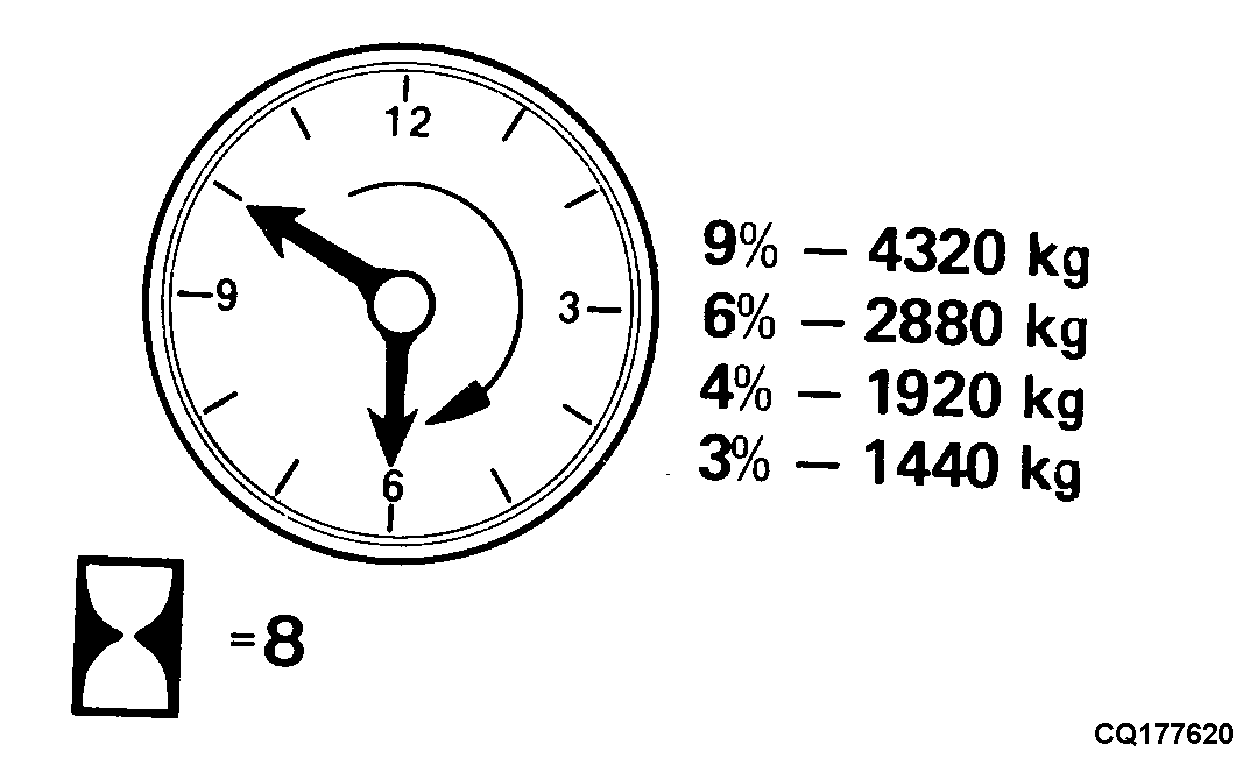
First Example: Combine operating at a loss of 9%. By better adjustment, the loss is reduced to 6%. The average harvest yield is of 3000 kg/ha (50 bags of 60 kg per hectare). Harvesting 2 hectares per hour adds up to 16 hectares in 8 hours of harvesting. Thus, 9% of 3000 kg/ha = 270 kg/ha 6% of 3000 kg/ha = 180 kg/ha After an 8-hour shift, we get: 270 kg/ha x 16 ha = 4320 kg loss 180 kg/ha x 16 ha = 2880 kg loss Difference = 1440 kg That is: For a harvest that yields 3000 kg/ha in an 8-hour shift, by reducing the loss rate from 9% to 6%, another 1440 bags are harvested (or 24 60-kg bags).
Second Example: |
The 6% loss of grains in the first example is still very high. Assuming that, by reducing the harvest speed, these losses are reduced to 3%. Thus, 6% of 3,000 kg/ha = 180 kg/ha 3% of 3,000 kg/ha = 90 kg/ha 16 ha x 180 kg/ha = 2,880 kg/ha (6%) 12 ha x 90 kg/ha = 1,080 kg/ha (3%) Difference = 1,800 kg. That is: By reducing from 16 to 12 hectares harvested in the 8-hour shift, 1800 kg (30 bags with 60 kg) that would be lost were harvested. What Does Loss of Grains Mean Loss of grains = less money in your pocket Correct operation + Adjusted combine = more money in your pocket |
AG,GG05155,134 -19-03FEB99-1/1 |