TIA - Status Page
LX1045770-UN-17DEC10
LX1045775-UN-20DEC10
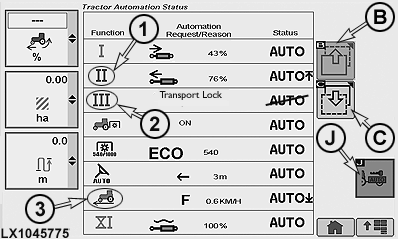
1 - Example for AUTO↑
2 - Example for AUTO
3 - Example for AUTO↓
C - Next Page Softkey
J - Softkey for Activating Tractor-Implement Automation
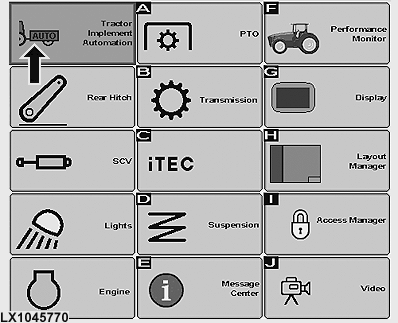
At the CommandCenter menu, select the softkey for TIA (see arrow), and access the status page.At the status page, the current status of all the functions requested by a TIA-capable implement is displayed.
NOTE: If no TIA-capable implement is connected, only a text message appears on the display.
If there are too many functions to display on one status page, softkeys (B) and (C) can be used to change to the next or previous pages respectively.
To activate or deactivate the implements, press softkey (J) and access the page for activating the implements. See also TIA - Activating the Implements on the following pages.
The status page has three columns:
|
Function |
Auto/Command/Cause of Fault |
Status |
|---|---|---|
|
Functions are only shown if there is a TIA-capable implement connected to the tractor and the implement is requesting this/these function(s). |
• OK appears on the display if the function is fault-free and can be automated by the implement. • A brief text appears on the display if the function is not ready to perform requests (commands) from the implement. • The current command from the implement appears on the display if the function is in auto mode and the implement is commanding the function. |
• AUTO indicates that the function is currently commanded and has no threshold. • AUTO indicates that the function is currently not controlled by the implement or cannot be controlled by it. The operator has control, or must enable the function. • !AUTO! indicates that the function currently has a fault. The cause is displayed in a brief text in the second column. • AUTO↑ indicates that the function has an upper threshold. The command from the implement is too high. • AUTO↓ indicates that the function has a lower threshold. The command from the implement is too low. |
In example (1), AUTO↑ is due to the fact that selective control valve (SCV) II has been limited by the operator at a setting of less than 76 %. To correct this, check the setting on the SCV page and change it if necessary.
In example (2), AUTO is caused by the fact that selective control valve III is still locked out. To correct this, enable selective control valve III.
In example (3), AUTO↓ is caused by the fact that the command is greater than 0 but less than 0.8 km/h while auto mode is active.
|
OULXA64,00026BF-19-20120622 |