Swinging Drawbar
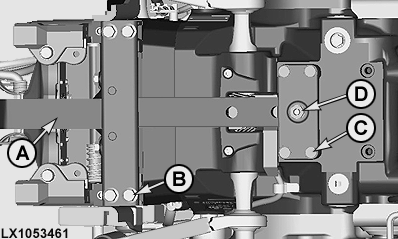
LX1053461-UN-28JAN13
CAT II Drawbar
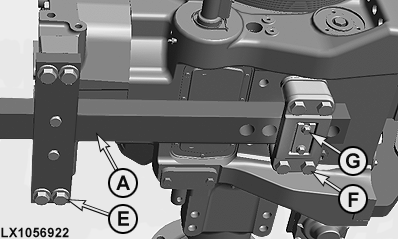
LX1056922-UN-15JAN14
CAT III Drawbar
A - Drawbar
B - Cap Screws (4 used), 340 Nm (250 lb-ft)
C - Cap Screws (4 used), 310 Nm (230 lb-ft)
D - Hex. Stopper (1 used), 310 Nm (230 lb.-ft.)
E - Cap Screws (4 used), 610 Nm (450 lb-ft)
F - Cap Screws (4 used), 610 Nm (450 lb-ft)
G - Cap Screws (2 used), 70 Nm (52 lb-ft)
The drawbar is used to pull drawn equipment of all types, particularly PTO-driven implements. The drawbar is located to increase the rear axle load and slightly reduce load on the front axle.
Besides having a variable swinging range, the drawbar can also be adjusted lengthwise. Maximum permissible static vertical loads and towable loads are stated in the Specifications section.
Depending on Category, drawbar (A) can be set to the following lengths:
|
CAT II .............. |
250 mm |
350 mm |
400 mm* |
|
9.8 in. |
13.8 in. |
15.7 in.* |
|
|
CAT III .............. |
350 mm |
400 mm |
500 mm |
|
13.8 in. |
15.7 in. |
19.7 in. |
|
|
* Not on tractors with AutoPowr™ or DirectDrive transmission |
|||
These lengths determine the distance from the end of the PTO shaft to the attachment point of the drawbar.
For adjustment, remove hexagonal stopper (D) or cap screws (G), and pull out pin. Push drawbar (A) and align the holes so that they are congruent. Then insert the pin, screw on hexagonal stopper (D) or cap screws (G), and tighten to the prescribed torque.
NOTE: Drawbar components that are subject to wear must be checked every 250 hours (see Service / Every 250 Hours). Replace them if necessary.
NOTE: Towing on public roads with the drawbar set to one side is not permitted!
|
OULXBER,0001A49-19-20140527 |