Adjusting Conditioner Roll Pressure (Roll Conditioner)
NOTE: Adjusting conditioner roll pressure is the same for steel and urethane rolls.
Optimum conditioning for legume-type crops, such as alfalfa and clover, occurs when 90 percent of the stems show some conditioning. Stems should be crimped with minimum leaf damage.
To check for correct conditioner roll pressure:
- Cut a pass through the field at normal ground speed with tractor engine operating at rated PTO rpm.
- Stop and check crop for conditioning effect. Stems should be crimped or slightly crushed. Healthy leaves should be intact on the stem and not smashed or bruised.
Overconditioning causes the leaves to dry faster and break off before stems are dry. Overconditioning also increases horsepower requirements and causes components to wear faster.
To adjust:
-
Lower machine down on blocks.
-
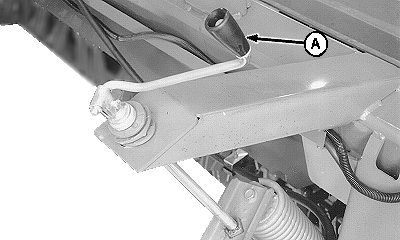
E41323-UN-25JAN97Right-Hand Side Shown
A - Crank
Remove crank (A) from storage position and turn handle counterclockwise to release float spring tension. -
NOTE: A total of eight positions are available to adjust roll pressure to desired setting.
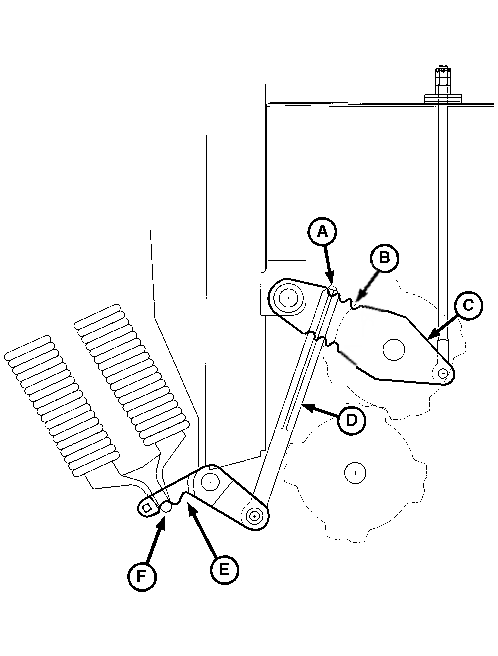
E55685-UN-25APR08Right-Hand Side Shown
A - Rear Notch
B - Front Notch
C - Roll Arm
D - Lever
E - Front Notch
F - Rear Notch
Lever can be put in any of the middle notches on roll arm to get finer adjustment of roll pressure. Moving lever to rear decreases roll pressure.- Left-Hand Side in notch 2 from rear.
- Right-Hand Side in notch 3 from rear.
Lever on left-hand should be one notch to the rear of lever on right-hand side to compensate for the torque reaction from the upper roll driveshaft on the left.
Roll Pressure—Arm-to-Lever Position
Roll Arm Notch Location
Float Spring Bell Crank Location
Roll Pressure Settings
A
E
Lowest
B
E
Medium (Low)
A
F
Medium (High)
B
F
Highest
-
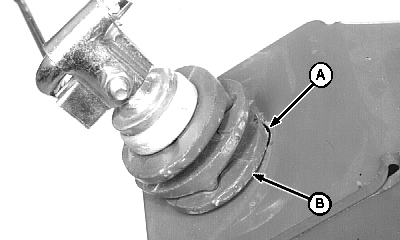
E41411-UN-08FEB97A - Slot
B - Rocker Plate
Turn float spring adjustment crank clockwise to increase float spring tension. Make sure tab on rocker plate (B) is inside slot (A) in frame. Remaining rocker plate tabs should alternate every 90 degrees and be seated in mating grooves.NOTE: Set the roll tension on the left side one notch lighter than the right side.
The left side has the reaction force from the drive to the conditioner that helps hold down the roll tension so less tension is needed on the springs.
-
Repeat procedure on opposite side of machine.
-
Raise platform and remove wooden blocks.
-
Adjust platform float. (See procedure in this section.)
|
OUO6085,000089E-19-20080925 |