Bale Short, Dry, Slick Crops
 CAUTION:
TS679-UN-28SEP89
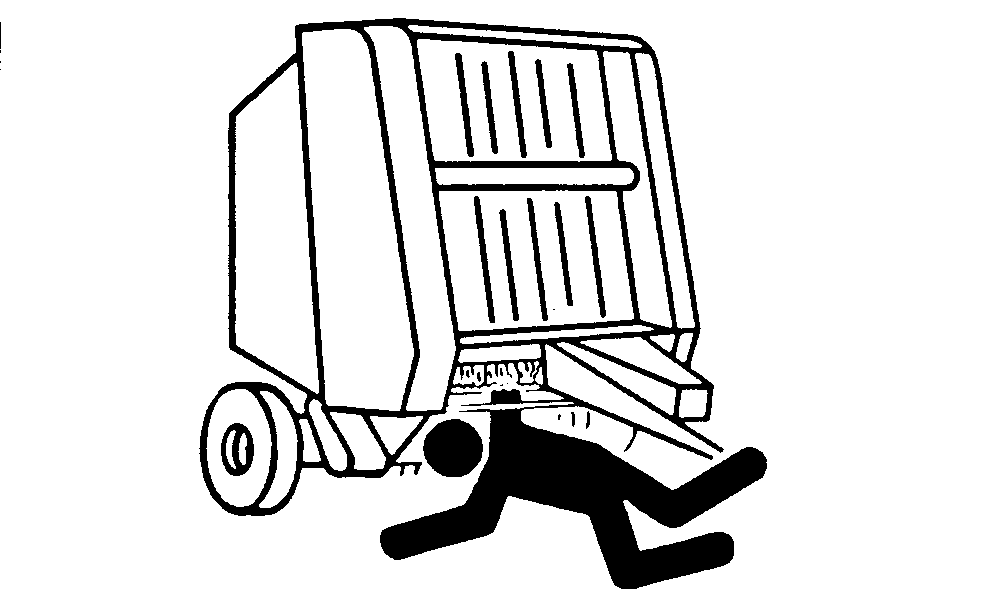
Do not attempt to feed crop or twine into baler or unplug feed area while baler is running. The baler feeds material faster than you can release it.
Disengage PTO and shut off engine.
To reduce plugging try one or more of the following techniques:
-
Regular Pickup: Check pickup belt tension and condition. (See ADJUST PICKUP BELT IDLER in Service—Baler section.)
MegaWide™ Plus Pickup: Check pickup slip clutch. (See CHECK PICKUP SLIP CLUTCH TORQUE in Service—Baler section.)
-
Check for missing or broken pickup teeth.
-
Raise pickup as high as practical.
-
Reduce engine speed to 1500 rpm or below (reduces chaffing) and shift transmission to higher gear to maintain ground speed.
-
If equipped with variable core valve, reduce bale density as necessary.
- Operating Baler with BaleTrak™ Pro System
See OPERATE VARIABLE CORE VALVE in one of the following sections:
-
Regular Pickup Only: Remove individual compressor rods, leaving one center rod and one rod on each end of the cross tube. If material still accumulates, remove compressor rack. Always replace compressor rack under normal conditions. (See REMOVE or INSTALL COMPRESSOR RACK in Service— Baler section.)
-
Make larger windrows (rake together as necessary), but keep windrows narrower than bale chamber width.
-
Disengage PTO anytime crop is not being fed into baler, such as turns and field borders.
-
Regular Pickup Only: In short, dry conditions, it can be necessary to lower the baler. (See WHEEL SPINDLE POSITIONS in Preparing the Baler section.)
-
Adjust pickup float springs to provide more force (float). (See ADJUST PICKUP FLOAT SPRINGS in Service—Baler section.)
-
When baling dry straw, it can be necessary to place twine across full width of bale or use net wrap (if equipped) to prevent straw from coming out of feed opening while tying. (See DRY STRAW TWINE WRAP PROGRAM [ADVANCED OPERATION INFORMATION] [CHANNEL 002] in this section.)
-
NOTE: Recommended Wraps
Bales stored with less than two wraps of net can be damaged by handling or weather conditions.
Different crops require a different number of wraps for effective baling.
Minimum recommendations are:
- 2 Wraps for Hay
- 3 Wraps for Straw, Wheat Hay, and Cereal Grains
- 4 Wraps for Corn Stalks, Sudex, Hay Grazer, and Milo Stalks
NOTE: If baler is equipped with slip clutch alert and it is turned on, net and twine wrapping is automatically adjusted as rpm is changed. Thus, no change is needed on the monitor.
If machine rpm is less than rated PTO speed, use the following charts as a guideline for desired wraps.
NET WRAP CHART
Engine rpm
Desired No. Of Wraps
Approximate Monitor Setting Needed
Rated PTO
2
2
3
3
1800 rpm
2
2.4
3
3.6
1500 rpm
2
2.9
3
4.3
1300 rpm
2
3.3
3
5.0
TWINE WRAP CHART
Engine rpm
Mechanical Setting
Monitor-Controller Setting
Rated Speed
10 cm (4.0 in.)
10 cm (4.0 in.)
1800 rpm
10 cm (4.0 in.)
9 cm (3.5 in.)
1500 rpm
10 cm (4.0 in.)
8 cm (3.0 in.)
1300 rpm
10 cm (4.0 in.)
6 cm (2.5 in.)
If bales fail to start rotating due to one or both sides of the windrow extending outside width of bale chamber, try the following suggestions:
- Make windrows narrower than bale chamber width, even with MegaWide™ Plus pickup.
- Center baler over windrow while starting, to avoid getting crop under the crop dividers.
|
PP98408,0000F18-19-20130320 |