Machine Break-In Service
|
HOURS |
ITEM |
CHECK |
|---|---|---|
|
Every 15 Minutes On Road Every Hour In Field |
Drive Wheel Nuts |
Torque: 300 Nm (220 lb. ft.) Repeat Checks Until Torque Stabilizes |
|
At 5 |
A/C Belt |
Tension |
|
Caster Wheel Nuts |
163 Nm (120 lb. ft.) |
|
|
Caster Wheel Anti-Shimmy Dampener Bolts |
Inboard Torque: 135 Nm (100 lb. ft.) Outboard Torque: 115 Nm (85 lb. ft.) |
|
|
Walking Beam Width Adjustment Bolts |
Torque: 448 Nm (330 lb. ft.) |
|
|
At 10 |
Walking Beam Width Adjustment Bolts |
Torque: 448 Nm (330 lb. ft.) |
|
Drive Wheel Nuts |
Torque: 300 Nm (220 lb. ft. Repeat Checks At 20 and 30 Hours |
|
|
Neutral |
Dealer Adjust |
|
|
At 50 |
Hose Clamps-Air Intake / Radiator / Heater / Hydraulic |
Hand Tighten - Visual Inspection Unless Otherwise Noted |
|
Walking Beam Width Adjustment Bolts |
Torque: 448 Nm (330 lb. ft.) |
|
|
Caster Wheel Anti-Shimmy Dampener Bolts |
Inboard Torque: 135 Nm (100 lb. ft.) Outboard Torque: 115 Nm (85 lb. ft.) |
|
|
Drive Wheel Nuts |
Torque: 300 Nm (220 lb. ft. Repeat Checks Until Torque Stabilizes |
|
|
Drive Wheel Lubricant |
Change |
|
|
Main Gear Box Oil |
||
|
Charge System Hydraulic Oil Filter |
||
|
Manifold Oil Filter |
||
|
Engine Oil |
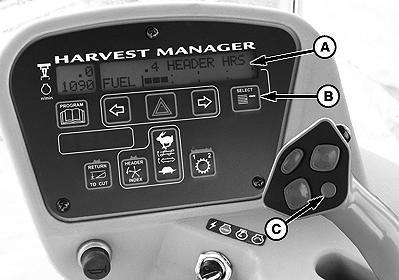
E65108-UN-20JUN12
A - CDM Display
B - CDM Display Selector Switch
C - GSL Display Selector Switch
The windrower is ready for normal operation. However, there are several items to check and watch out for during the first 150 hours..
Engine and platform hours are displayed on the CDM.
The engine is ready for normal operation. However, you should use special care during the first 50 hours of operation.
Watch the engine hours located on the CDM display screen to monitor service intervals.
During the first 20 hours avoid sustained maximum load operation.
-
Promote good ring seating and prevent cylinder wall glazing, put the engine to work as soon as possible. Avoid unnecessary idling. Turn off engine if windrower must be idled longer than 5 minutes.
-
Watch coolant temperature closely. View the display (A) and use switches (B or C) on the W110 to scroll to the engine temperature. View the gauge on the console of the W150 windrower. If temperature exceeds 110° C (230° F), slow ground speed to reduce load.
IMPORTANT: Normal engine operating temperature range is 82° - 107° C (180° - 225° F).
-
Monitor fuel frequently by using selector switches (B or C) on the W110 and scrolling to Fuel Level, as shown or view the gauge on the W150. Do not let fuel tank run dry.
IMPORTANT: Do not allow the fuel tank to run dry.
-
IMPORTANT: Check engine oil and coolant levels frequently. After starting the engine, do not accelerate or apply load until the engine oil pressure warning light is out. Turn off engine by idling at least 1—3 minutes before stopping engine. Refer to Fuel, Coolant and Lubricants section for types of fluids and oils to use.
This engine is factory-filled SAE 15W-40 API Class SJ/CH-4 oil. Operate the engine at heavy loads with minimal idling during the break-in period.
-
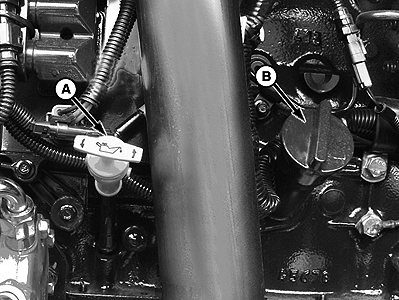
E63265-UN-18JUN12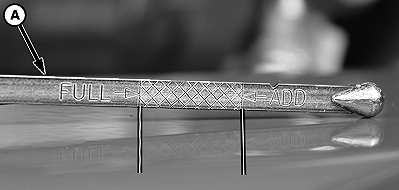
E65099-UN-20JUL12A - Engine Oil Dipstick
B - Engine Oil Fill Cap
Check engine oil level with dipstick (A) more frequently during engine break-in period.Keep engine oil between lines as shown in graphic. If necessary, add oil at (B).
-
After the first 50 hours (maximum), change engine oil and replace the oil filter.
-
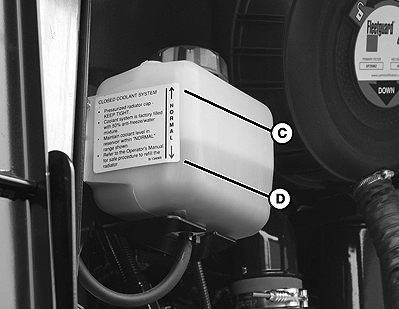
E65100-UN-18JUN12C - Coolant Tank High Mark
D - Coolant Tank Low Mark
Check coolant level in tank. Level must be in the NORMAL range (C) and (D). See instructional decal on both ends of the coolant tank. -
Follow fluid recommendations in Fuel, Coolant, and Lubricants section very closely.
-
Check hydraulic oil level in sight tube (E). Sight glass and hydraulic tank are found on the left cab-forward side.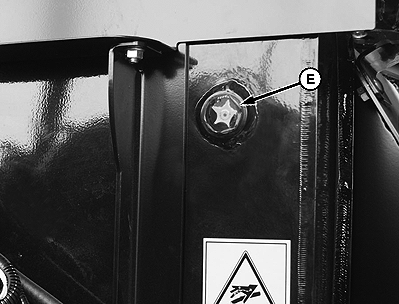
E65101-UN-18JUN12 -
Maintain hydraulic oil between LOW and FULL marks.
-
Follow fluid recommendations in Fuel, Coolant, and Lubricants section very closely.
|
OUO6043,0000203-19-20130130 |