Interpret Bale Shape Indicators
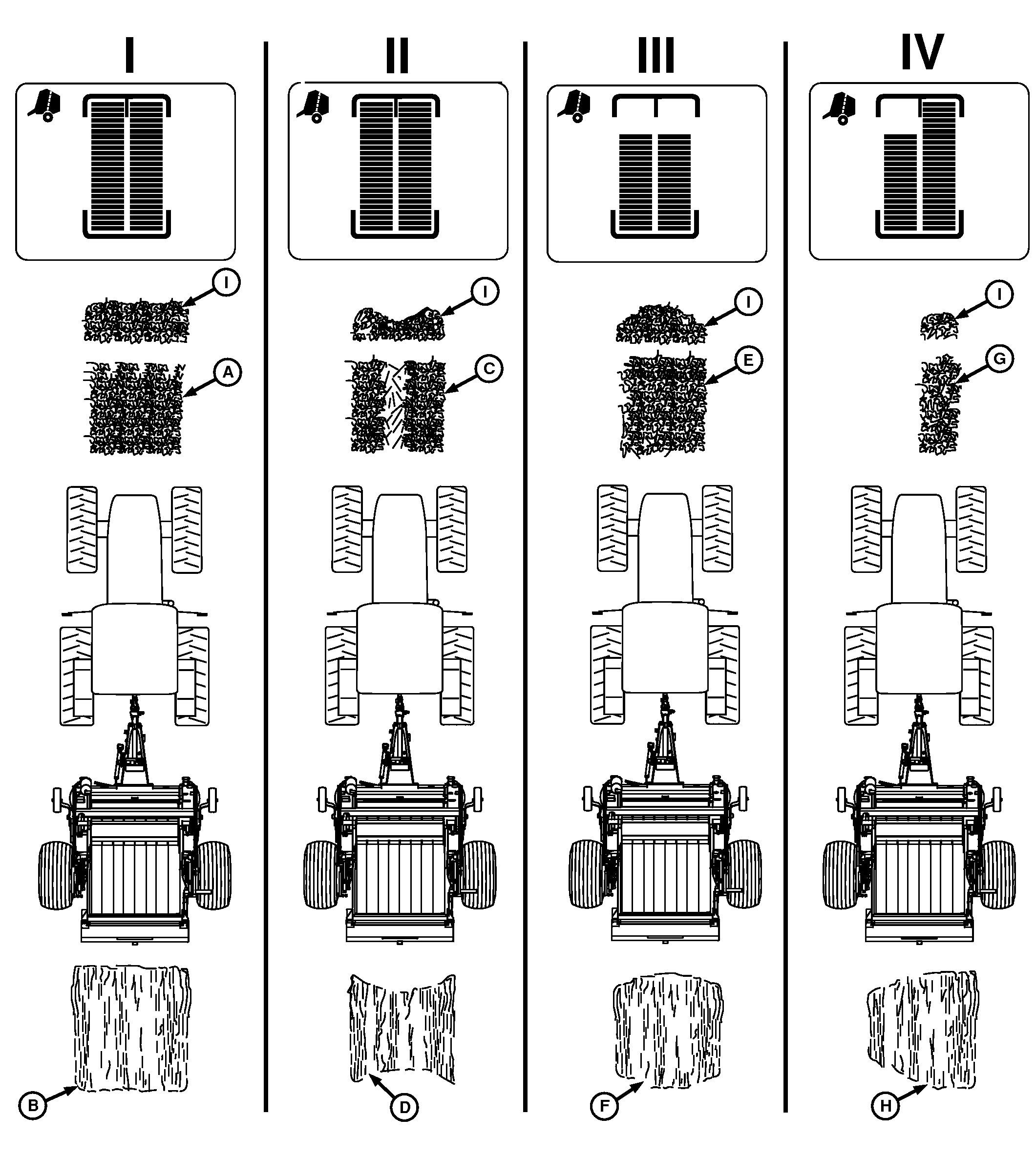
E82741-UN-07SEP17
A - Uniform Windrow
B - Best Shaped Bale
C - Full-Width Windrow
D - Hourglass-Shaped Bale
E - Less than Full-Width Windrow
F - Barrel-Shaped Bale
G - Narrow Windrow
H - Cone-Shaped Bale
I - Windrow Cross Section
The illustration on the facing page and the following information describes the relationship between the monitor-controller display, windrow variations, and actual bale shape.
To ensure optimum bale shape and maximum bale density, the top bar must be shown on BOTH sides of the bale shape indicator display as shown in Example I. The top bars must be displayed when bale is being wrapped. (See Recommended Baling Guidelines in this section.)
I— Best shaped bales (B) are formed when the windrow (A) has uniform density from side-to-side (I) and the width is the same as bale chamber.
Weaving is not necessary. Create windrows up to one-half the width of the bale chamber and follow the bale shape bars. (See Recommended Baling Guidelines in this section.)
II— If a full-width windrow (C) is heavy on the outside edges and light at the center, an hourglass-shaped bale (D) is formed even though bale shape bars are balanced and all lit. Hourglass-shaped bales can also be formed with wide windrows on balers equipped with the MegaWide™ Plus pickup.
If possible, weaving back and forth across windrow helps fill the middle of the bale. Otherwise, proper windrow formation is needed.
III— Bale shape bars do not reach maximum height and a barrel-shaped bale (F) is formed if any of the following conditions exist:
- Windrow width (E) is approximately 2/3—3/4 the width of the baler.
- Windrow width is correct but the operator is not weaving over far enough.
- The windrow is full width but density is heavier in the middle of the windrow.
- Baler is weaving back and forth too frequently.
If the windrow is almost as wide as the bale chamber, reduce the tractor engine rpm and increase ground speed to spread the material across the pickup.
The windrow width must be less than one-half the bale chamber width or the full bale chamber width. If necessary, rake windrows to obtain correct width.
Bale shape bars cannot reach maximum height when operating at reduced bale density or using the variable core option. This is also true when operating in certain crops such as light coastal Bermuda grass or short wheat straw, because the ends of the bale are soft.
IV— If a narrow windrow (G) is baled without weaving back and forth, a cone-shaped bale (H) is formed because more material is fed to one side.
To keep the bale shape bars as high as possible, weave back and forth across narrow windrows. (See Weave In The Windrow in this section.)
Bale shape sensitivity is adjustable between responsive and dampened. (See Set Bale Shape Sensitivity [Channel 011] in this section.)
|
MegaWide is a trademark of Deere & Company |
DP99999,0000D4D-19-20171109 |