Bale Cornstalks

TS679-UN-28SEP89
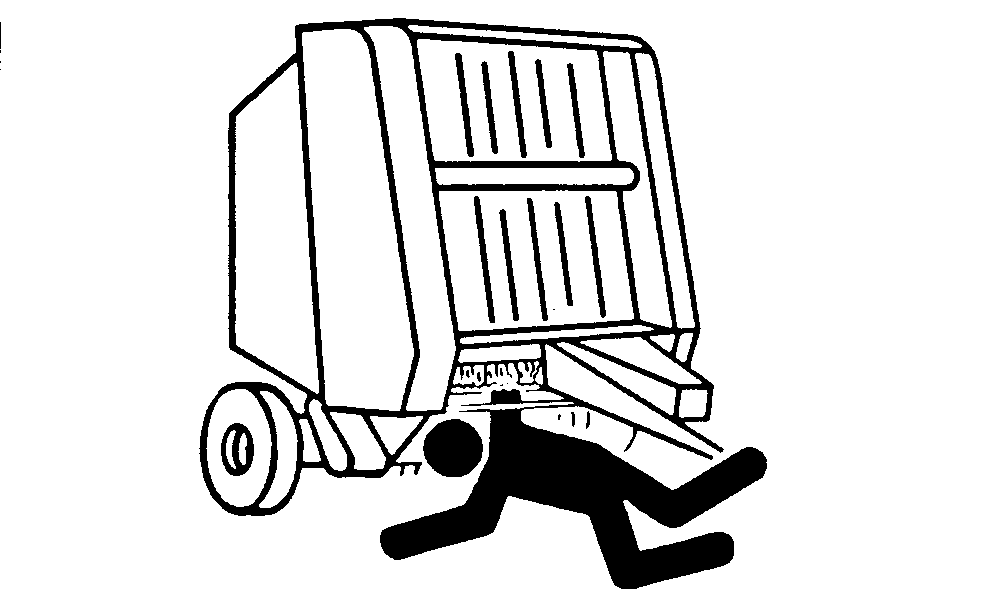
Do not attempt to feed crop or twine into baler or unplug feed area while the baler is running. The baler feeds material faster than you can release it.
Disengage PTO and shut off engine.
-
Cut or rake stalks before baling to improve pickup tooth life.
-
Do not rake more than six rows together or plugging can occur at the pickup area. Higher productivity can be obtained by baling smaller windrows at faster ground speeds. Avoid crowding the edges of the windrow and avoid windrows wider than the baler chamber to reduce plugging at the crop dividers.
- Since cornstalks tend to roll and spread out in front of the pickup, windrows 1/2—3/4 the width of the bale chamber usually do not require weaving, and reduce plugging at crop dividers.
- Windrows less than 1/2 the width of the bale chamber, and normal weaving allows one side of the pickup to clear as the other side is feeding.
- Let shredded cornstalk windrows sit overnight if possible. Windrows settle overnight gaining moisture which improves feeding and reduces wear on pickup components.
-
Maintain rated PTO speed for most cornstalk baling conditions, to facilitate a regular flow to the bale chamber.
-
If equipped, remove the starter roll scraper.
-
MegaWide™ Plus pickup only: Unhook both pickup baffle torsion springs allowing the compressor rack to hold the crop down on the pickup and facilitate regular crop flow.
-
Check for missing or broken teeth. Replace if necessary.
-
Regular pickup: Check pickup belt tension and condition. (See ADJUST PICKUP DRIVE BELT IDLER in Service—Baler section.)
MegaWide™ Plus pickup: Check pickup slip clutch. (See CHECK PICKUP SLIP CLUTCH TORQUE in Service—Baler section.)
-
Add extra compressor rods if cornstalks push up between existing rods and cause plugging.
-
Install the following kits to increase productivity even further:
- Cornstalk Feeding Enhancement Kit.
- Pickup Filler Plates for Cornstalks.
- Hydraulic Pickup Lift Kit.
-
Bales stored with fewer than two layers of net can be damaged by handling or weather conditions.
Add at least one additional layer of net wrap when baling using a precutter.
When applying net wrap material, different crops require a different number of net wrap layers for effective baling. The following number of layers of net wrap are recommended:
- 2 layers of net wrap for hay
- 3 layers of net wrap for straw, wheat hay, and cereal grains
- 4 layers of net wrap for corn stalks, sudex, hay grazer, and milo stalks
If the baler is equipped with the slip clutch alert feature and it is turned on, the system applies the desired number of layers of net wrap or twine, regardless of PTO speed. Thus, no change is needed on the monitor.
If machine rpm is less than rated PTO speed, use the following charts as a guideline for desired net wrap layers or twine spacing.
NET WRAP CHART
Engine rpm
Desired Number of Net Wrap Layers
Approximate Monitor Setting Needed
Rated PTO
2
2
3
3
1800 rpm
2
2.4
3
3.6
1500 rpm
2
2.9
3
4.3
1300 rpm
2
3.3
3
5.0
TWINE SPACING CHART
Engine rpm
Mechanical Setting
Monitor-Controller Setting
Rated Speed
10 cm (4.0 in)
10 cm (4.0 in)
1800 rpm
10 cm (4.0 in)
9 cm (3.5 in)
1500 rpm
10 cm (4.0 in)
8 cm (3.0 in)
1300 rpm
10 cm (4.0 in)
6 cm (2.5 in)
|
DP99999,0000DFE-19-20170920 |