Check Belt Tracking
Check belt tracking before making any belt tracking adjustments.
If belts are new and have not been used, apply granular oil absorbent (oil dry granules) to simulate crop dust and allow belts to track freely.
It is best to apply oil dry granules to belts on a sunny, dry day with the baler in a building or under shelter. If the baler is outside, be sure that belts and rolls are dry. Do not apply oil dry granules on belts that are damp with early morning dew.
-
 To avoid serious injury from entanglement, ensure that
bystanders stand clear when operating baler. Do not apply oil dry
granules with the baler running.
To avoid serious injury from entanglement, ensure that
bystanders stand clear when operating baler. Do not apply oil dry
granules with the baler running.Position gate as follows:
-
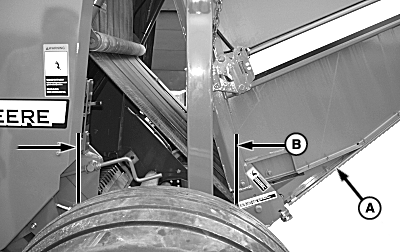
E55225-UN-01JUN07A - Gate
B - Distance, 0.6—0.9 m (2—3 ft)
With a tractor attached to the baler, open gate (A) fully. Then, lower the gate and allow it to remain open a distance (B) of 0.6—0.9 m (2—3 ft). -
Lock the gate and lower the tension arm until the belts are tight.
-
Shut off engine and remove ignition key.
-
-
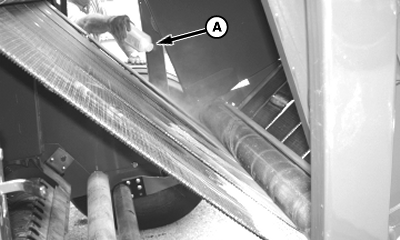
E82716-UN-26APR17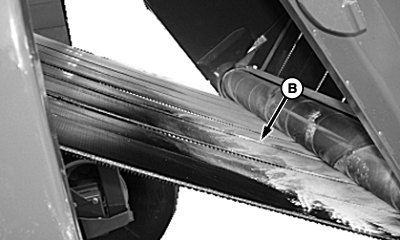
E82717-UN-26APR17A - Oil Dry Granules
B - Belts
Apply oil dry granules to the belts:-
Stand outside of the baler tire and liberally sprinkle oil dry granules (A) on all belts (B).
-
Start the tractor, engage the PTO, and rotate the belts approximately 2.4 m (8 ft). Disengage the PTO.
-
Shut off engine and remove ignition key.
-
Repeat steps until the complete length of all belts are thinly coated.
-
-
When removing oil dry granules from rolls, ensure that
the gate is properly supported, shut off the tractor engine, and remove
key.
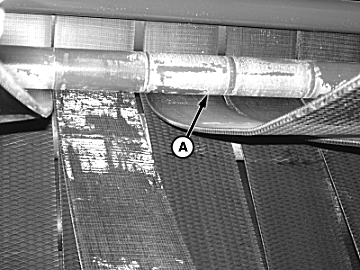
E85613-UN-21NOV17A - Oil Dry Granules on Rolls
If the belts are slightly damp, or humidity is high, oil dry granules can stick to the rolls (A). If the rolls are coated, remove oil dry granules from the rolls, then reapply fresh oil dry granules to the belts. -
If belts are new and have not been used, apply oil dry granules to simulate crop dust or the belts do not track properly on the rolls.
Remove any wrappage or buildup on the rolls.
-
Determine if the gate closes evenly using the following instructions:
-
Open the gate using tractor hydraulics.
-
Stop the tractor engine and remove the key.
-
To allow the gate to close freely, move the tractor SCV lever to the float position.
-
If both sides of the gate contact the main frame at the bottom, proceed to the next step.
-
If one side makes contact but the other side has a gap between the gate and frame, see your John Deere dealer or qualified service provider for proper procedure to straighten the gate.
Ensure that gate latches are adjusted correctly and latched. If not, belts do not track correctly when bale is being formed.
-
Adjust gate latches it necessary. (See Adjust Gate Latch Stop in this section.)
-
-
Park the baler on a level surface. With the baler empty and gate closed, engage the PTO and run at slow speed. Be sure that the gate is fully closed, and the pressure gauge is reading 10:00 or higher. Check belt tracking by observing belt positions relative to belt guides.
-
If adjusting is necessary, raise gate with the tractor selector control valve (SCV) until tension arm rotates, releasing belt tension. Lock gate.
Shut off engine and remove ignition key. Adjust rolls, if necessary. (See Adjust Belt Tracking in this section.)
|
DP99999,0000D26-19-20171121 |