Bale Long, Stiff, Cane-Type Crops

TS679-UN-28SEP89
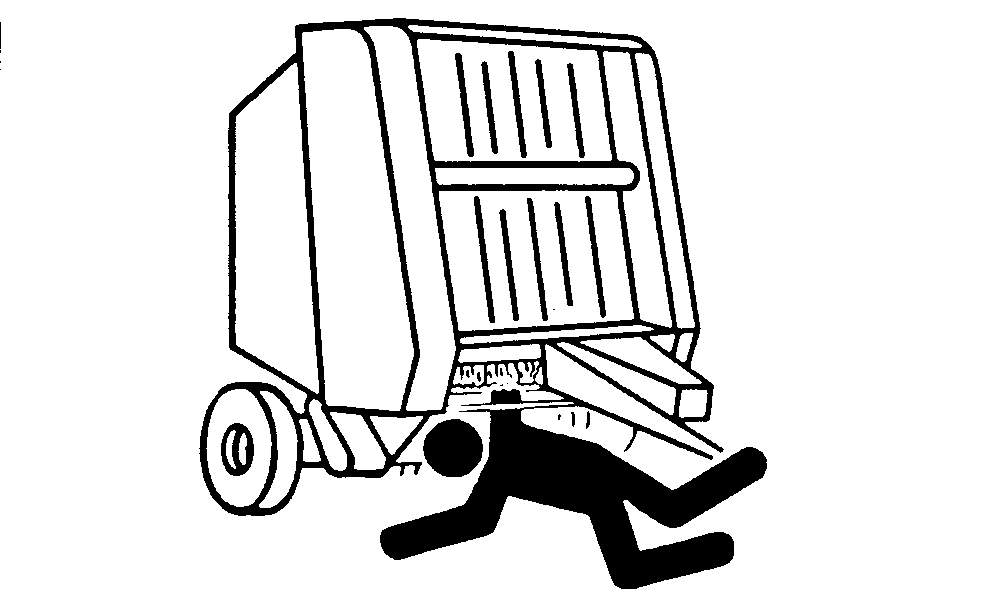
Do not attempt to feed crop or twine into baler or unplug feed area while the baler is running. The baler feeds material faster than you can release it.
Disengage PTO and shut off engine.
If bales fail to start rotating due to crop wedging into top of starting chamber, try the following suggestions:
-
Regular Pickup: Check pickup belt tension and condition. (See Adjust Pickup Belt Idler in Service—Baler section.)
MegaWide™ Plus Pickup: Check pickup slip clutch. (See Check Pickup Slip Clutch Torque in Service—Baler section.)
-
Condition crop as much as possible so stems bends and forms the bale core without wedging.
-
Make windrows narrower than bale chamber width.
-
Approach windrow with crop centered in the pickup.
- Avoid getting crop under crop dividers.
-
Approach windrow at an angle and immediately turn and drive forward.
- This allows the stems to bend and start the bale core.
- Avoid getting crop under crop dividers.
-
If equipped with hydraulic pickup lift, raise and lower pickup during bale starting at a reduced ground speed.
-
Travel forward at least 3 m (10 ft) without stopping to allow enough crop into the baler to start rolling.
-
To form a bale core with less belt tension, use the variable core feature, if equipped.
-
Surface moisture on the bottom of the windrow causes crop to slip more easily against forming belts. Turn windrows with a rake or tedder to improve bale starts.
-
Recommended Wraps
Bales stored with fewer than two wraps of net can be damaged by handling or weather conditions.
Different crops require a different number of wraps for effective baling.
Minimum recommendations are:
- 2 Wraps for Hay
- 3 Wraps for Straw, Wheat Hay, and Cereal Grains
- 4 Wraps for Corn Stalks, Sudex, Hay Grazer, and Milo Stalks
Reduce bale density or use variable (soft) core feature. (See Adjust Variable Core Diameter in this section.) Reduced belt tension allows belts to deflect and start the bale.
-
If the baler is equipped with the slip clutch alert and it is turned on, the net and twine application automatically adjusts as the rpm is changed. Thus, no change is needed on the monitor.
If machine rpm is less than rated PTO speed, use the following charts as a guideline for desired wraps.
NET WRAP CHART
Engine rpm
Desired No. Of Wraps
Approximate Monitor Setting Needed
Rated PTO
2
2
3
3
1800 rpm
2
2.4
3
3.6
1500 rpm
2
2.9
3
4.3
1300 rpm
2
3.3
3
5.0
TWINE WRAP CHART
Engine rpm
Mechanical Setting
Monitor-Controller Setting
Rated Speed
10 cm (4.0 in)
10 cm (4.0 in)
1800 rpm
10 cm (4.0 in)
9 cm (3.5 in)
1500 rpm
10 cm (4.0 in)
8 cm (3.0 in)
1300 rpm
10 cm (4.0 in)
6 cm (2.5 in)
|
MegaWide is a trademark of Deere & Company |
SF04007,0000F32-19-20170914 |