Adjust Net Wrap Stretch
-
Unroll 1 m (3 ft) of material from the roll of the net being used. Locate a starting point in the net and, with the net wrap pulled snug, measure between the 10 weaves as shown in the illustration. Divide the measurement by 10 to obtain the initial net measurement.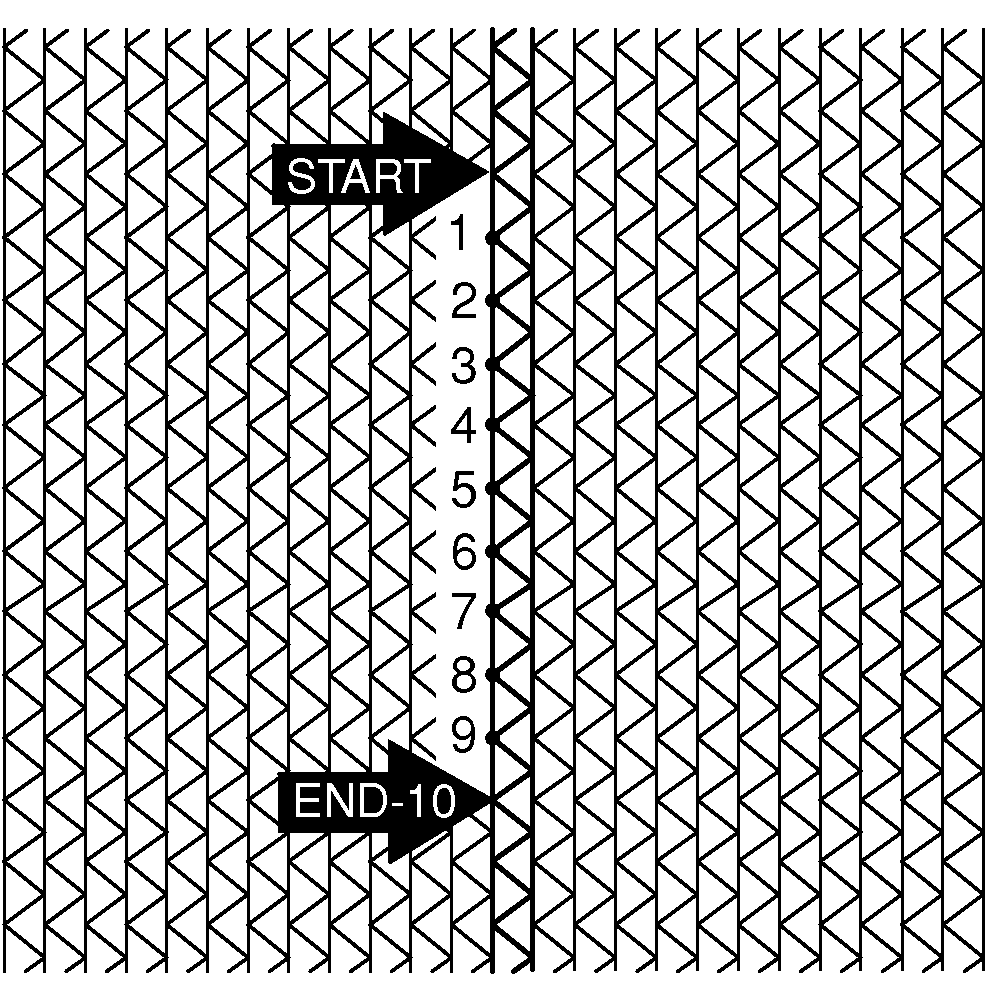
E51238-19-20FEB02 -
Thread net properly and make, wrap, and dump a bale
Make a uniform, cylindrical bale. (Do not try to measure the net stretch on a barrel-shaped, lumpy, or crooked bale). Measure stretch on the bale at a point where the net feels tightest.
-
Locate the end cut-off on the bale. Use the net directly under the cut-off as a starting point for measurement.
-
Take the measurement between 10 weaves as shown in illustration. Divide the measurement by 10 to obtain the net stretch value.
-
The net stretch value must be 3—4 mm (0.118—0.157 in) greater than the value measured in Step 1. If measurement is not within this range, proceed to Step 6.
-
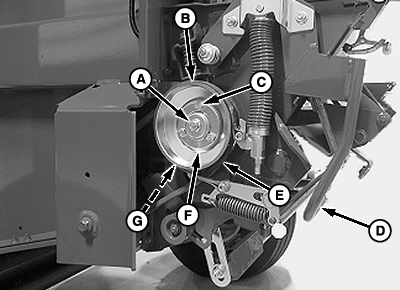
E83151-UN-23MAY17A - Cap Screw and Washer
B - Sheave
C - Cap Screw (3 used)
D - Lever
E - Belt
F - Shims (Stored)
G - Shims (In Use)
Put pressure on brake lever (D) while loosing three cap screws (C) and cap screw and washer (A). -
Release brake lever (D).
-
Remove cap screw and washer (A). Remove sheave (B) and belt (E).
-
Separate sheave (B) by removing three cap screws (C).
-
Balers are shipped from the factory with two shims (G) between sheave halves.
Transfer shims (G) to and from stored location (F) to meet the net stretch value of 3—4 mm (0.118—0.157 in) more than the value measured in step 1.
- Decreasing the number of shims (G) between sheave halves increases the distance (stretch).
- Increasing the number of shims (G) decreases the distance (stretch).
-
When changing shims, If necessary, readjust the v-belt idler. (See Check and Adjust Net Wrap V-Belt Idler Tension in this section).
-
When installing sheave (B), torque the cap screw (A) to specification.
Cap Screw Torque 80 N·m (60 lb·ft)
|
SF04007,0000F3C-19-20170913 |