Adjusting Brakes
-
Park machine safely. (See Parking Safely in Safety Section.)
-
Block front wheels securely, disengage MFWD and release park brake lock.
-
 CAUTION: Avoid injury! The machine can fall or slip from an
unsafe lifting device or supports.
CAUTION: Avoid injury! The machine can fall or slip from an
unsafe lifting device or supports.Use a safe lifting device rated for the load to be lifted.
Lower machine onto jack stands or other stable supports and block wheels before servicing.
Raise rear of machine and support on jack stands. Remove right rear wheel.
-
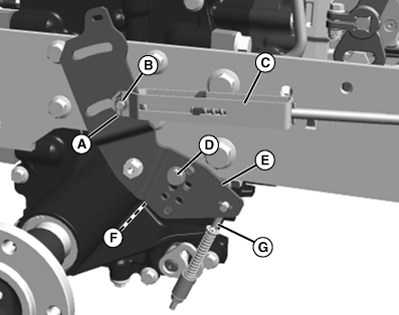
LVAL38358-UN-21AUG12Parts removed for better view.
A - Spring Retainer
B - Washer and Pin
C - Brake Rod Yoke
D - Bolt
E - Brake Bellcrank
F - Transmission Bellcrank
G - Differential Lock Rod Assembly
Remove spring retainer (A), washer and pin (B) from brake rod yoke (C). -
Remove bolt (D), two washers and nut connecting brake bellcrank (E) and transmission bellcrank (F) together.
-
NOTE: Keep both bellcranks together. Do not remove the differential lock rod assembly (G).
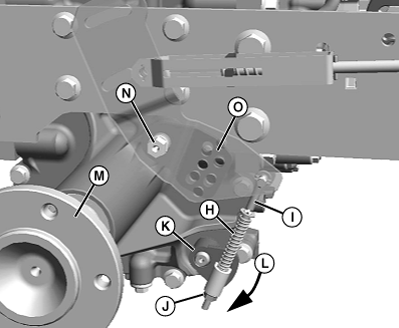
LVAL38359-UN-21AUG12H - Spring
I - Differential Lock Rod
J - Locknut
K - Differential Lock Bellcrank
L - Clockwise
M - Wheel Hub
N - Transmission Brake Input Shaft
O - Holes
Check the compressed length of the spring (H) on the differential lock rod (I). Adjust spring length to 65 mm (2.56 in.) with locknut (J) if required. -
Rotate the differential lock bellcrank (K) clockwise (L) to fully engage the differential lock.
-
NOTE: Turn the wheel hub (M) while rotating the bellcrank to ensure complete engagement. Depress and hold the differential lock control to maintain the engagement.
With the differential lock fully engaged, use a 17 mm socket on the transmission brake input shaft (N) to apply and hold 5—15 N•m (44—133 lb-in) of torque specification.
-
Locate the set of holes (O) with the best alignment in the brake and transmission bellcranks. Install the original hardware and tighten to 50 N•m (37 lb-ft).
-
Rotate the wheel hub to release the differential lock control and allow the differential lock bellcrank (K) to return to its original counter-clockwise disengaged position.
-
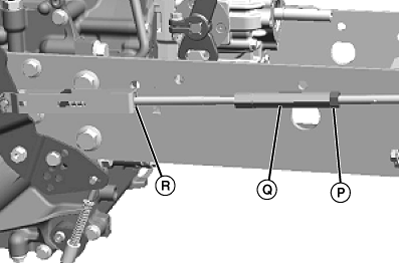
LVAL38360-UN-21AUG12P - Locknut
Q - Turnbuckle
R - Brake Rod Yoke
Loosen the brake rod turnbuckle locknut (P). Turn the turnbuckle (Q) several turns to increase the length of the brake rod. -
Align the brake rod yoke (C) with the single hole on the transmission bellcrank (E) and secure with the original pin, washer and spring retainer. The slotted hole in the bellcrank is only used for European models.
-
NOTE: When a wheel hub is slowly rotated and the differential lock is operated, a clicking sound will be heard or felt in the hub when the differential components begin to engage or disengage. The absence of this sound ensures the differential is completely engaged or disengaged.
Turn the turnbuckle (Q) as required to shorten the brake rod until the differential lock components just begin to engage and a clicking is heard (or felt in the hub) as the hub is rotated.
-
Turn the turnbuckle in the opposite direction just until the clicking is no longer heard (or felt in the hub) as the hub is rotated. Tighten the turnbuckle locknut (P) securely.
-
Rotate the hub to ensure it turns freely, without brake drag or partial differential lock engagement.
- If brake drag is noted, repeat steps 4 through 14.
- If partial differential lock engagement is noted, repeat steps 10 through 14.
-
Lock the park brake. The brake rod spring must not be completely compressed. It should be partially compressed and a specified gap exist between the brake rod yoke and the roll pin (R). If the gap is not 4—7 mm (0.16—0.28 in.), repeat steps 4 through 15.
-
Install rear wheel and tighten lug bolts to 120 N•m (89 lb-ft).
-
Lower machine and check operation of brakes and differential lock.
|
KN52281,1003F3D-19-20120823 |