Ballasting Machine
 CAUTION: Avoid injury! Ballasted machine can become unstable
when attachment is raised. Always drive slowly over uneven ground
and when turning with raised attachment.
CAUTION: Avoid injury! Ballasted machine can become unstable
when attachment is raised. Always drive slowly over uneven ground
and when turning with raised attachment.
IMPORTANT: Avoid damage! Do not overload tires. Do not exceed tire maximum inflation pressure or maximum load capacity.
Add weight to machine front end if needed for stability. Heavy pulling and heavy rear-mounted implements tend to lift front wheels. Add enough ballast to maintain steering control and prevent roll-over. Remove weight when it is no longer needed.
IMPORTANT: Avoid damage! Remove ballast from machine when no longer needed.
Implement Codes
Use the following tables to determine the number of front weights to use with John Deere implements. Implement code data can be found in the ballasting section of the implement operator’s manual.
Match the implement code from the implement manual with the codes for your machine and type of hitch. If the code falls between two numbers in the table, use the next higher number for the number of front weights to use with that implement.
These codes are for ideal conditions. Actual field conditions can require additional ballast. Some John Deere implements require using a certain number of front weights rather than giving implement codes.
NOTE: Maximum allowable ballasted weight is 4000 kg (8820 lb.)
|
Ballast Code |
Open Station Tractor No. of 20 kg (42 lb) |
Cab Station Tractor No. of 20 kg (42 lb) |
Open Station Tractor No. of 32 kg (70 lb) |
Cab Station Tractor No. of 32 kg (70 lb) |
|---|---|---|---|---|
|
10 |
0 |
0 |
0 |
0 |
|
15 |
0 |
0 |
0 |
0 |
|
20 |
0 |
0 |
0 |
0 |
|
25 |
0 |
0 |
0 |
0 |
|
30 |
0 |
0 |
0 |
0 |
|
35 |
0 |
0 |
0 |
0 |
|
40 |
1 |
0 |
1 |
0 |
|
45 |
3 |
1 |
2 |
1 |
|
50 |
4 |
3 |
3 |
2 |
|
55 |
6 |
5 |
4 |
3 |
|
60 |
8 |
7 |
5 |
4 |
|
65 |
10 |
9 |
6 |
5 |
|
70 |
12 |
10 |
7 |
6 |
|
75 |
N/A |
12 |
8 |
7 |
|
80 |
N/A |
N/A |
9 |
11 |
Tire Capacities
IMPORTANT: Avoid damage! Do not overload tires. Do not exceed tire maximum inflation pressure or maximum load capacity.
If necessary ballast exceeds tire load capacity, reduce load or install other tires.
Recommended operating pressures for Golf tires are 6 psi rear and 8 psi front. Operate at reduced loads. If MFWD is engaged with tires at maximum air pressure, front axle damage may result.
See tire maximum inflation pressure and maximum load capacities in the Specifications section.
Verify maximum tire inflation pressure and maximum load information if embossed into the tire side wall.
Using Optional Rear Cast Iron Wheel Weights
IMPORTANT: Avoid damage! Do not overload tires. Do not exceed tire maximum inflation pressure or maximum load capacity.
CAUTION: Avoid injury! Machine component or attachment is heavy.
Use a safe lifting device or get an assistant to help lift, install,
or remove component or attachment.
-
Mount rear wheels in the wide position for improved stability.
-
Fasten weight to each rear wheel using a safe lifting device. A total of three weights per wheel can be used. See your implement operator’s manual for installation and number of weights to use.
Using Optional Rear Ballast Box
CAUTION: Avoid injury! To improve front loader-machine stability,
use of ballast box is recommended. Use ballast as recommended in loader
operator’s manual.
IMPORTANT: Avoid damage! Do not overload tires. Do not exceed tire maximum inflation pressure or maximum load capacity.
The rear ballast box is used for carrying ballast on the 3-point hitch. Approximate weight of different materials is given in the implement operator’s manual.
Using Liquid Weight in Tires
CAUTION: Avoid injury! Installing liquid ballast requires special
equipment and training. Injury can occur from exploding tire. Have
the job done by your John Deere dealer or a tire service store.
IMPORTANT: Avoid damage! Cover rim completely with solution to avoid corrosion, but never more than 90% full. More solution would leave too little air space to absorb shocks. Damage to tire could occur.
NOTE: Use of alcohol as ballast is not recommended. Calcium chloride solution is heavier and more economical.
A solution of water and calcium chloride provides safe economical ballast, and prevents freezing. If used properly, it will not damage tires, tubes, or rims.
A mixture of 0.4 kg of calcium chloride per liter of water (3.5 lb./gal.), prevents freezing solid above —45°C (—50°F).
Fill tubeless tires at least to valve stem level (minimum 75% full). Less solution would expose part of rim, possibly causing corrosion.
Tube-type tires can be filled to any level below 90%.
Optional Front Weights and Front Weight Bracket Extension
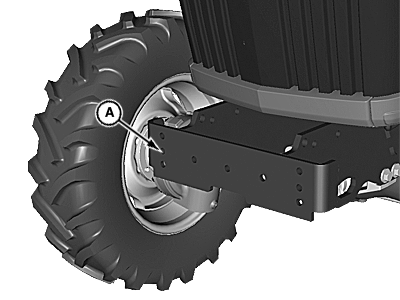
LV18602-UN-06AUG13
A - Front Weight Bracket
IMPORTANT: Avoid damage! Do not install weights on front bumper plate. Damage to the front grille can occur. Use optional bolt-on weight bracket for front weights.
Quik-Tatch™ weights and attaching hardware are available at your John Deere dealer. Each weight is 19 kg (42 lb.) or 32 kg (70 lb.).
See your implement operator’s manual for installation and required number of weights to use.
An optional front weight bracket extension kit (A) is available at your John Deere dealer. This optional front weight bracket extension kit holds up to ten Quik-Tatch weights.
|
Quik-Tatch is a trademark of Deere & Company |
KN52281,100486C-19-20131122 |