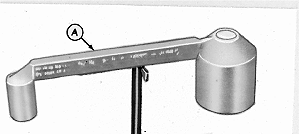
Using Density Meter and Seed ChartsNOTE: Rates are determined by adjusting seed index to settings shown on rate charts in this section. 1. Rates on seed charts are based on a standard density of seed being used. Use density meter (A) to find actual seed density so seeding rate can be more accurately chosen from rate charts. 2. Fill meter bucket with material, tap lightly, level material across top, balance on knife edge and take reading. 3. If actual density differs from standard density (found on "Standard Density Chart", use the following formula to calculate a conversion factor that will be applied to desired seeding rate: STANDARD DENSITY (from density chart) ÷ ACTUAL DENSITY (from density meter) = CONVERSION FACTOR 4. Multiply desired seeding rate by conversion factor, find new value on rate chart and adjust seed index to match this new rate.
EXAMPLE: Using 15 cm (6-in.) Rate Chart: |
|
|||||||||||||||||||||||||||||||||||||||||||||||||||||||||||||
OUO6074,0000497 -19-13DEC01-1/2 |
Calculating conversion factor using formula: 774 kg/m 3 ÷ 721 kg/m 3 = 1.07 (48.2 lb/ft 3 ) ÷ (45 lb/ft 3 ) = 1.07 Multiplying desired seeding rate by conversion factor: 90 kg/hectare x 1.07 = 96.3 kg/hectare (81 lb/acre) x 1.07 = (87 lb/acre) Locating closest value to 90 kg/hectare (87 lb/acre) on 15 cm (6 in.) rate chart indicates a meter setting of 16. For further accuracy, see CHECKING QUANTITIES DRILLED in Operating The Machine section. |
OUO6074,0000497 -19-13DEC01-2/2 |