|
NOTE:
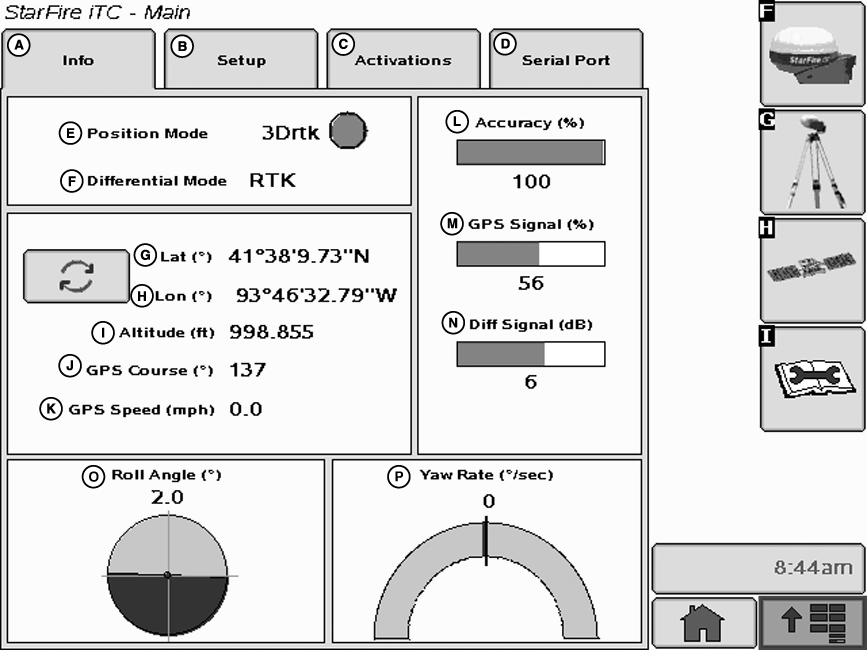
TOGGLE button allows operator to change the way latitude and longitude are displayed from degrees/minutes/seconds to decimal degrees.
-
Altitude: displays height of receiver, measured from top of dome, in feet (meters) above sea level.
-
GPS course: Displays direction of travel, in degrees relative to true north (zero degrees) as measured by receiver. Angle is measured in clockwise direction.
NOTE:
Course and speed normally show small speeds and various courses even when machine is not moving.
-
GPS speed: displays ground speed of machine in miles per hour (kilometer per hour) as measured by receiver.
-
GPS Accuracy Indicator (GPS AI): GPS AI gives indication of GPS position accuracy achieved by receiver, and is displayed as a percentage (0-100%)
When receiver is initially powered, GPS AI will display 0%. As receiver acquires satellites and calculates a position, GPS AI will increase as accuracy improves. Acceptable guidance performance for Parallel Tracking and AutoTrac is achieved when GPS AI displays 80% or greater. This may take up to 20 minutes. GPS accuracy is affected by many factors. If 80% accuracy or greater is not achieved within 25 minutes, consider the following possibilities:
-
Unobstructed view of sky › trees, buildings, or other structures may block receiver from receiver signals from all available satellites.
|
-
L1/L2 signal to noise ratio (SNR) › radio interference from 2-way radios or other sources may cause low SNR (check satellite button › Graph)
-
Satellite position in sky › poor GPS satellite geometry can reduce accuracy (check satellite button › SkyPlot)
-
Number of satellites above elevation mask › this is the total number of GPS satellites available to receiver that are above 7 degrees elevation mask (check satellite button › SkyPlot).
-
Number of satellites in solution › this is total number of satellites that are being used by receiver to calculate a position (check satellite button› SkyPlot).
-
GPS Signal Quality: Displays quality of signals being received from constellation of GPS satellites.
-
Differential Signal Quality: Displays quality of differential correction signal being received by receiver.
-
TCM (Terrain Compensation Module):
-
Roll Angle: Is both a graphical and numerical representation of amount of roll TCM is measuring, relative to calibrated zero degree reference. A positive roll angle means vehicle is rolled to right (depicts what horizon would look like from cab).
-
Yaw Rate: This gives a graphic representation and a numeric figure for amount of rotation TCM is measuring. Positive yaw rate means vehicle is turning to right.
|