CANBUS Theory of Operation
PC16933-UN-13MAY13
Tractor CANBUS
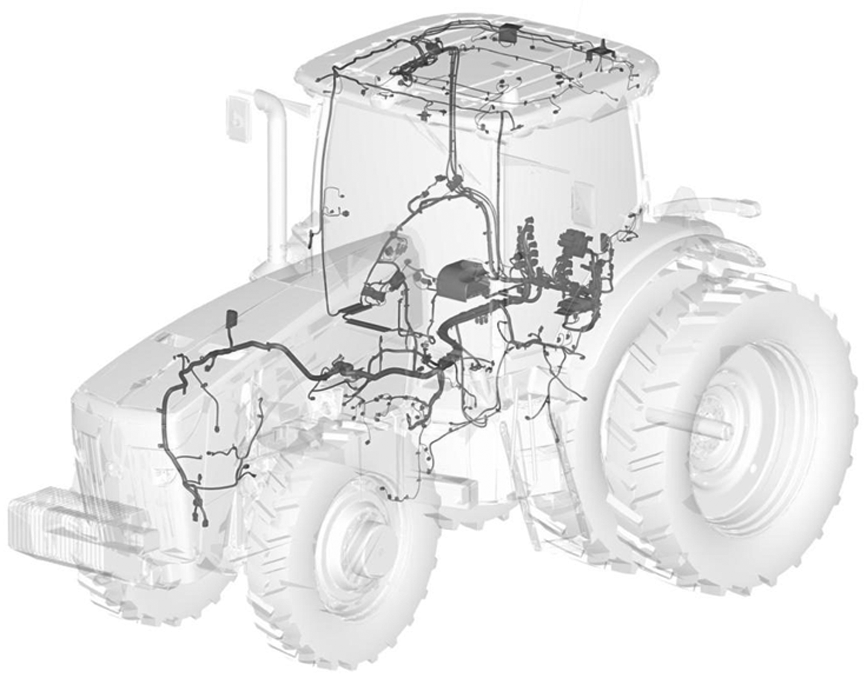
The CANBUS (Controller Area Network) system is a vital component to the operation of AMS equipment. CANBUS is a harness that runs from the front of the machine to the rear. All controllers on the machine communicate with each other using the CANBUS system. Think of this as the Interstate Highway system with cars constantly moving up and down the system.

PC16930-UN-10MAY13
CANBUS Overview
A - Controller 1
B - Controller 2
C - Controller 3
D - Branch Line
E - Passive Terminator
F - Main Line
G - Active Terminator
H - Keyed power supply from machine
A sample CANBUS system is shown. In this system, there is an active terminator, a passive terminator and 3 controllers.
The active terminator has 6 wires (2 reds, 2 blacks, a yellow and a green).
- One red wire and one black wire are a power and ground Input from the machine. These are the power supply for the CANBUS.
-
The other four wires are the twisted quad CANBUS wires. They
are what transfer and protect the data between controllers.
- The red and black wires are power and ground to provide magnetic shielding of the CAN high and CAN low wires (green and yellow).
- The green and yellow wires are CAN Hi and CAN Lo. They are the two wires that carry the messages between the controllers.
PC16934-UN-13MAY13
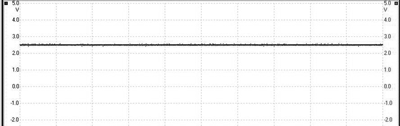
No messages on CANBUS
PC16935-UN-13MAY13
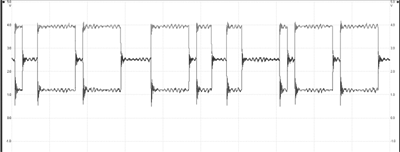
Messages sent on CANBUS
CAN High and CAN Low wires transmit data, or messages, on BUS using binary code. (0 means Power On and 1 means Power off. Voltage of both CAN Hi and CAN Low is 2.5V if there are no messages on the BUS.
If a message is sent, CAN High increases 1 V and CAN Low decreases by 1 V during the time the bit is sent.
Each controller has 2 CANBUS wires going into it.
- These are the green and yellow wires (CAN Hi and CAN Lo). Only the green and yellow wires carry the messages.
- The red and black wires go up to the controller but do not go into the controller. These wires provide magnetic shielding up to the controller in the branch.
The Main Line of the CANBUS is the four wires going from the active terminator to the passive terminator. Think of this like the main Interstate.
The Branch Lines of the CANBUS are the wires coming off the Main line and going to each controller. Think of this like an exit ramp off the Interstate.
PC16932-UN-10MAY13
Twisted Quad Cable
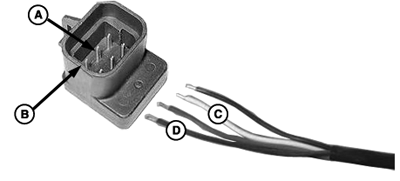
A - Pin E goes to Yellow Wire (C)
B - Pin F goes to Green Wire (D)
C - Yellow Wire goes to Pin E (A)
D - Green Wire goes to Pin F (B)
Twisted Quad Cable
The twisted quad CANBUS wire has 4 wires twisted together inside a black heat shrink. It is a non-shielded wire. Instead of having a physical shield, the CANBUS uses a magnetic shield. The red wire is a 12 volt wire that sends current from one end of the CANBUS (the Active Terminator) to the other end of the CANBUS (the Passive Terminator). Since all 4 wires are twisted together, the red wire’s magnetic field has good coverage over the other three wires. This magnetic field makes it hard for outside magnetic forces to penetrate the CANBUS and appear as bogus or “garbage” messages.
NOTE: Shielding is used to keep electrical current from passing between two wires laying side by side but not physically touching. This is known as electromagnetic induction (EMI).
The Yellow wire is CAN Hi (think of the color of the sun high in the sky) and plugs into Pin E on the terminator. The Green wire is CAN Lo (think of the color of the grass that is low) and plugs into Pin F on the terminator. Resistance between these two pins is approximately 120 Ohms. Since there are two terminating resistors on the CANBUS, the resistance between the yellow and green wire should be 60 Ohms on a working system.
Active Terminator
The Active Terminator is where the CANBUS starts. It contains six wires and feeds the CANBUS system from battery power. It makes sure CAN Power is always 12V. The Active Terminator is responsible for the following actions:
- Powering up the CANBUS (Sending current out to the red wire to provide the magnetic shield and to power up the passive terminator).
- Regulating voltages in the CAN Hi and CAN Lo wires
- Terminating messages.
NOTE: The Active Terminator must be in the system for the CANBUS to work. However, the CANBUS can operate without a Passive terminator. Both the active and passive terminator have the same part number. Because of this, they are swappable and are great for diagnostics. If you think you have a failed terminator, you can remove one or swap them and see if that fixes the problem.
Passive Terminator
The Passive Terminator is at the very end of the CANBUS. It must be the last node on the opposite end as the Active Terminator on the CANBUS. The Passive Terminator is responsible for:
- Regulating voltages in the CAN Hi and CAN Lo wires
- Terminating messages
NOTE: The Active Terminator must be in the system for the CANBUS to work. However, the CANBUS can operate without a Passive terminator. Both the active and passive terminator have the same part number. Because of this, they are swappable and are great for diagnostics. If you think you have a failed terminator, you can remove one or swap them and see if that fixes the problem.
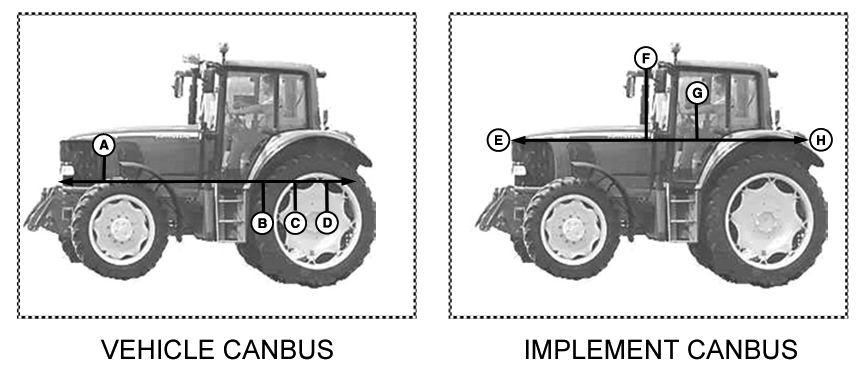
PC16936-UN-14MAY13
Vehicle CANBUS vs Implement CANBUS on a Tractor
A - Engine
B - SCV’s
C - Transmission
D - Hitch
E - Passive Terminator
F - GPS
G - Virtual Terminal
H - IBBC (Active Terminator)
Vehicle CANBUS vs. Implement CANBUS on a Tractor
A vehicle CANBUS on a tractor connects the engine in the front of the tractor with the transmission and hydraulics in the rear of the tractor and enables communication between them. An Implement CANBUS on a tractor would connect the GPS receiver, the display (VT), and the ISO connector (IBBC) in the rear of the tractor.
NOTE: The Implement CANBUS on a tractor is commonly referred to as the ISOBUS.
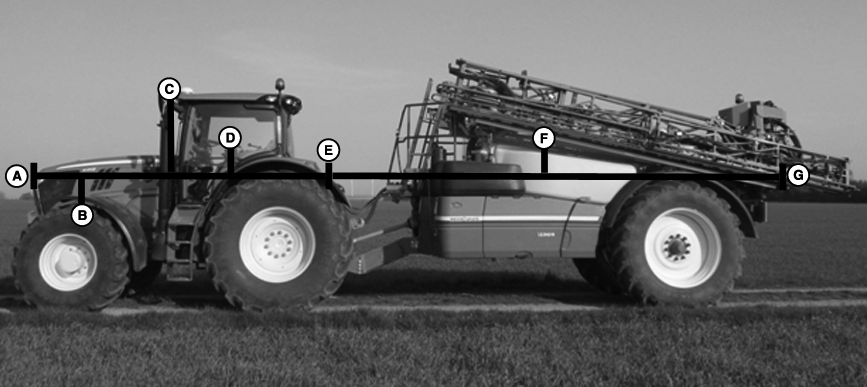
PC16941-UN-15MAY13
Extension of CANBUS to Implement
A - Passive Terminator
B - TECU
C - GPS
D - Virtual Terminal
E - ISOBUS Plug-in
F - Sensor
G - Active Terminator
Extension of the CANBUS to an attached Implement
The ISOBUS can extend the tractor implement CANBUS to the implement attached. This extension results in the implement and tractor communicating over the same CANBUS system.
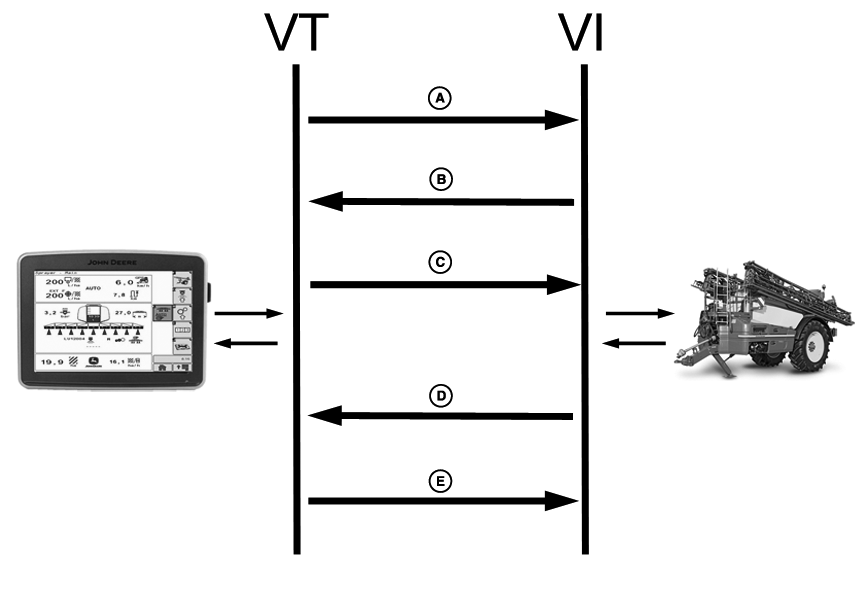
PC16937-UN-14MAY13
Communication on the CANBUS
A - I am a display. Is there an implement attached?
B - Yes I am a pull behind sprayer. I have five sections that can turn on or off.
C - I can display those five sections to the operator and utilize Section Control to determine when to turn each section on and off. We have now entered a field that hasn’t been sprayed and the five sections need to be opened.
D - I have opened all five of my sections and I have started spraying my chemical.
E - We are approaching a waterway and we need to turn off sections 4 and 5 but leave sections 1, 2 and 3 open to spray.
Communication on the CANBUS
The tractor and implement are able to communicate back and forth by messages transmitted on the CANBUS. Messages would include loading the graphic user interface, such as section control commands, to the 2630 display. Another message from the implement communicated to the display would be application rates from a pull behind sprayer.
An example would be a pull behind sprayer hooked up to a tractor. The conversation would be as follows:
- (A) - I am a display. Is there an implement attached?
- (B) - Yes I am a pull behind sprayer. I have five sections that can turn on or off.
- (C) - I can display those five sections to the operator and utilize Section Control to determine when to turn each section on and off. We have now entered a field that hasn’t been sprayed and the five sections need to be opened.
- (D) - I have opened all five of my sections and I have started spraying my chemical.
- (E) - We are approaching a waterway and we need to turn off sections 4 and 5 but leave sections 1, 2 and 3 open to spray.
|
RW00482,000018D-19-20130516 |