TCM Calibration
PC8278-UN-22JUN04
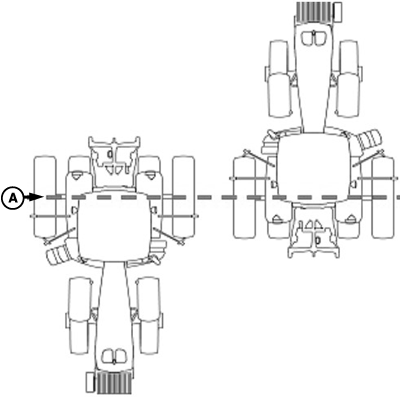
Floating Front Axle Vehicles
PC8277-UN-01MAY06
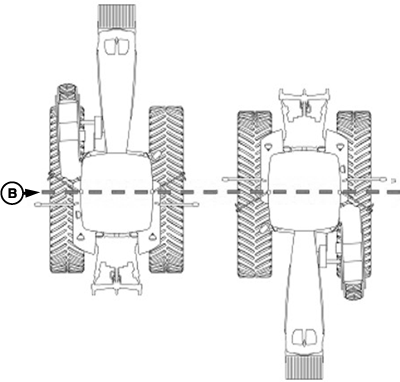
Fixed-Axis Wheels Or Tracks Vehicles
A - Rear Axle
B - Vehicle Pivot Point
TCM can be toggled ON or OFF by selecting TOGGLE button. When TCM is turned off, StarFire GPS message is not corrected for vehicle dynamics or side slopes. TCM defaults to ON when cycling power.
NOTE: TCM must be turned on for AutoTrac to activate.
TCM must be calibrated so receiver can determine zero degree roll angle and pitch angle.
NOTE: Calibrate receiver when it is attached or reattached to machine. Receiver does not require recalibration until removed from machine and reattached.
Positioning Machine during Calibration
IMPORTANT: When calibrating, it is important that TCM is at same angle when facing either direction. If roll angle is positive 2 degrees when facing one direction, place vehicle negative 2 degrees when facing opposite direction. To position TCM at same angle it is important when turning vehicle around and facing other direction that tires are placed in correct location. Once vehicle is parked on a hard flat surface, note location of tires on ground. When turning around use following instructions:
- Floating Front Axle Vehicles (MFWD, ILS, TLS)—put rear axle/wheels in same location when performing 2 point calibration. See previousdiagram for Floating Front Axle Vehicles.
- Fixed-Axis Wheels Or Tracks Vehicles (Track Tractors, 47X0 and 49X0 Series Sprayers, 9000, And 9020 Series Wheel Tractors)—Place all in same location when facing either direction. See diagram for Fixed-Axis Wheels Or Tracks Vehicles.
Calibration Surface
IMPORTANT:
PC8279-UN-16JUL04
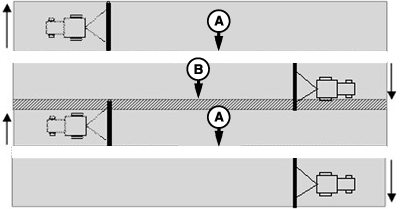
A - Skip
B - Overlap
Vehicle must be on a hard, flat level surface for calibration. If TCM is not calibrated on a level surface or TCM mounting angle is not level in relation to vehicle angle (StarFire mounting bracket or vehicle cab being slightly offset, uneven tire pressures from one side to other, etc.), an offset is created during operation. This offset could look like a consistent skip (A) or overlap (B) in pass-to-pass operation. To eliminate offset, re-calibrate on a level surface, drive down a pass, turn around, and drive down same pass in opposite direction. If vehicle does not follow same pass, measure offset distance and enter in implement offset. After initial calibration of TCM, it is not necessary to calibrate again unless TCM angle in relation to vehicle has changed. For example, tire pressure has been lowered on one side of vehicle causing vehicle angle in relation to ground to change.
Calibration Procedure:
- Press CALIBRATION button.
- Park vehicle on a hard, level surface and come to a complete stop (cab is not rocking).
- Press ENTER button.
- Calibrating Status bar appears.
- Turn vehicle 180 degrees to face opposite direction. Ensure that tires are in proper location for fixed or floating front axle and vehicle has come to a complete stop (cab is not rocking).
- Press ENTER CALIBRATION button.
- Calibrating Status bar appears.
- A calibration value is displayed upon completion. 0 degree calibration value is the difference between factory calibration value and actual calibration value just determined.
- Press ENTER button to return to SETUP tab.
|
TCM Calibration Failure Alert Screens |
|
|---|---|
|
Error description |
Cause |
|
Vehicle motion unkown. |
TCM could not detect vehicle speed. |
|
Results out of range: check vehicle position and bracket alignment. |
Roll and/or pitch values exceed limits. Vehicle is on too severe a slope or SF mounting bracket is not properly aligned. |
|
Vehicle motion detected. |
Vehicle motion exceeded limits during calibration. |
|
User defined. |
Invalid values entered through display. |
|
DK01672,000019E-19-20110926 |