Theory of Operation
Machine Communication Radio Theory of Operation
The Machine Communication Radio (MCR) is a 2.4 GHz wireless network radio that acts as a wireless router to enable direct data exchange between machines in a single network. A network is established by radios that have a direct line-of-sight to repeat data to other radios on the same frequency channel up to a 3 mile radius for the high power radio. The data transmitted between radios communicates speed, position, and heading of machines in the network. This information is sent to each display via Ethernet communication which the 2630, with Machine Sync activation, processes along with any additional Machine Sync-related information that is coming from the machine controllers. This network allows the sharing of logistics information and facilitates on-the-go unloading.
The filter kit included in the installation kit eliminates interference caused by other high power wireless devices, such as business band radios.
Line-of-Sight Notes
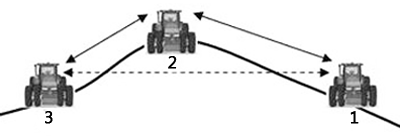
The MCR is a line-of-sight system. Any obstructions, such as trees, hills, or parts of the machine, that block antennas from having direct line-of-sight decrease the system’s range. Visual line-of-sight between machines does not define the radio’s line-of-sight. For example, although two machines may physically see each other, their antennas may not have clear line-of-sight due to rolling terrain, causing poor or no network connectivity.
PC16375-UN-11DEC12
MCR Mesh Network
Multiple MCRs create a mesh network where each radio serves as a repeater for other radios. Information transmits along a path from radio to radio until the destination is reached. When line-of-sight is unavailable between the two radios trying to communicate, additional radios that do have line-of-sight with the original radios trying to communicate can allow the information to be passed. The graphic illustrates this concept. Tractor 1 is trying to communication with tractor 3, but a hill is obstructing line-of-sight. Tractor 2’s antenna has line-of-sight with both tractors 1 and 3; therefore, tractor 2 acts as a rrepeater, and allows the information to be communicated between tractors 1 and 3.As a result, the network reliability has the potential to be improved when more radios are in the network as there is often more than one path between the source and destination. This is helpful for populating and updating the logistics map.
|
RW00482,000015E-19-20130424 |