Shift e23™ Transmission with Left-Hand Reverser
Shift Lever Positions
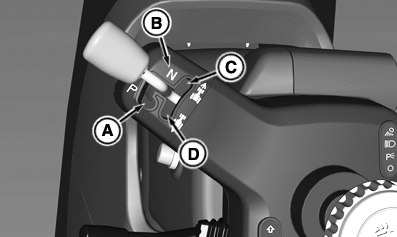
RXA0130292-UN-11JAN13
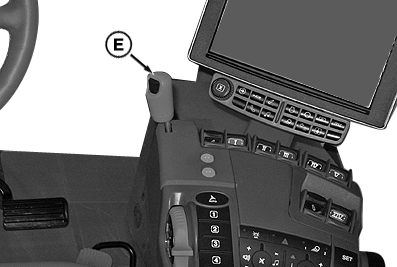
RXA0130293-UN-30JUL14
A - PARK
B - NEUTRAL
C - Forward
D - Reverse
E - Shift Lever
PARK — Lower left slot (A) — The park brake is applied when lever is fully inward in slot.NEUTRAL — Middle slot (before Park) (B) — The park brake is released when lever is moved to this slot.
Forward — Upper right slot (C) — The tractor begins moving forward when lever enters this slot. Push lever (E) forward for upshifts (+), pull rearward for downshifts (-).
Reverse — Lower right slot (D) — The tractor begins moving rearward when lever enters this slot. Push lever (E) forward for upshifts (+), pull rearward for downshifts (-).
IMPORTANT: Operator can always move shift lever to PARK Position; however, park brake will not engage until ground speed is below 1.75 km/h (1.0 mph).
Command Gears
NOTE: Optimum engine speed is 1800 — 2200 rpm in full load conditions. Using higher gear and lower engine speed for light load operation saves fuel and reduces wear. Under full load conditions, use full throttle engine speed.
Each time transmission enters forward or reverse shift pattern, transmission starts in command gear, shown on corner post display.
Transmission starts out in F8 and R4 after engine is started. These are default command gears. Startup default command gears may be changed from F1 - F15 in forward and R1 - R6 in reverse (see Set Start Gear in this section).
Command gear temporarily changes to the last gear used when shuttling between forward and reverse, or Shift from gear to neutral.
Initial command gear can be changed before initiating motion to match operation.
Forward Gear—Gears between F1 and F15 may be preselected by depressing clutch pedal and pushing or pulling shift lever until desired command gear is displayed.
Reverse Gear—Gears between R1 and R6 may be preselected by depressing clutch pedal and pushing or pulling shift lever until desired command gear is displayed.
The transmission will start in the preselected forward or reverse gear when clutch pedal is released.
Cold Weather Starting
When temperature is -10°C (14°F) or lower, it may take one minute to release park brake with operator in the seat and the transmission shifted into gear. Several shifts between PARK and NEUTRAL may be required to release park in extremely cold conditions.
When temperature is -10°C (14°F) or above, it may take 3 seconds to release park brake with operator in the seat.
When left hand reverser is moved to NEUTRAL, corner post display shows “N” for three seconds. If park brake does not release, “N” changes back to “P”. Move left hand reverser back to PARK then back to NEUTRAL until “N” displays more than three seconds.
Delayed Shift, slow hydraulic operation, hard steering, and limited engine rpm may also be noticeable until operating temperature is obtained.
Shift Without Using Clutch Pedal
Gear to Gear — Hold lever to shift up or down until desired gear is reached. The transmission shifts one gear at a time until lever is released.
Gear to Gear — Quickly ”bump” lever to shift up or down to desired gear. The transmission may skip gears if lever is moved faster than transmission can shift.
Shift Using Clutch Pedal
IMPORTANT: Clutch pedal must be fully depressed to completely disengage clutch for correct operation.
Gear to Gear — Depress clutch pedal and hold or “bump” lever to shift up or down until desired gear is displayed. Transmission goes into displayed gear when clutch pedal is released.
Transport Shift
When the tractor is in a light load condition, the transmission can shift faster by rapidly “bumping” the shift lever until the desired transport speed is reached. To reach transport speed quickly from a stop, depress the clutch pedal and “bump” the shift lever to F15. The transmission will shift directly to F15 when the clutch pedal is released. Once the tractor is underway in F15, rapidly “bump” the shift lever to reach the desired gear.
Press and Hold Shift
When operator holds the shift control lever in the up or down position, the transmission will shift through the gears one gear at a time.
Double Shift
The transmission may shift two gears at a time by double “bumping” shift lever to slow down or speed up. A double “bump” down shift is useful in field operations when hitting tough spots. Double “bumping” may also be useful in making headland turns.
Ground Speed Matching
 CAUTION: Avoid possible accident and injury from loss of vehicle
control. Never coast down hill.
CAUTION: Avoid possible accident and injury from loss of vehicle
control. Never coast down hill.
The transmission may shift gears to match ground speed if clutch pedal is pressed.
The transmission will shift up to prevent engine over speed if vehicle accelerates. The transmission may also shift down to F15 or the start up gear as the vehicle decelerates.
If Efficiency Manager™ is engaged, transmission will return to original set speed once the clutch pedal is released
In manual mode, the transmission will not return to the gear it was in prior to pressing the clutch pedal when the clutch is released.
|
RD47322,00004FB-19-20140625 |