Instrument Panel
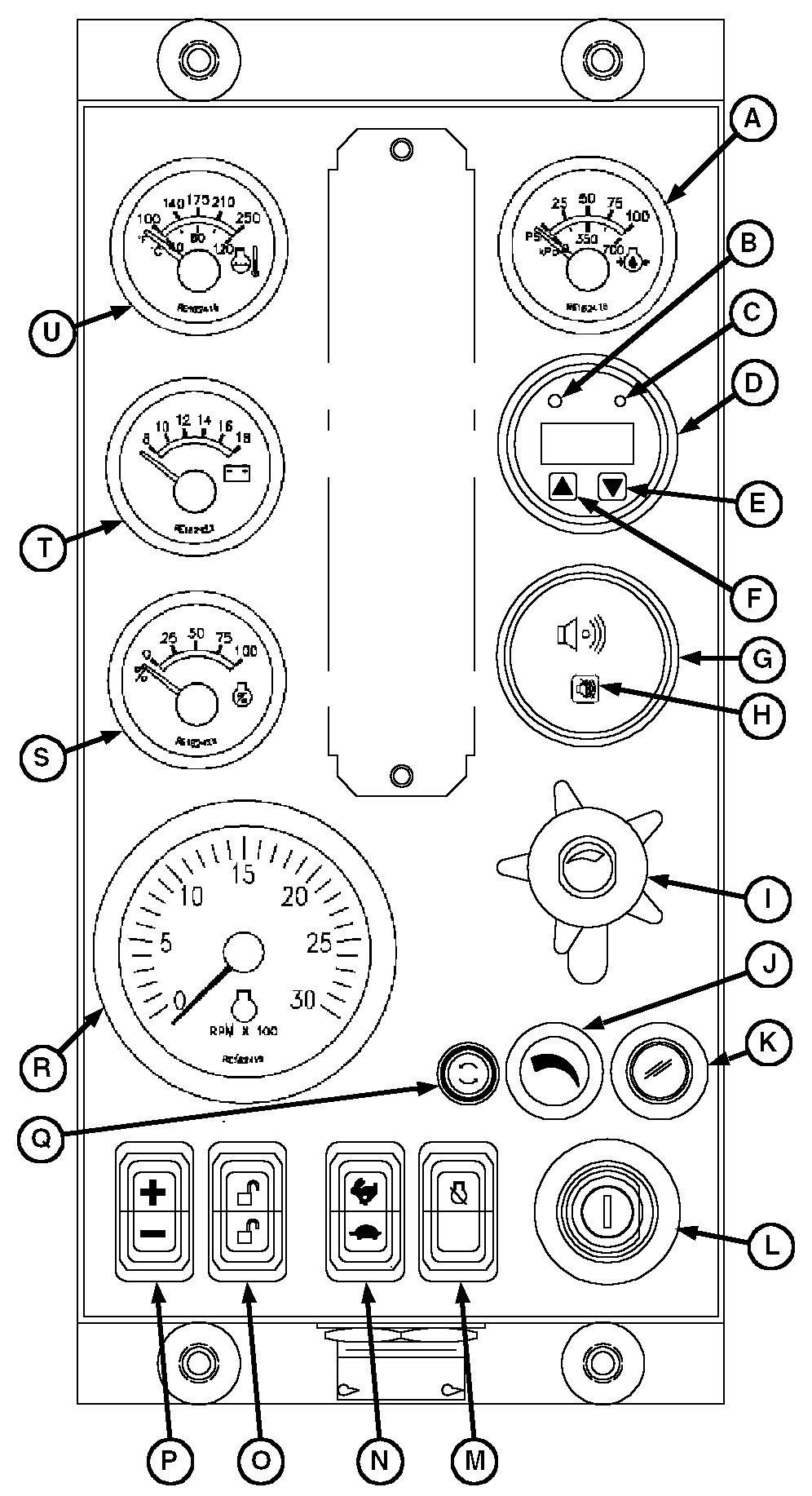
RG11169-UN-01NOV00
Instrument Panel (Earlier Electronically Controlled Engines)
A - Engine Oil Pressure Gauge
B - Amber “WARNING” Indicator
C - Red “STOP ENGINE” Indicator
D - Diagnostic Gauge/Hour Meter
E - Touch Switch
F - Touch Switch
G - Audible Alarm (Optional)
H - Audible Alarm Override Switch (Optional)
I - Analog Throttle Control (Optional)
J - Dimmer Control (Optional)
K - Engine Preheater Indicator (Optional)
L - Key Start Switch
M - Override Shutdown Rocker Switch
N - High-Low Speed Select Rocker Switch
O - Bump Speed Enable Rocker Switch
P - Speed Select Rocker Switch
Q - Fuse Holder (5-Amp Fuse)
R - Tachometer
S - Power Meter (Percent Load) (Optional)
T - Voltmeter (Optional)
U - Engine Coolant Temperature Gauge
This instrument panel for earlier ™ 4.5 L and 6.8 L electronically controlled engines is electronically linked to the John Deere engine control unit (ECU). This allows the operator to monitor engine performance as well as to diagnose any troubles during engine operation.
All electronic engine controls are optional equipment for John Deere ™ OEM Engines. These electronic controls may be provided by the equipment manufacturer instead of purchased from John Deere. Refer to your engine application manual for specific guidelines if John Deere sourced controls and instrumentation are not used.
IMPORTANT:
RG11169-UN-01NOV00
Instrument Panel
Any time an electric gauge or meter does not register correctly, replace with a new one. Do not attempt to repair it. All gauges are plug-in type.Following is a brief description of the electronic controls found on John Deere-provided instrument panels. Refer to manufacturer's literature for information on controls not provided by Deere.
Engine Oil Pressure Gauge
The engine oil pressure gauge (A) indicates engine oil pressure in pounds per square inch (psi) or kPa. An optional audible alarm (G) warns the operator if engine oil pressure falls below a safe operating pressure.
Amber “Warning” Indicator
The amber “WARNING” indicator (B) signals an abnormal condition such as low oil pressure, high coolant temperature, water in fuel, low battery voltage, etc. Observe displayed code in window of diagnostic gauge/hour meter (D) for diagnostic trouble code (DTC). (Use the service code menu. See USING DIAGNOSTIC GAUGE TO ACCESS ENGINE INFORMATION later in this section.)
Red “Stop Engine” Indicator
The Red “STOP ENGINE” indicator (C) signals operator to stop engine immediately or as soon as safely possible. A condition exists that could cause damage to engine.
Diagnostic Gauge/Hour Meter
The diagnostic gauge/hour meter (D) displays diagnostic trouble codes (DTCs) as they are accessed. Other information on the engine can be accessed using the touch switches (E and F). The hour meter shows the operating hours of the engine. If engine trouble occurs, the gauge will alternately flash from displayed parameter to the message “SvrcCode”. Then the touch switches (E and F) can be used to access the trouble code (see following).
Touch Switches
RG11169-UN-01NOV00
Instrument Panel For Earlier Engines
The touch switches are used to change the display on the window of the diagnostic gauge to access engine performance data. Pressing the DOWN switch (E) or UP switch (F) scrolls through various engine parameters and diagnostic trouble codes. (See Using Diagnostic Gauge To Access Engine Information on the following pages for instructions.)
Audible Alarm (Optional)
The audible alarm (G) sounds whenever a low oil pressure, high coolant temperature or water-in-fuel/plugged fuel filter condition exists. This includes all signals that light up the amber “WARNING” indicator (B) or the red “STOP ENGINE” indicator (C).
Audible Alarm Override Switch (Optional)
The audible alarm override switch (H) can be pressed to silence the alarm for approximately 2-1/2 minutes.
Analog Throttle Control (Optional)
The throttle control (I) is used to control engine speed. This control is available only on engines with analog throttle.
Dimmer Control (Optional)
The dimmer control (J) is used to control illumination of the instrument panel gauges.
Engine Preheater Indicator (Optional)
RG11169-UN-01NOV00
Instrument Panel For Earlier Engines
The engine preheater indicator (K) lights up while the engine is being preheated for cold weather starting. When the engine is warmed up, the light goes off, indicating the engine can now be started.
Key Start Switch
The three-position key start switch (L) controls the engine electrical system. When the key switch is turned clockwise to “START”, the engine will crank. When the engine starts, the key is released and returns to the “ON” (RUN) position.
Override Shutdown Rocker Switch
Switch will be present, but may not be active, depending on engine controller (ECU) options originally selected. If switch is active, pressing the upper half of the override shutdown switch (M) will override an engine shutdown signal. The switch must be pressed within 30 seconds to prevent undesired shutdown of engine. Pressing this switch will override the engine shutdown for 30 seconds at a time to move vehicle to a safe location.
High-Low Speed Select Rocker Switch
This instrument panel has two versions, one with a two position switch as shown, and one with a three position switch. The two position switch has high/low and is used to set the engine operating speeds at slow (turtle) or fast (rabbit). Factory preset idle speeds can also be adjusted using bump speed enable switch (O) with speed select switch (P).
The three position switch has Slow (turtle), Middle (Adj) and Fast (rabbit) settings. Slow (turtle) position is factory preset at low engine idle, while middle (ADJ) position is factory set at high engine idle. To adjust engine speeds, See Changing Engine Speeds in Section 18.
Bump Speed Enable Rocker Switch
RG11169-UN-01NOV00
Instrument Panel For Earlier Engines
This is a three-position switch (O) with the center position as “OFF” (locked). With this switch in the “OFF” position, the speed select switch (P) is also locked, to prevent accidental changes in operating speed. Pressing upper or lower half of switch (O) will unlock or enable the bump speed switch to take effect using speed select switch (P).
Speed Select Rocker Switch
The speed select switch (P) is used to bump engine speed up (+) or down (-) in small increments during operation. This switch must be used with the bump speed enable switch (O) in the unlocked position (top or bottom half of button depressed).
How To Select Preset Operating Speeds (Bump Speeds)
First select slow or fast speed option by pressing high-low speed select switch (N) to “turtle” (slow) or “rabbit” (fast). Then you can press either the upper or lower portion of the bump speed enable switch (O) to unlock the high or low setting. The bump speed enable must be held down as the speed select switch (P) is used to change the high or low setting by pressing (+) to increase speed or (-) to decrease speed.
Once the slow idle speed has been set, the bump speed enable switch must be pressed and released three times within two seconds to commit the new operating speed to memory. If not done, the engine's new speed will only be effective until the key switch is shut off. Then the speed will revert back to the previous setting.
The fast idle speed cannot be locked into memory. It will always go back to the factory preset fast idle speed.
Fuse Holder
The fuse holder (Q) contains a 5-amp fuse for power to the instrument panel.
Tachometer
RG11169-UN-01NOV00
Instrument Panel For Earlier Engines
The tachometer (R) indicates engine speed in hundreds of revolutions per minute (rpm).
Percent Load (Optional)
The power meter (S) shows percent of available power being used by the engine.
Voltmeter
The voltmeter (T) indicates system battery voltage. The amber “WARNING” light (B) will illuminate when battery voltage is too low for proper operation of the fuel injection system.
Engine Coolant Temperature Gauge
The coolant temperature gauge (U) indicates engine coolant temperature in degrees Celsius or Fahrenheit. An optional audible alarm (G) warns the operator if coolant temperature rises above the preset safe operating temperature.
Cruise Control
Engine ECUs are available with the cruise control function. The cruise control is an off-road type that maintains a constant engine rpm under varying load conditions.
The cruise cancel/resume function is a one-button cancel, then resume, function. The first time contact is made with the cruise control active, the cruise control will disengage and the engine speed will drop to idle. If the contact is made again within one minute and with the engine speed above 1300 rpm, the cruise control will “resume”. This feature allows the placement of the cancel/resume button in a convenient location in the vehicle cab and does not require the use of the normal cruise controls for momentary interruptions in cruise operation.
The cancel/resume function is intended for applications like agricultural tractors and sprayers that turn around at the end of each row in a field. This allows the operator to use the throttle and/or brake to turn the vehicle around. When ready to resume field operations, the operator brings the engine speed above 1300 rpm and activates the cancel/resume function again to resume cruise speed. An internal timer gives the operator one minute to complete the turnaround maneuver.
The cruise control has the normal functions of:
- Cruise control power “ON” or “OFF”.
- “Set” or “bump up” engine speed.
- “Resume” or “bump down” engine speed.
- Use vehicle brake or clutch pedal to disengage cruise control.
The “bump up” and “bump down” speed controls allow the operator to change the set speed. Small engine speed changes can be made by “bumping” the control switch. Holding the “bump up” or “bump down” switch will result in greater engine rpm changes until the engine reaches either full speed or idle. The cruise control cannot operate beyond the normal min/max engine speeds.
|
is a trademark of Deere & Company. |
OURGP11,000027A-19-20060807 |