General Troubleshooting Information
RG13140-UN-07OCT03
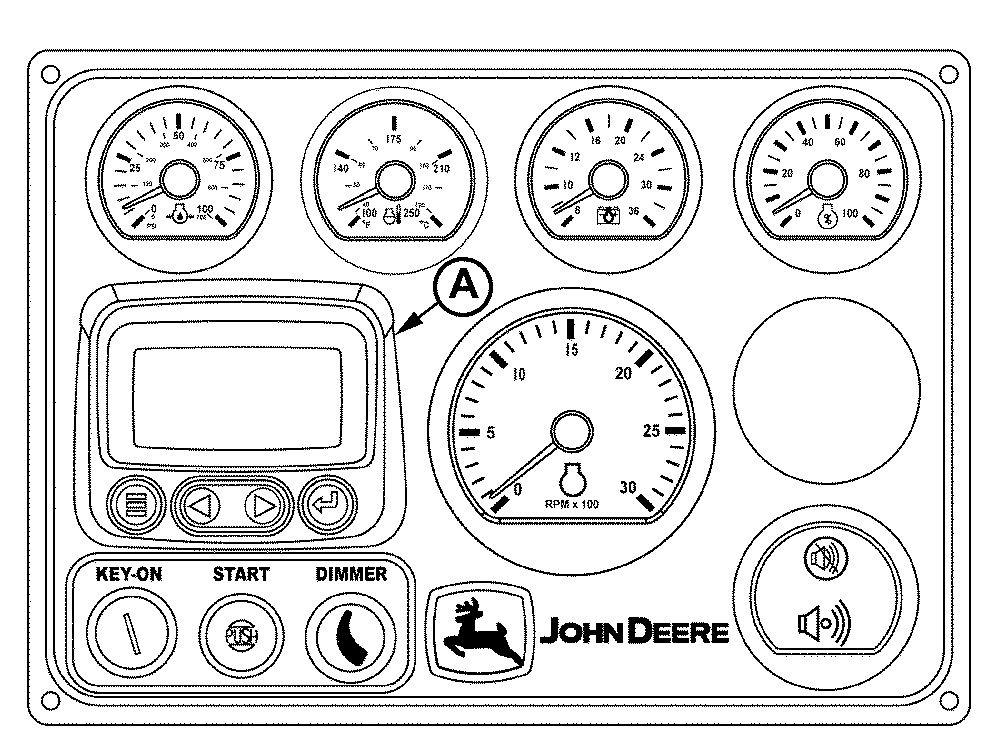
Diagnostic Gauge
A - Diagnostic Gauge - Electronically Controlled Engine
Troubleshooting engine problems can be difficult.Later in this section is a list of possible engine problems that may be encountered, accompanied by possible causes and corrections. Troubleshooting information is of a general nature; final design of the overall system for your engine application may be different. See your engine distributor or servicing dealer if you are in doubt.
For Electronically Controlled Engines: The Engine Control Unit (ECU) has the ability to detect problems internally and in the electronic control system. This includes determining if any of the sensor input voltages are too high or too low, if the camshaft and crankshaft position sensor inputs are valid, and if the unit injector solenoids are responding properly.
If the ECU detects a problem with the electronic control system a Diagnostic Trouble Code (DTC) specific to the failed system will be stored in the ECU’s memory.
- Active
- Inactive (Stored)
There are two types of DTCs:
Active DTCs indicate that the failure is occurring. These type of failures are sometimes called “hard” failures. They can be accessed on the diagnostic gauge (A) on the instrument panel.
Inactive or stored DTCs indicate that a failure has occurred in the past, but is not currently occurring. This type of “stored” DTC can be caused by an “intermittent” failure. These could be problems such as a bad connection or a wire intermittently shorting to ground.
To access DTC's with the diagnostic gauge (A), see section 15 of this manual.
If a sensor or wiring fails and a DTC is active for the sensor, the ECU will use a substitute “limp home” value in its calculations to continue engine operation.
A list of DTCs is given later in this section with a description of each. Contact your engine servicing dealer to correct any DTCs which are displayed on the instrument panel.
|
OUOD006,00000F8-19-20171220 |