Check Battery
-
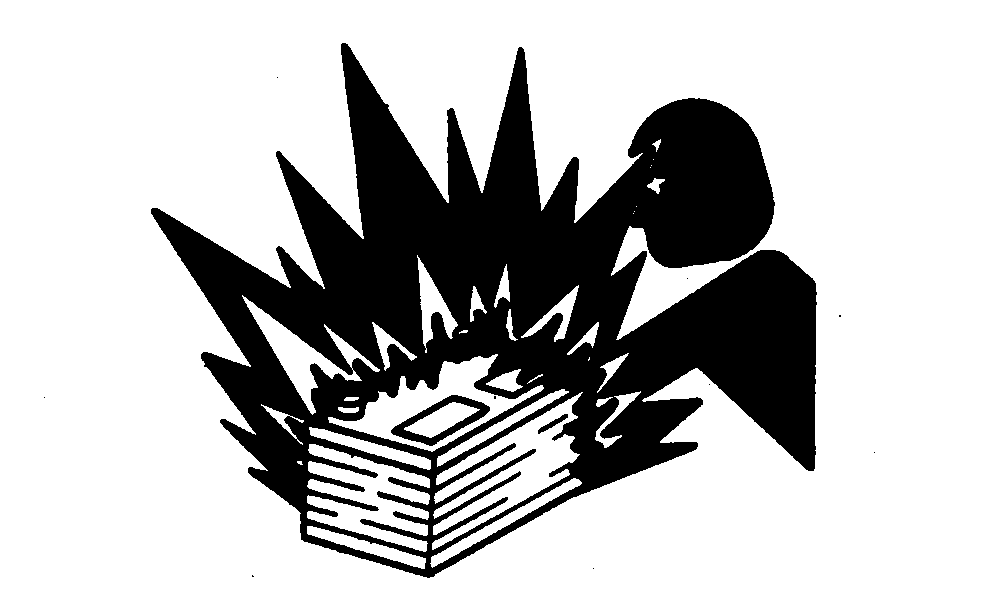
 CAUTION: Never short out the battery terminals, including when
checking the remaining battery charge. Battery gas can explode and
may cause an explosion or fire. Keep sparks and flames away from batteries.
Use a flash light to check battery electrolyte level.
CAUTION: Never short out the battery terminals, including when
checking the remaining battery charge. Battery gas can explode and
may cause an explosion or fire. Keep sparks and flames away from batteries.
Use a flash light to check battery electrolyte level.Never check battery charge by placing a metal object across the posts. Use a voltmeter or hydrometer to check the remaining battery charge.
Always remove grounded (—) battery clamp first and replace it last.
TS204-UN-15APR13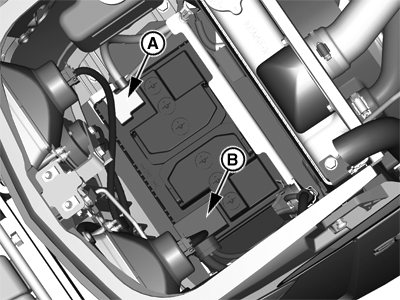
PY23241-UN-30JAN15A - Negative (—) Battery Terminal
B - Positive (+) Battery Terminal
When the amount of fluid nears the lower limit, fill with distilled water, so it is at the upper limit. If operation continues with insufficient battery fluid, the battery life is shortened, and the battery may overheat and explode. During the summer, check the fluid level more often than specified. -
Use a battery hydrometer to check specific gravity of electrolyte in each cell. Charge battery if reading is below 1.215. Replace battery if difference between cells is more than 0.050 or if battery will not charge above 1.225.
-
Always correct specific gravity reading for electrolyte temperature variation. Add 0.004 to the reading obtained in step one for every 10°F above 80°F (add 0.007 to the reading for every 10° above 27°C). Subtract at same rate if electrolyte temperature is below 80°F (27°C). Corrected specific gravity of a fully charged battery is from 1.265 to 1.280.
-
A battery is considered fully charged when three consecutive hydrometer readings, taken at hourly intervals, show no rise in specific gravity.
|
RA84036,00003A5-19-20150130 |