Adjust 540E PTO Throttle Limiter (Synchronized Transmission Only) — If Equipped
|
Service Interval — As Required |
-
LV5095-UN-26JUN00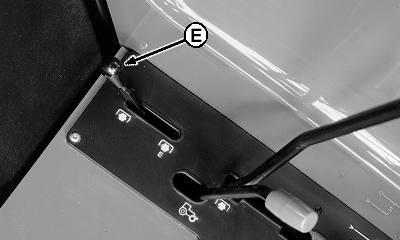
P13718-UN-09AUG05OOS Shown, Cab Similar
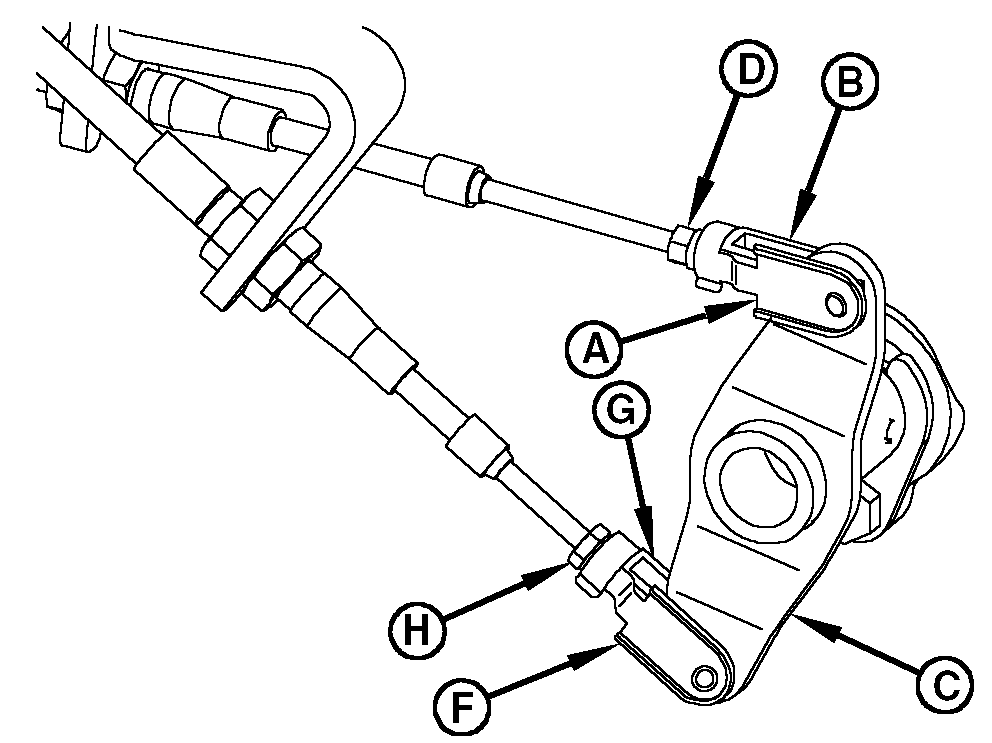
A - Clip Pin
B - Clevis
C - Arm
D - Jam Nut
E - PTO 540/540E Speed Shift Lever
F - Clip Pin
G - Clevis
H - Jam Nut
Remove clip pin (A) and disconnect clevis (B) from speed shift arm (C). -
Shift PTO 540/540E speed shift lever (E) to the rearward position.
-
Turn speed PTO shift lever (E) to full rearward position (clockwise).
-
Loosen jam nut (D) and adjust clevis (B) so clip pin (A) aligns with hole in clevis and arm (C). Install clip pin and tighten jam nut (D).
-
Remove clip pin (F) and disconnect clevis (G) from speed shift arm (C).
-
Start engine and increase engine rpm to 1850—1900 with no load.
-
Loosen jam nut (H) and adjust clevis (G) so clip pin (F) aligns with hole in clevis and arm (C). Install clip pin and tighten jam nut (H).
-
Apply a load to PTO shaft and start engine. With the PTO 540/540E speed shift lever in rearward position, push hand throttle forward to stop. Tachometer should read 1700 rpm.
-
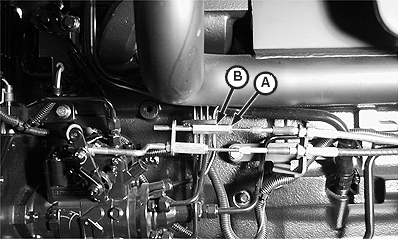
LV5096-UN-27JUN00A - Jam Nut
B - Throttle Limiter
If engine speed IS NOT 1700 rpm, pull hand throttle back, loosen jam nut (A), and adjust throttle limiter (B) until proper engine speed is attained. If engine speed is above 1700 rpm, turn throttle limiter clockwise. If engine speed is below 1700 rpm, turn throttle limiter counterclockwise. -
Push hand throttle forward to stop. Ensure engine speed is 1700 rpm. Repeat step 9 as necessary.
IMPORTANT: The 540 Economy is ideal for any PTO application where full horsepower is not needed.
Overall operating experience improves because there is less noise and vibration for the operator.
For heavy-duty operations that require maximum PTO power use only 540 PTO (Not 540E).
IMPORTANT: When using 540E PTO engine rpm should be within 1700 to 1900, operating above these rpm could damage some internal components or implements.
|
MK41968,0000268-19-20071019 |