Operational Checkout Procedure
|
Use this procedure to check all systems and functions on the machine. It is designed so you can make a quick check of machine operation while doing both a walk-around inspection and performing specific checks from the operator's seat. Should you experience a problem with your machine, you will find helpful diagnostic information in this checkout that will pinpoint the cause. Use the table of contents to help find adjustment procedures. This information may allow you to perform simple repairs yourself, reducing machine down time. The information obtained after completing the operational checkout will allow you or your authorized dealer to pinpoint a specific test or repair needed to restore the machine to specifications. |
A location will be required which is level and has adequate space to complete the checks. No tools or equipment are needed to perform this checkout. Complete the necessary visual checks (oil levels, oil condition, external leaks, loose hardware, linkage, wiring, etc.) prior to doing the checkout. The machine must be at operating temperature for many of the checks. Locate the check to be performed at the top of the left column and read completely down the column before performing the check. Follow this sequence from left to right. In the far right column, if no problem is found, you will be instructed to go to next check. If a problem is indicated, you will be referred to either a group in this manual or to your authorized dealer for repair. |
OUO1043,00001E9 -19-05NOV03-1/1 |
Gauge and Indicator Check with Engine Off
- - -1/1 |
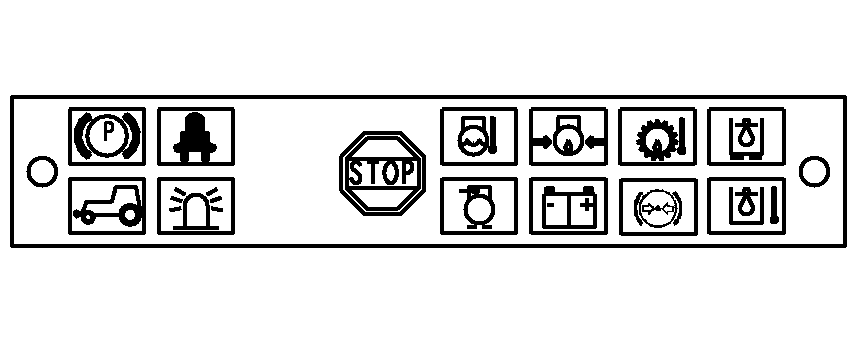
Monitor Indicator Lights and Alarm Checks |
|
YES: Go to next check. NO: Check monitor and alarm fuses. If motor starts and bulb check position is OK, key switch has failed or there is a short in wiring. See your authorized dealer. |
||||||
- - -1/1 |
FNR, Neutral Start Circuit and Reverse Warning Alarm Checks
- - -1/1 |
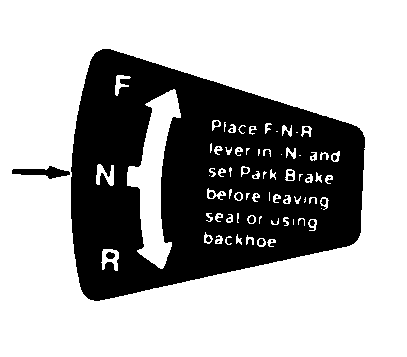
FNR Switch Check |
|
|||
- - -1/1 |
Neutral Start CheckMove FNR lever to forward (F) position and turn key switch to start position. Move FNR lever to reverse (R) position and turn key switch to start position.
See your authorized dealer. Go to next check. |
- - -1/1 |
Start Circuit CheckMove FNR lever to neutral (N) position and turn key switch to START position. Observe and listen to monitor as engine is cranking.
LOOK: During engine cranking, were all indicator lights ON? Is STOP indicator ON? Go to next check. If engine turns but does not start, check fuel/start aid/reverse alarm fuses. If starting motor does not operate check start fuse. If fuses are OK, see your authorized dealer. |
- - -1/1 |
Reverse Warning Alarm CheckKey switch ON. Move FNR lever to reverse (R) position.
Go to next check. See your authorized dealer. |
- - -1/1 |
Park Brake, Charge Indicator Light, Tachometer/Hour Meter Circuit and Engine Speed Control Linkage Checks
- - -1/1 |
Park Brake Indicator CheckIMPORTANT: If engine oil pressure indicator light stays ON, STOP ENGINE IMMEDIATELY, check oil level. Engage park brake. Put FNR lever in neutral (N) and start the engine. Put FNR lever in forward (F) position. LOOK: Is STOP indicator ON? Does alarm sound? Is park brake and seat belt light ON? Are all other indicator lights out? Release park brake. LOOK/LISTEN: Is park brake indicator and STOP light out? Alarm will not sound. Go to next check. If engine low oil pressure indicator light stays ON, STOP ENGINE IMMEDIATELY and check oil level. If alternator indicator light is ON, increase engine speed to 1200 rpm and alternator light MUST go out. If no park brake light, inspect wiring connector at switch on park brake linkage. See your authorized dealer. |
- - -1/1 |
Hour Meter Circuit CheckIMPORTANT: If engine low oil pressure indicator light stays ON, STOP ENGINE IMMEDIATELY and check oil level. Engage park brake. Put FNR lever in neutral and start the engine. LOOK/LISTEN: Is hour meter indicator rotating? Does tachometer (if equipped) indicate rpm? Go to next check. See your authorized dealer. |
- - -1/1 |
Engine Speed Control Knob Linkage Check-If EquippedEngage park brake. Put FNR lever in neutral and start engine. Move speed control knob to fast idle position. LOOK: Does speed control lever remain at selected position? (S.N. -882699) See Adjust Engine Speed Control Linkage (Section 3-8) or see your authorized dealer. (S.N. 882700- ) See your authorized dealer. Go to next check. |
- - -1/1 |
Engine Speed Control Pedal Linkage CheckDepress speed control pedal
Go to next check. (S.N. -882699) See Adjust Engine Speed Control Linkage (Section 3-8) or see your authorized dealer. (S.N. 882700- ) See your authorized dealer. |
- - -1/1 |
Brake System Checks
- - -1/1 |
Pedal Stop CheckLift left and right brake pedals. LOOK: Are brake pedals against pedal stop screws? NOTE: This ensures that brake check valves are opened and brakes released. Go to next check. Adjust brake pedal stops. See your authorized dealer. |
- - -1/1 |
Brake System Leakage CheckDepress and hold left brake pedal, then right brake pedal, using approximately 267 N (60 lb force). LOOK: Brake pedal must NOT feel spongy (caused by air in system). Does pedal settle more than 25 mm (1.0 in.) per minute? Go to next check. Bleed brake system. See Bleeding Service Brakes (S.N. -880907) or Bleeding Service Brakes (S.N. 880908- ) (Section 4-1) or see your authorized dealer. |
- - -1/1 |
Brake Drag/Park CheckPosition machine on a gradual slope with front of machine downhill. Lift bucket so it clears ground. Shift FNR lever to neutral, differential lock control up, disengage park brake and release service brakes. Let machine coast freely for several feet. Apply park brake. LOOK: Did machine stop? Release park brake. LOOK: Did machine move or coast freely? NOTE: If machine does not move freely on slope, drive the machine for five minutes. Feel axle housing area to locate which brake is dragging. Go to next check. See your authorized dealer. |
- - -1/1 |
Steering System Checks
- - -1/1 |
Steering CheckRaise loaded bucket to place added weight on front wheels. Operate engine at approximately 1000 rpm. Turn steering wheel from full left to full right several times. LOOK: Did front wheels move smoothly in both directions? LOOK: When steering wheel was stopped, did front wheels stop moving? NOTE: Internal leakage or a sticking steering valve spool can cause wheels to continue to move after steering wheel is stopped. Go to next check. See your authorized dealer. |
- - -1/1 |
Steering Leakage CheckNOTE: Hydraulic oil must be at operating temperature. Run engine at slow idle. Turn steering wheel until wheels are in maximum right turn position. Continue turning steering wheel, using approximately 11.3 N·m (100 lb-in.) force while counting steering wheel rpm. Repeat leakage check turning steering wheel to the left. LOOK: Did steering wheel turn 5 rpm or less to the left or right? This represents acceptable steering wheel movement during normal operation. Go to next check. If steering wheel turns more than 5 rpm, verify whether valve or cylinder is leaking. See your authorized dealer. |
- - -1/1 |
Steering Priority Valve CheckOperate engine at slow idle. Turn steering wheel to stop left and right. Note effort required to turn wheel. Turn wheel to stop and apply constant pressure. LOOK/FEEL: Does wheel stop at both axle stops and require normal steering wheel effort? LOOK/LISTEN: Does tachometer (if equipped) decrease in rpm or does engine rpm decrease when steering wheel is held against stop? Go to next check. Steers hard and no decrease in engine rpm. See your authorized dealer. |
- - -1/1 |
Transmission Neutral Disconnect Circuit Check
- - -1/1 |
Neutral Disconnect Circuit Check
Start engine; set idle speed at approximately 1/3 throttle. Put transmission in fourth gear. Release park brake. Shift FNR lever to forward (F) position.
Press button on gear shift lever or loader control lever individually and note sound of engine.
Go to next check. See your authorized dealer. |
 CAUTION:
Machine will move forward as FNR lever is moved.
CAUTION:
Machine will move forward as FNR lever is moved.
- - -1/1 |
Driving Checks
- - -1/1 |
Transmission Shift Linkage, Synchronizer and Noise CheckIMPORTANT: Press button on gear shift lever when shifting gears. Run engine at approximately 1/2 throttle with FNR lever in forward (F) position. Shift transmission into each gear and drive for a short distance.
Go to next check. See your authorized dealer. |
- - -1/1 |
Differential Lock CheckRaise rear of loader onto floor stands so rear wheels are off ground. Unlock brake pedals. Turn MFWD switch off (if equipped). Operate machine at approximately 1/2 throttle in 1st forward. Depress differential lock control. Apply one brake pedal. LOOK: Both wheels must stop. Go to next check. See your authorized dealer. |
- - -1/1 |
Differential Gear and Pinion CheckShift transmission to first gear and operate engine at approximately 1/2 throttle. Move FNR lever to forward (F) position. Steer machine in a maximum left turn and depress left brake pedal to stop the left wheel. Steer machine in a maximum right turn and depress right brake pedal to stop the right wheel.
Go to next check. See your authorized dealer. |
- - -1/1 |
Front Wheel Alignment (Toe-In) CheckDrive machine in fourth gear forward on a surface with loose material. LOOK: Is material from behind front wheels thrown excessively inward or outward? Go to next check. If material is thrown, excessive tire wear will result. See Checking and Adjusting Toe-In (Section 4-1). |
- - -1/1 |
Engine and Torque Converter Check (Without MFWD)Position machine with loader bucket at ground level against dirt bank or immovable object. Shift transmission into 4th gear. Move FNR lever to forward (F) position. Engage differential lock. Increase engine speed to fast idle. LOOK: Do rear wheels stall? NOTE: This test will give a general indication of engine, transmission and torque converter performance. Go to next check. If the wheels can be easily stalled. See Engine or Transmission in Miscellaneous Troubleshooting (Section 4-3). See your authorized dealer if necessary. |
- - -1/1 |
Transmission Hydraulic System CheckRun engine at approximately 1/2 throttle. Shift transmission into third gear. Move FNR lever to forward (F) position. Make several shifts from third forward to third reverse. Start counting the number of seconds when FNR lever is moved to opposite direction. LOOK: Is shift from one direction to the other completed in three seconds? NOTE: If longer in one direction ONLY, check direction pack. Go to next check. See your authorized dealer. |
- - -1/1 |
Mechanical Front Wheel Drive (MFWD) Driving Check
- - -1/1 |
MFWD Switch CheckPush switch to engage MFWD. LOOK: Does MFWD light in display monitor come ON when switch is pressed? Push switch to disengage MFWD. LOOK: Is MFWD light in display monitor OFF with MFWD disengaged? NOTE: Indicator light in MFWD switch will remain ON while MFWD is engaged. If MFWD is turned OFF while operating, light will go out but MFWD could stay engaged until load on drive train is released. Go to next check. See your authorized dealer. |
- - -1/1 |
Engine and Torque Converter Check (With MFWD)With loader bucket level and cutting edge at the centerline of front wheels, put machine against a dirt bank or immovable object. Engage MFWD and differential lock. Place FNR lever in forward position. Shift gear shifter to first forward. Increase engine speed to fast idle LOOK: Do both rear wheels and both front wheels turn? Go to next check. If all wheels stop, a torque converter or transmission control valve problem is indicated. See your authorized dealer. |
- - -1/1 |
MFWD Gear and Pinion CheckDrive machine at transport speed with MFWD engaged, then disengaged.
NOTE: It is normal for MFWD to "whine" when engaged. Go to next check. If MFWD whines, check oil levels and fill to correct levels. See your authorized dealer. |
- - -1/1 |
Hydraulic System Checks
- - -1/1 |
Main Hydraulic Pump Performance CheckNOTE: If hydraulic oil is not at operating temperature, heat oil to 38-52°C (100-125°F). Put loader bucket flat on ground. Transmission in neutral, FNR in Forward. Run engine at slow idle. Measure cycle time of loader rise to maximum height (including bucket leveling). LOOK: Does loader rise to maximum height in 15 seconds or less? NOTE: Take the average cycle time for at least three cycles. This time will give a general indication of hydraulic pump performance. Go to next check. If cycle time slow, see Hydraulics in Miscellaneous Troubleshooting (Section 4-3) or see your authorized dealer. |
- - -1/1 |
Loader Function Drift CheckNOTE: Cylinder oil temperature should be 38-52°C (100-125°F). If not, heat oil to specifications. Position loader bucket cutting edge 50 mm (2.0 in.) off the ground. Run engine at slow idle and observe bucket cutting edge. LOOK: Does cutting edge touch ground within one minute? Go to next check. See your authorized dealer. |
- - -1/1 |
Loader Boom Float CheckPut loader bucket at maximum height position with bucket dumped. Run engine at approximately 1/2 throttle. Move the loader control lever forward into boom float detent position, and at the same time into bucket rollback detent position. Remove hand from control lever. LOOK: Does loader control lever remain in the boom float detent position? Go to next check. If it jumps out of detent, check detent spring and detent balls. See your authorized dealer. |
- - -1/1 |
Loader Return-to-Dig CheckRaise loader bucket to two-thirds maximum height position with bucket dumped. Run engine at approximately 2/3 throttle. Move the loader control lever forward into boom float detent position, and at the same time into bucket rollback detent position. Remove hand from control lever. LOOK: Does the loader control lever disengage from the bucket rollback detent when the bucket is level? LOOK: When the bucket is at ground level, bucket must be level and the bucket indicator pointer must be aligned with mark on the boom pivot. NOTE: When return-to-dig is used with loader boom in full up position, the bucket leveling linkage will move the bucket control valve out of return-to-dig position before bucket is actually level. Go to next check. Adjust switch until it is activated in cam. See your authorized dealer. |
- - -1/1 |
Bucket Leveling Linkage CheckNOTE: The loader bucket leveling feature functions during the boom raise cycle only. When bucket is lowered, the operator can manually level the bucket or use the return-to-dig. Put loader bucket in the rollback position with the boom near ground level. Raise the loader and at the same time hold the control lever in the bucket rollback position. Observe bucket and loader control lever as the loader rises. LOOK/FEEL: Does loader control lever move into the bucket dump position and the bucket dump function slowly activate? When the loader control lever moves to activate the bucket dump function, does the bucket position remain stationary the remainder of the loader boom raise cycle? Go to next check. Adjust loader control valve linkage. See your authorized dealer. |
- - -1/1 |
Hitch Hydraulic Function CheckOperate machine at approximately 1/3 throttle. Operate controls to check each hitch cylinder function. LOOK/FEEL: Does each cylinder extend smoothly? LOOK/FEEL: Does each cylinder retract smoothly? Go to next check. See your authorized dealer. |
- - -1/1 |
PTO Function Check-If EquippedOperate machine at approximately 1/3 throttle. Operate control to check engagement function. LOOK: Does PTO engage and rotate smoothly? LOOK: Does PTO disengage and stop rotating? NOTE: If machine is started with PTO switch ON, PTO should not operate until switch is cycled. Go to next check. See your authorized dealer. |
- - -1/1 |
Check Operation of Accessories (Engine Stopped)
- - -1/1 |
Drive Light CheckTurn key switch to ON position. Push light rocker switch to middle position. LOOK: Are two front lights, two red taillights and gauge lights ON? Go to next check. Check fuse and bulbs. Check wiring. See your authorized dealer. |
- - -1/1 |
Work Light CheckTurn key switch to ON position. Push light rocker switch to upper (WORK) position. LOOK: Are two front lights, two red taillights, gauge lights and two rear white lights ON? Go to next check. See Fuse Specifications or Remove and Install Halogen Bulb in Miscellaneous Machine (Section 4-1) or see your authorized dealer. |
- - -1/1 |
Turn Signal CheckTurn key switch to ON position. Push right side of turn signal rocker switch down. LOOK: Is right amber light flashing? Does right indicator light on top of steering column flash? Is left light on? Push left side of turn signal rocker switch down. LOOK: Is left amber light flashing? Does left indicator light on top of steering column flash? Is right light on? Go to next check. Check fuses, bulbs and wiring. See your authorized dealer. |
- - -1/1 |
Brake Light Switch CheckKey switch in the ON position. Depress and hold left brake pedal, then right brake pedal. LOOK: Rear brake light must come ON when either pedal is depressed with key switch in ON position. Go to next check. Check fuse and bulbs. Check wiring. See your authorized dealer. |
- - -1/1 |
Warning Light CheckKey switch ON. Push bottom of warning light rocker switch in. LOOK: Are both amber lights flashing? Are both turn signal indicators and light in warning light rocker switch flashing? Go to next check. Check fuses, bulbs and wiring. See your authorized dealer. |
- - -1/1 |
Horn CheckTurn key switch to ON position. Push horn button
Go to next check. Check fuses and wiring. See your authorized dealer. |
- - -1/1 |
Operator Station Checks
- - -1/1 |
Seat Linkage CheckMove lever sideways. Move seat forward and rearward and release lever. LOOK: Does lever move freely and lock seat in desired position? Go to next check. Repair linkage. See your authorized dealer. |
- - -1/1 |
Suspension Seat Height Adjustment CheckTurn knob or lift lever to raise or lower seat to desired position. LOOK: Does seat move up or down and remain in desired position? Go to next check. See your authorized dealer. |
- - -1/1 |
Suspension Seat Swivel Linkage CheckPull lever forward. Swivel seat clockwise to stop and release lever. Repeat steps to return seat to normal forward facing position. LOOK: Does seat stop about 15 degrees clockwise from normal forward facing position? FEEL: Does lever move freely and hold seat in positions? Go to next check. Lubricate or repair linkage. See your authorized dealer. |
- - -1/1 |
Suspension Seat Back Linkage CheckTurn lever to position seat back as desired. FEEL: Does lever move freely and hold seat in desired positions? Go to next check. Lubricate or repair linkage. See your authorized dealer. |
- - -1/1 |
Miscellaneous Checks
- - -1/1 |
Check Periodic Maintenance DecalCheck periodic maintenance decal on right side of dash pedestal. LOOK: Is periodic maintenance decal legible? Go to next check. Replace decal. See your authorized dealer. |
- - -1/1 |