Shifting Transmission
IMPORTANT: When transmission sump oil temperature is below 7°C (19°F), only neutral, reverse and second gears are available.
IMPORTANT: When transmission sump oil temperature is above 128°C (262°F), the TCU will restrict the use of higher gears.
NOTE: With dump body in raised position, transmission will not shift beyond first gear from neutral. If already in gear, transmission can downshift but not upshift.
The transmission has 6 forward gears and 1 reverse gear with automatic lock-up in all gears.
The transmission can be operated as a fully automatic transmission. All automatic gear shifting is controlled by the transmission control unit (TCU). Gear shifting is dependent upon engine speed (rpm) and operating conditions.
Shifting Transmission
-
IMPORTANT: Stop machine before shifting from a forward gear to reverse gear.
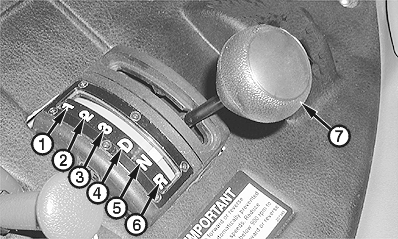
T147638B-UN-26NOV011 - 1st Gear
2 - 2nd Gear
3 - 3rd Gear
4 - Drive Gear
5 - Neutral
6 - Reverse Gear
7 - Gear Shift Control
With engine running, park brake engaged, and gearshift control in neutral (N) (5) apply service brake. -
Select drive (D) (4) or reverse (R) (6) using gearshift control (7).
-
Release park brake.
-
Release service brake and increase engine speed.
When transmission is in drive (D), the transmission will sequentially select the next gear as machine speed increases and downshift as machine speed decreases.
Gear Pre-Selection
NOTE: The transmission will shift to gear above pre-selected gear, up to gear 6, if an engine overspeed condition occurs.
A lower drive gear (1st gear (1), 2nd gear (2) or 3rd gear (3)) may be pre-selected to match anticipated driving conditions, giving the operator better control on slick or icy roads and on downgrades. Pre-selecting a gear limits the maximum attainable gear to the gear selected. For example, if gear 3 is pre-selected, gear 4, gear 5 and gear 6 will not be attained unless an overspeed condition occurs.
Downshifting to a lower gear increases engine braking.
The selection of a lower gear often prevents cycling between that gear and the next higher gear on a series of up-and-down grades.
Move gear shift control to drive gear (D) to revert to normal operation, allowing the machine to shift through the full range of gears.
Downshift or Reverse Inhibitor
NOTE: Shifting from neutral (N) to drive (D) or reverse (R) is inhibited when engine speed is above 1100 rpm. Before shifting to drive (D) or reverse (R) engine speed must be below 1100 rpm.
Although there is no speed limitation on upshifting, there is on downshifting and shifts from neutral to drive or reverse. If a downshift or neutral-to-gear shift is selected when engine speed is too high, the TCU will prevent the shift until neutral is selected or engine speed is reduced.
Accelerator Control
 CAUTION: To avoid injury or property damage caused by sudden
movement of machine, do not make shift from neutral (N) to drive (D)
or reverse (R) while pressing accelerator.
CAUTION: To avoid injury or property damage caused by sudden
movement of machine, do not make shift from neutral (N) to drive (D)
or reverse (R) while pressing accelerator.
NOTE: Shifting from neutral (N) to drive (D) or reverse (R) is inhibited when engine speed is above 1100 rpm. Before shifting to drive (D) or reverse (R) engine speed must be below 1100 rpm.
Shifting transmission from neutral (N) to reverse (R) or drive (D) is not allowed if engine speed is above 1100 rpm. If shift is attempted while engine speed is above 1100 rpm, release accelerator and allow engine speed to drop below 1100 rpm, then attempt shift again.
The position of the accelerator pedal influences the timing at which automatic shifting occurs. When the pedal is fully depressed, upshifts will occur automatically at fast engine speeds.
A partially depressed accelerator pedal position will cause upshifts to occur at slow engine speeds.
|
OUO1043,0000DF8-19-20011030 |