Slowing and Stopping the Machine
During normal operation, stop machine using service brakes. When machine is stopped for more than a few seconds, engage park brake.
Using Exhaust Brake to Slow Machine
 CAUTION: Use a combination of downshifting and braking while
going downhill.
CAUTION: Use a combination of downshifting and braking while
going downhill.
Under normal driving conditions, the transmission prevents automatic upshifting above the lower gear selected. However, during downhill operation, if engine governed speed is exceeded in the lower gear, the transmission may upshift to the next higher gear. This will reduce braking. Apply service brakes to prevent exceeding engine governed speed in the lower gear selected.
Remove foot from accelerator pedal to use engine as a braking force. The transmission will start to downshift and the exhaust brake will be engaged.
Use service brakes to slow machine if machine is exceeding maximum speed for held gear.
Engine braking provides good speed control for traveling downhill. When machine is fully loaded, or slope is steep, it may be desirable to preselect a lower gear before reaching gradient. Downshifting to a lower gear increases engine braking and helps the operator maintain control of machine.
The exhaust brake system is fully automatic and will be activated when accelerator pedal is released.
When exhaust brake is engaged, the transmission automatically starts to downshift to a lower gear. When 2nd gear is attained and machine has slowed, the exhaust brake will be disengaged.
Using Transmission Retarder to Slow Machine
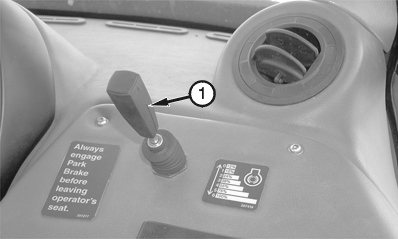
T143568B-UN-06JUL01
1 - Transmission Retarder Lever
The transmission retarder, along with the exhaust brake, is automatically engaged when the accelerator pedal is completely released.
The retarder indicator light on the dash will light whenever the transmission retarder engages.
Using transmission retarder lever (1), select a level of retardation between 0 and 6 depending on the amount of retardation required for the operating conditions, with the 0 position having the least amount of retardation, 0%, and 6 having the maximum amount of retardation, 100%. The level of retardation can be changed while the machine is moving or stationary.
When brake pedal is applied and transmission retarder lever is set in positions 0, 1, 2, or 3, the transmission retarder will apply 50% retardation. When brake pedal is applied and transmission retarder lever is set in positions 4, 5, or 6, the transmission retarder will apply retardation indicated by lever setting.
|
Transmission Retarder Lever Position |
Percentage of Retardation |
|---|---|
|
0 |
0% |
|
1 |
12% |
|
2 |
24% |
|
3 |
39% |
|
4 |
57% |
|
5 |
76% |
|
6 |
100% |
Service Brakes
-
CAUTION: Excessive use of service brakes will result in brake
components overheating, which in extreme circumstances could result
in a brake assembly problem.
NOTE: When operating in 2nd gear or higher, the exhaust brake and transmission retarder is activated when accelerator is released.
Release accelerator pedal.
-
NOTE: When brake pedal is applied and transmission retarder lever is set in positions 0, 1, 2, or 3, the transmission retarder will apply 50% retardation. When brake pedal is applied and transmission retarder lever is set in positions 4, 5, or 6, the transmission retarder will apply retardation indicated by lever setting.
Depress service brake pedal.
To resume driving, release service brake pedal. The transmission will automatically select the lowest gear.
Park Brake
-
NOTE: Park brake will engage when key is turned to OFF position. If engine is stopped while park brake is not engaged, then when engine is started, park brake lever must be moved to the engaged position before park brake can be released.
NOTE: The park brake should be engaged only when machine is completely stationary.
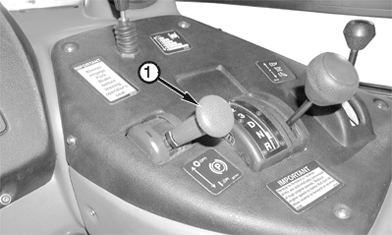
T147640B-UN-08NOV011 - Park Brake Lever
Stop machine using service brake pedal. -
Move park brake lever rearward until it locks in place to engage park brake.
-
Release service brake.
-
Select neutral (N) on gearshift control.
|
OUO1043,0000DFA-19-20011030 |