Determining Vehicle Load Capacity
Find weights and capacities for your machine model in SPECIFICATIONS.
 Avoid injury! Overloading the vehicle or trailer causes
loss of control and causes serious injury or death.
Avoid injury! Overloading the vehicle or trailer causes
loss of control and causes serious injury or death.
- Do not allow the Gross Vehicle Weight (GVW) to exceed the Gross Vehicle Weight Rating (GVWR) of the vehicle.
- Remove excess weight before operating vehicle.
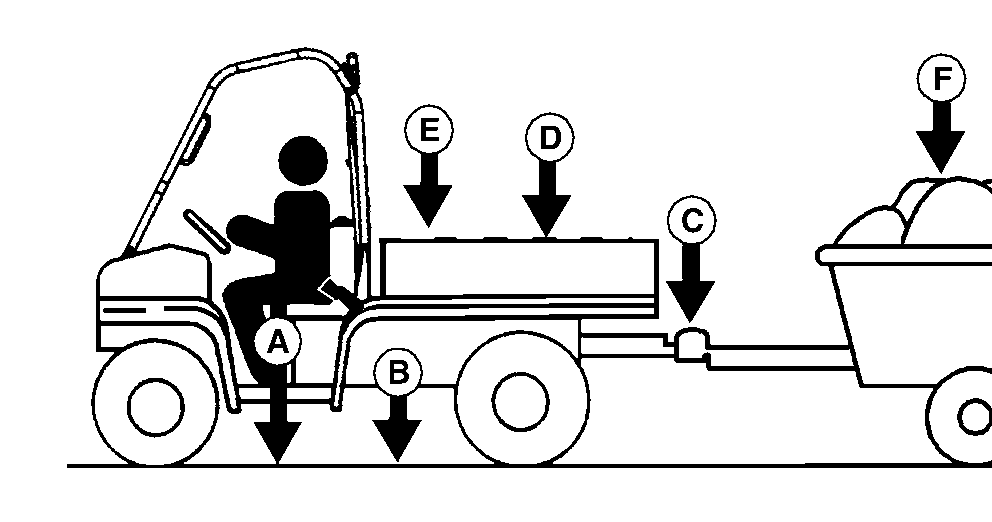
MXAL45669-UN-09APR13
Factors in Determining Vehicle Load Capacity
Optional equipment or attachments that are not standard equipment, must be included when determining gross vehicle weight, and reduces cargo box capacity.
-
Gross Vehicle Weight (GVW) is the
combination of the empty vehicle weight, payload, trailer tongue weight,
and the weight of any other kits or attachments on the vehicle.
GVW = A+B+C+D+E
- Gross Vehicle Weight Rating (GVWR) is the maximum permissible vehicle weight.
- Payload is the weight of all occupants plus the cargo box load.
- (A) Occupant load is the combined weight of all occupants (operator and one passenger).
- (B) Empty vehicle weight is the weight of the vehicle (full fluids) without occupant(s) or load or attachments.
- (C) Trailer tongue weight is the weight measured if the tongue of a loaded trailer was placed on a scale. The tongue weight must be approximately 10% of the total of the trailer weight and the weight of its load.
- (D) Cargo box load is the weight of the cargo in the cargo box. It may be less depending on the weight of the occupants, attachments, and the trailer tongue weight.
- (E) Attachment and Option weight is the combined weight of all attachments and options that were not standard equipment. For help with this information, contact your John Deere dealer.
- Vehicle Load capacity is the remaining amount of weight that the vehicle can haul in the cargo box and/or the additional weight from the operator, passenger, trailer tongue, and attachments.
-
Determine maximum vehicle load capacity:
- Calculate GVW = A+B+C+D+E
- Subtract the Gross Vehicle Weight (GVW) from the Gross Vehicle Weight Rating (GVWR).
-
The weight difference between the two numbers is the vehicle
load capacity.
Vehicle Load Capacity=GVWR-GVW
- The Gross Vehicle Weight must be less than or equal to the Gross Vehicle Weight Rating. If GVW exceeds GVWR, remove excess weight from vehicle before operating.
Example:
The following example is for an RSX860i with a 68 kg (150 lb.) cargo load, a 91 kg (200 lb.) operator, 100 kg (220 lb.) of attachments and options (such as a heavy duty brush guard, ROPS poly roof, cargo box power lift kit); towing a trailer with 23 kg (50 lb.) of tongue weight.
Find the correct specifications for your machine model in the SPECIFICATIONS section in this manual. To determine your machine capacity, use those numbers.
|
Key |
Description |
|---|---|
|
(A) Operator Weight: |
91 kg (200 lb.) |
|
(B) RSX860i: |
672 kg (1481 lb.) |
|
(C) Trailer Tongue Weight: |
23 kg (50 lb.) |
|
(D) Cargo Load: |
68 kg (150 lb.) |
|
(E) Attachments and/or Options: |
100 kg (220 lb.) |
GVW = 953 kg (2101 lb.)
- 91 kg (200 lb.) + 672 kg (1481 lb.) + 23 kg (50 lb.) + 68 kg (150 lb.) + 100 kg (220 lb.)
Vehicle Load Capacity = 61 kg (134 lb.)
- GVWR 1014 kg (2235 lb.) less GVW 953 kg (2101 lb.)
Use the remaining vehicle load capacity of 61 kg (134 lb.) to haul additional operator, passenger, cargo, trailer tongue, and attachment weight.
|
OUMX068,0000B83-19-20150506 |