High Performance Shocks
Performance Suspension Adjustment
Shock absorbers can be adjusted for static spring preload and compression damping stiffness. Increased static spring preload provides for increased ride height or resistance to squat with heavier loads. Adjustment of damping stiffness provides a means of controlling suspension reaction to surface or terrain irregularities for increased ride comfort or chassis stability.
-
Park machine safely on a flat, level surface.
-
Check tire pressure. Adjust to specification if needed.
-
Raise and safely support machine, removing load from suspension.
-
Spring compression should be adjusted equally at each side of the front or rear axle.
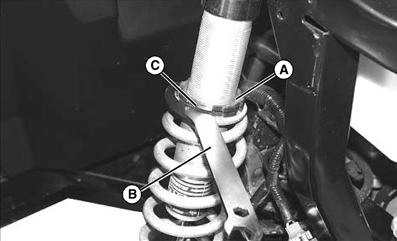
MXAL45688-UN-09APR13Front shock absorber shown (without shock absorber reservoir) - Rear adjustment is similar.
Increase or decrease spring compression as required for cargo load.-
Loosen jam nut (A).
-
Fit adjustment tool (B) to adjusting ring (C).
-
Rotate threaded adjuster to increase or decrease static spring compression as needed. Adjust spring compression equally at each side of the front or rear axle.
-
Tighten jam nut (A).
-
-
Remove supports and lower machine.
-
Measure chassis height from a flat surface to the bottom of the frame behind the front wheels in the front and to the bottom of the rear hitch plate in the rear. The measured distances should be nearly equal at the front or rear.
-
Shock absorber compression dampening adjusters have a limited range of adjustments. Do not attempt to adjust beyond the internal stop in either direction. Forcing the adjuster beyond the stops may damage the internal valving.
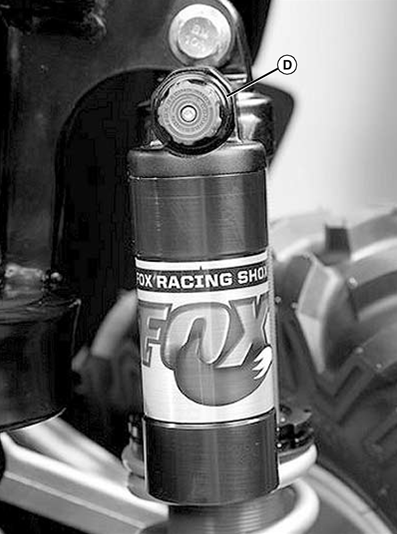
MXAL45689-UN-09APR13Rear shock absorber shown - Front adjustment is similar.
Rotate control knob (D) at shock absorber reservoir to adjust dampening stiffness. Shock absorber dampening should be adjusted equally at each side of the front or rear axle.-
Rotate knob clockwise to increase compression dampening stiffness.
-
Rotate knob counterclockwise to decrease compression dampening stiffness.
-
|
RH75544,000019B-19-20130408 |