Spraying with the TwinFluid System
Fine droplets are therefore often required for spraying with low liquid outputs and also in spraying jobs where a high degree of coverage is required (e.g. contact fungicides), in order to achieve good results. The smaller the droplet size, the more effective the spraying droplets, due to better uptake and less rolling off or merging of the droplets. Moreover, when the droplet size is decreased, less liters are required per hectare to give the same number of droplets/cm 2 . Production of smaller droplets is not a problem as such: a small nozzle with high pressure produces sufficiently fine droplets. However, in conventional spraying techniques, the fine droplets have too low a flow speed and therefore less energy to reach the crops or to penetrate. This often increases the risk of drifting and evaporation and the application may well sometimes be prohibited by law. Using conventional spraying techniques, therefore, liquid outputs cannot be strongly reduced without the risk of less effective crop protection. In the TwinFluid air/liquid system, auxiliary air is used to increase the flow speed so that spraying can take place with finer droplets and without drifting. Now that spraying can often take place using finer droplets, the percentage of excessively coarse droplets is also limited. TwinFluid therefore leads to less loss of spraying liquid through drifting on the one hand and rolling off of droplets on the other. Liquid output of TwinFluid nozzlesThe air/liquid pressure ratio determines the droplet size, the liquid output and the flow speed in the TwinFluid system. The higher the air pressure (at a fixed liquid pressure), the lower the liquid output, the finer the droplet size and the higher the flow speed. The Twin Fluid Control System was developed in order to keep all these aspects under control. |
 CAUTION:
When working with TwinFluid nozzles (AirJet type), make sure there is air pressure in order to avoid spraying liquid entering the air pipe.
CAUTION:
When working with TwinFluid nozzles (AirJet type), make sure there is air pressure in order to avoid spraying liquid entering the air pipe.
WZ00085,0000364 -19-23JUN05-1/4 |
|
TwinFluid control system
The Twin Fluid control system is a separate control system which is used in combination with the automatic rate control system. After all, application of a spraying computer for control of dosage is not automatically an option for air/liquid nozzles, due to spraying computers adjusting the spraying pressure whenever the driving speed changes, in order to maintain the required liquid output. Upon raising or lowering the liquid pressure, the required droplet size would then constantly vary. This is also the case in conventional nozzles! This problem is solved by the Twin Fluid control system, due to the droplet size being kept constant when the driving speed and/or liquid pressure vary. |
WZ00085,0000364 -19-23JUN05-2/4 |
|
Selection of droplet size
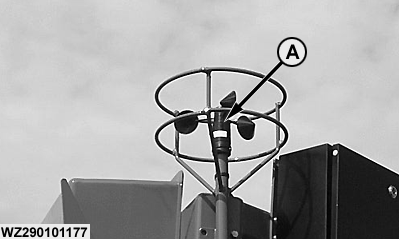
The driver can choose between four different droplet sizes, adapted to the type of crop protection and weather conditions, without a single nozzle needing to be changed. The required droplet size can be chosen in the GreenStar display. A wind meter (A) is fitted on top of the machine. This allows for measurement of the prevailing wind speed, for 30 seconds, prior to spraying. The wind speed is measured when the machine is stationary, for example during or prior to filling the tank. Based on the measuring results, the display gives the driver advice on the best setting for the droplet size with regard to drifting and effectiveness. If it is too windy to spray effectively and without drifting, a warning not to spray is given on the display. Of course, the driver can always determine the setting for himself. How the TwinFluid system worksThe control system ensures that the set droplet size remains constant during spraying. Both the liquid pressure and the air pressure are constantly measured, due to the droplet size being dependent on both the liquid pressure and the air pressure. This means that, should the liquid pressure fluctuate, the air pressure also needs adjustment in order to retain the same size droplet. The ratio between the required air pressure in keeping with a given liquid pressure has been programmed in the TwinFluid Controller for certain droplet sizes. This ratio is different for each of the four droplet sizes (very fine, fine, medium and coarse). At a liquid pressure of 4.0 bar, for example, an air pressure of 1.3 bar is required for a fine droplet spectre, while an air pressure of 0.7 bar is required for a coarse droplet spectre (AirJet 035/TKVS10). Due to there being four droplet size settings, there are also four curves showing the ratio of the air pressure and liquid pressure. Each curve (droplet size) has a minimum and maximum liquid pressure. This means that, at a constant application rate in l/ha, the liquid pressure can vary within these limits (caused, for example, through variations in driving speed). As soon as the liquid pressure exceeds the set limits, the Controller gives a speed alarm. See also "Regulation of Droplet size" in the section "Operation of the machine" |
|
WZ00085,0000364 -19-23JUN05-3/4 |
|
Spraying with conventional nozzles
When spraying with conventional nozzles, the Crop Protection Manuals can be consulted for advice on the correct choice of nozzle and setting. The Crop Protection Manuals give information on the quantity of liquid (in l/ha) and on the droplet spectre with which optimal results are obtained in different sprayings. This information is usually represented by a code. The code consists of a digit (for the output) followed by a letter (for the droplet size). Code 4M, for example, means that it is recommended to spray at 400 l/ha with a nozzle which upon dosing produces a droplet size from the "Medium" spectre. |
WZ00085,0000364 -19-23JUN05-4/4 |