Calibrate the Plough Working Width
 CAUTION: Ensure there are no bystanders near the implement during calibration.
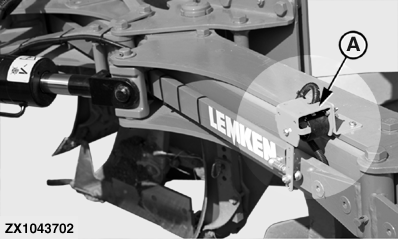
ZX1043702-UN-30NOV09
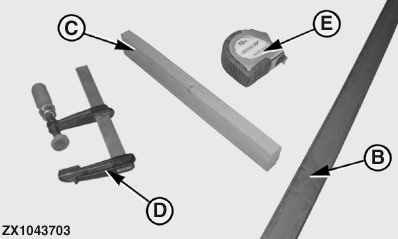
ZX1043703-UN-30NOV09
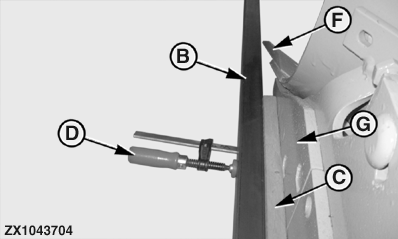
ZX1043704-UN-30NOV09
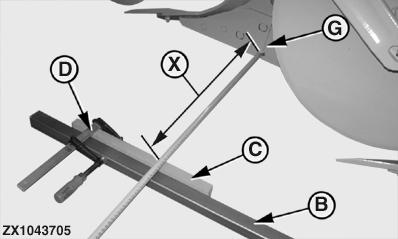
ZX1043705-UN-30NOV09
A - Sensor
B - Bar
C - Slat
D - Clamp
E - Measuring Tape
F - Share
G - Side Cap
X - Distance to measure
To obtain accurate working width measurement results from the plough control unit, it is essential to calibrate the working width sensor (A) after its installation on the plough frame.NOTE: Inaccurate measurement causes the ploughing width to be wider or narrower than calculated by the control unit. As a result, the tractor always drives beside its line on the GS2 display.
To calibrate the sensor (A), proceed as follows :
Requirements:
- A +/- 3 m (10 ft.) straight iron bar (B).
- Two equally thick slats (C).
- Two clamps (D).
- A measuring tape (E).
Mounting the bar to the plough:
Put the plough on a flat surface. Clamp the bar (B) to the side cap (G) of the plough element and let the bar extend to the front.
IMPORTANT: The bar (B) must be mounted exactly parallel to the side cap of the plough element. Because the edge of the share (F) is wider than the side cap (G), the bar (B) must be mounted with a slat (C) in between .
Measuring the plough:
Adjust the width of the plough to its narrowest (contract) position.
Measure the distance (X) between the side cap (G) and the second slat (C) which is clamped to the bar (B).
Convert the measured width (X) to the total ploughing width. To do this, divide the measured width (X) by the number of measured elements. Multiply the result with the total number of elements.
Example for a three-element plough: Adjust the plough to its minimum width.
Measure the working width of two elements.
To calculate the total ploughing width, the measured width is divided by 2 and the value obtained is then multiplied by 3. If the measured width is for instance 58 cm ( 23 in.), the minimum total ploughing width is: 58 / 2 x 3 = 87 cm (34 in.).
Measure and calculate the maximum ploughing width in the same way.
IMPORTANT: If the plough has four elements or more, it is recommended to measure the distance between at least three elements.
Check if measured widths (X) (narrow and wide) are equal to those displayed in the graph on the iSteer Plough - RUN Page on the GS2 display (see iSteer Plough - RUN Page). If they are not equal, the sensor (A) must be readjusted accordingly.
OUCC002,0002D63-19-20091202 |